
المقال: The Move-Out Test: What Really Happens When You Take Renter-Friendly Wallpaper Down
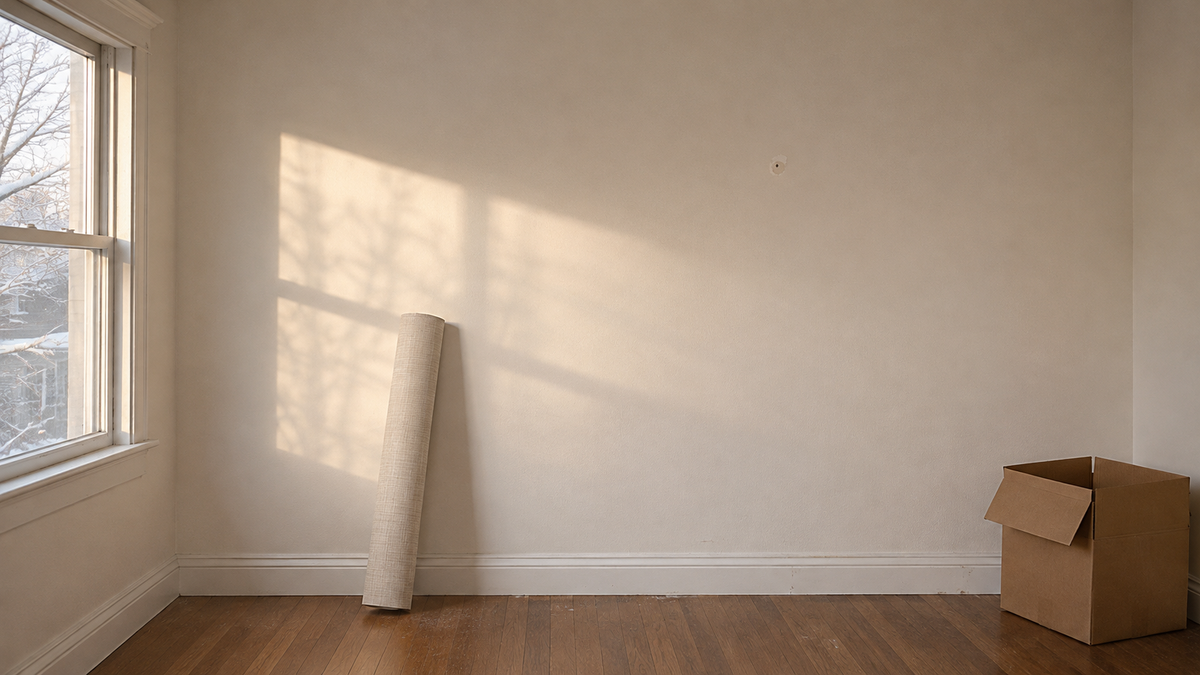
The Move-Out Test: What Really Happens When You Take Renter-Friendly Wallpaper Down
Your lease ends Friday. The landlord does the walkthrough in ten minutes, standing very close to the wall with a phone flashlight, looking for exactly one thing.
Everyone films the other half of this story. The roll going up, the wall going from builder's beige to something with a pulse, the "I can't believe this is a rental" comment. Nobody films the part that decides whether renters keep doing this: the take-down, the flashlight sweep, the moment you find out whether your deposit survived.
So let's talk about that part honestly. Renter-friendly wallpaper only works if it comes off as gracefully as it goes on; everything else is secondary to a ten-minute inspection.
Why Renters Still Don't Trust the Word "Removable"
If you've ever helped a parent strip a wall, you know why. Old wallpaper meant a scoring tool, a steamer, a scraper, an afternoon of glue turning to paste under your fingernails, then spackle, then primer, then a paint match that never matched. That memory lives in a generation's hands, which is why "removable" still sounds like marketing.
Modern peel-and-stick is a different product: no paste, no water, no hired equipment. It's a printed sheet with a pressure-sensitive adhesive engineered to let go of a properly prepared, fully cured painted wall. Not magic — a product with conditions, and knowing them is the difference between a clean wall and a repair job.
What "Damage-Free" Actually Depends On
The adhesive isn't the only variable. The wall is.
- Cured paint. Fresh paint needs roughly 30 days to cure; paper over paint that's still soft can lift the film. If your landlord repainted last month, pick another wall.
- A sound, sealed surface. Painted drywall and painted plaster are ideal. Unpainted drywall, chalky limewash, flaking paint and water-damaged patches are not — the paper isn't the problem there, the substrate is.
- Clean and dry. Dust, kitchen grease and condensation are the top three reasons edges curl.
- Temperature and humidity. Adhesive behaves differently in a cold room than in a steamy bathroom; most failures happen in unheated spaces, or directly above a shower.
- A test patch. Leave a sample on a hidden patch of the actual wall for a few days, then peel it. That five-dollar experiment beats any spec sheet.
None of this is a reason to avoid wallpaper. It's a reason to spend four minutes checking the wall before you spend an afternoon decorating it.
The Ten-Minute Take-Down
The goal is boring and uneventful.
- Clear the baseboard line. Move furniture back and give yourself room to work along the bottom edge.
- Warm the room. Aim for 68–75°F. Cold makes adhesive grip harder and go brittle; a warm room releases more predictably.
- Start at a corner or the top edge with a fingernail or plastic card. Never a metal scraper — that's how walls get gouged, not how paper comes off.
- Pull at a low angle. Peel the sheet back toward itself, hands close to the wall. That low, slow angle protects the paint film underneath.
- Go slow. Genuinely slow. A steady pull lets the adhesive release; a fast yank takes a layer of paint with it.
- Warm stubborn corners. A hair dryer on low, a few inches away for 20–30 seconds, softens adhesive without scorching paint.
- Clean tacky residue with a warm, barely damp cloth and a drop of mild dish soap. No solvents, no abrasive pads — they dull the sheen, and that shows under a flashlight.
If the first inch fights you, stop — that's temperature or substrate, not technique. Warm it, wait, try another corner.
What Your Landlord Will Actually Look At
Walkthroughs aren't forensic. They're pattern-matching. Four things get flagged:
- Corners, especially the top one where a panel was trimmed.
- Outlet and switch plates, where paper is often cut hastily.
- The baseboard line, where a blade may have scored the wood or the caulk.
- A change in paint sheen in the shape of a missed patch — the ghost outline of where the paper was.
Two habits prevent all four: trim with a fresh blade against a straight edge, and photograph the wall before you install and after you remove. A dated photo pair has settled more deposit disputes than any argument.
Then run your hand along the wall. Light residue feels tacky, not damaged, and lifts with warmth. Real damage feels different: a lifted paint edge, a soft spot, a bubble. Knowing which one you're touching is what keeps you calm.

Where Texture Earns Its Keep
Live with a wall for a year and texture does more work than pattern.
A textured surface hides what's already there. Faint scuffs, old anchor holes, the waviness of a wall patched badly in 1998 — a fine woven texture absorbs all of it the way matte fabric hides a stain a glossy surface would announce. Pattern can't; it sits on top of the wall and points at it.
It also means you need less on the wall: a textured neutral reads finished on its own, with no gallery wall and no molding — and at move-out, no fourteen picture hooks to patch.
- Brown Linen Texture Peel and Stick Wallpaper — the workhorse: warm brown, woven, sits behind a bed or sofa without demanding anything.
- Sage Green Linen Texture Vertical Stripe Wallpaper — adds height to a low ceiling, in a green that photographs well in dim light.
- Wabi Sabi Distressed Stripe Peel and Stick Wallpaper — deliberately imperfect, which is why it forgives an imperfect wall.
- Green Grass Fine Grid Neutral Wallpaper — quiet enough for an entryway, structured enough to look deliberate.
- Truffle Brown Linen Textured Grid Wallpaper — for the wall behind the TV, where a deep tone beats a bright one at night.
A test before you commit: put the sample at eye level, stand three feet back, look at it under side light. If the surface changes as the light moves, it's real texture. If it stays flat, it's a print — and a printed texture is what makes a wall look like a rental.
If You're Renewing the Lease: Change the Wall, Not the Wallpaper
Twelve months in, plenty of people decide they don't want that wall back — they want a different one. One roll, one afternoon, and the paper moves from behind the sofa to behind the bed. Removal is a low-angle peel, not a demolition, so redecorating becomes a rotation.

Shop Renter-Friendly Wallpaper
Order two or three samples, tape them to the wall you actually plan to cover, and live with them for a week. Then measure width and height, add two inches for trimming, and order.
- Shop all peel and stick wallpaper
- Shop grasscloth and linen texture wallpaper
- Shop 3D textured peel and stick wallpaper
The deposit deserves a straight answer, not a slogan: a good peel-and-stick paper on a properly prepared, fully cured painted wall comes away with a slow, low pull — and if the wall was never sound, no product fixes that. Check the wall first. Then decorate it like you're staying.


اترك تعليقًا
This site is protected by hCaptcha and the hCaptcha Privacy Policy and Terms of Service apply.