Private Label Wallpaper: Can You White-Label Peel and Stick Designs for Your Own Brand?
You've built a client base. They trust your eye. Now they're asking where to buy the products you specify — and the honest answer is 'someone else's brand.'
That's the inflection point where a lot of interior designers and home stagers start thinking seriously about private label. Not because they want to become manufacturers, but because they realize the product they're recommending could be carrying their name — and generating revenue between projects, not just during them.
The peel and stick wallpaper category is one of the most accessible places to start. Design quality is high, production is fast, the market is growing, and the infrastructure for white-label and OEM production has matured significantly in the past three years. This guide covers what private label actually means in this category, the three models to know, what separates a capable manufacturing partner from one that will disappoint you, and how to launch without overcommitting capital before you've validated demand.
Part 1 · Private Label vs. White Label: The Vocabulary That Matters
What's the Actual Difference — and Which Model Fits Where You Are Now?
The terms 'private label' and 'white label' are often used interchangeably, but they describe meaningfully different business models. Getting this right determines your launch timeline, your upfront investment, and what you actually own.
According to Shopify's definitive guide on private label, the key distinction is customization depth: white label products are pre-made and offer branding-only customization — your name, their product. Private label gives you full control over specifications, materials, and design, with the manufacturer producing exclusively to your requirements. In practice, most wallpaper sourcing falls somewhere between the two, and a good manufacturing partner offers a clear spectrum.
|
Model |
What You Control |
Best For |
|
White Label |
Branding + packaging only; product is pre-made |
Fastest launch, lowest cost, less exclusivity |
|
OEM |
You supply the designs; manufacturer produces to spec |
Your patterns, your IP, full design ownership |
|
ODM |
Choose from catalog; customize colors, scale, palette |
Faster than OEM, more exclusive than white label |
|
Full Custom |
Design, substrate, adhesive, packaging — all yours |
Established brands building proprietary collections |
Which Model Is Right for a Designer or Stager Starting Out?
For most home stagers and interior designers entering this space for the first time, ODM is the practical starting point. You're selecting from an existing design library — already market-tested patterns in current colorways — and customizing enough to make them yours: your label, your packaging, potentially your own colorway adjustments. The IP is cleaner, the timeline is faster, and the minimum order commitment is lower than full OEM.
White label is even faster to launch, but carries less competitive protection — the same design can appear under other brands simultaneously. OEM gives you the strongest exclusivity but requires design assets upfront and typically a higher production minimum. Most successful private label wallpaper brands start with ODM for speed-to-market, then transition key designs to OEM as volumes grow and they know which patterns are actually selling.
The real question isn't which model — it's which designs. A beautifully branded product with patterns your clients don't want is still a business problem. Start with design validation first. Private label infrastructure second.
Part 2 · What You Actually Own — and What You Don't
What Intellectual Property Questions Should You Resolve Before You Launch?
This is the part of the private label conversation most sourcing guides skip. The design on your wallpaper roll — who owns it? Who can resell it? Who can modify it? If you're building a brand around a pattern, the answers to these questions determine whether you have a product line or a temporary competitive advantage that evaporates as soon as another buyer orders the same design from the same factory.
The Four IP Questions to Ask Before Signing Anything
• Design exclusivity: Will the manufacturer sell this exact design to other buyers simultaneously, or is there a minimum volume threshold for exclusivity? For white label, exclusivity typically doesn't exist. For OEM with your own design files, the IP is yours. For ODM, negotiate exclusivity by region or channel as a minimum.
• Design file ownership: If you submit original design files for OEM production, confirm in writing that you retain full ownership — the manufacturer cannot reproduce, resell, or modify without your permission.
• Colorway differentiation: In ODM, even if the base pattern is in a supplier's catalog, producing it in an exclusive colorway creates meaningful market differentiation. Require that your specific colorway combination is not sold to other buyers for a defined period.
• Reorder consistency: Confirm the supplier can match your exact color across reorders — not just the first batch. Batch-consistent production to a documented ΔE tolerance is what allows you to build a named collection that holds visual identity over time.
Designer-specific consideration: The comp-shopping problem. If your clients can identify and source your wallpaper directly from the manufacturer, your private label loses its strategic value. A strong OEM or ODM agreement with confidentiality terms on your SKU list protects that relationship. This is especially important for designers who include wallpaper sourcing in their project fees — the exclusivity is part of what you're charging for.
Part 3 · From Concept to Branded Product
What Does the Launch Process Actually Look Like — Step by Step?
The biggest misconception about private label wallpaper is that it requires a significant upfront capital commitment to launch. With the right manufacturing partner, the opposite is true: you can validate demand with physical samples before committing to volume, and scale production in 15 days once you know what's selling.
Stage 1: Design Selection and Sample Validation (Week 1–2)
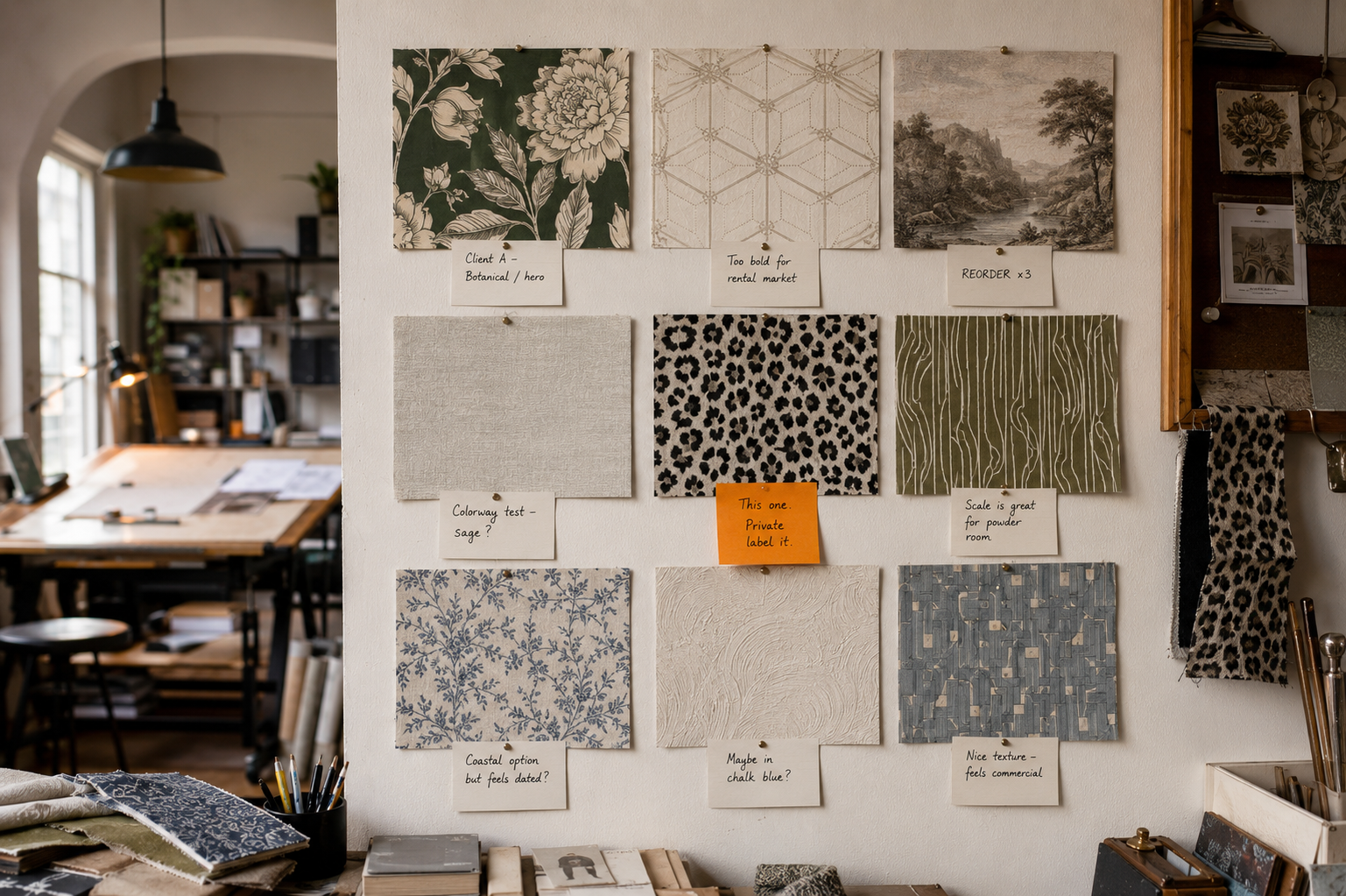
For ODM, browse the manufacturer's pattern library and select 5–10 designs across 2–3 style families that align with your client base's aesthetic. Request physical samples of each — not digital proofs, physical rolls — within 48 hours. Install them in a real space (a staging property, a showroom, your studio wall) and photograph them under actual lighting conditions.
This step has two purposes: it validates the product quality before you put your name on it, and it gives you content. The installation photos from this stage are your product photography — real-space, properly lit, context-aware images that no generic white-background shot can replicate.
Stage 2: Branding and Packaging Design (Week 2–3)
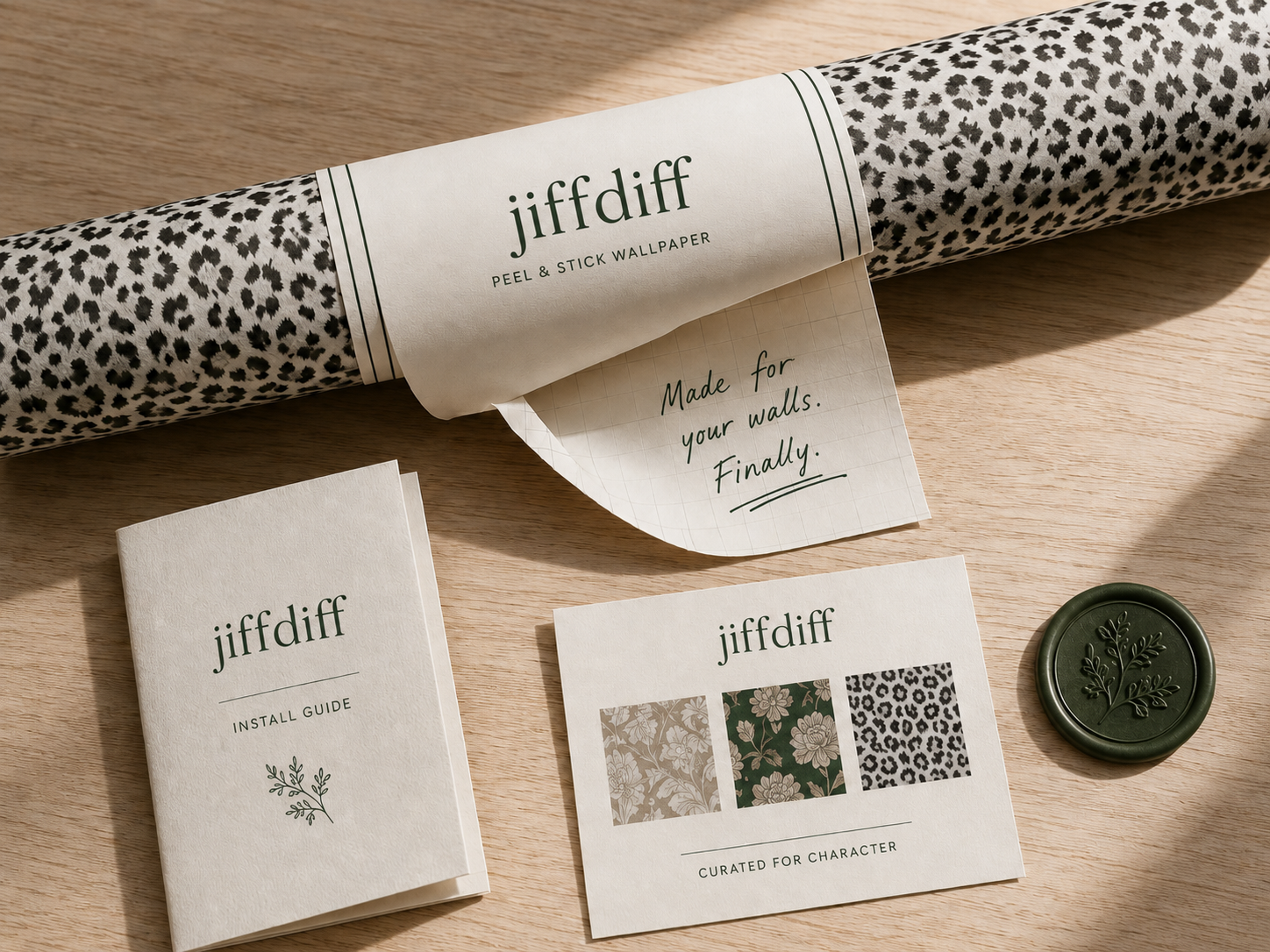
Your brand on the package is the primary visual differentiator for private label at launch. For interior designers and stagers, this doesn't need to be elaborate — a clean, professional label with your studio name, a QR code linking to your install guide, and a short brand tagline does more for client confidence than an expensive custom tube design.
A capable manufacturing partner provides the branded packaging infrastructure without charging a premium for it. At JIFFDIFF, custom label and packaging insert design is included in our B2B collaboration program — because a product that arrives in generic white tubes doesn't reflect the care that goes into the specification behind it.
Stage 3: Small-Batch Test Order (Week 3–4)
Before placing a volume order, run a commercial test. Order 10–30 rolls of your 3–5 strongest designs. Use them in your next 2–3 staging or client projects. Track which designs generate the most client interest, the most install photos worth sharing, and the most reorder inquiries. This is real market data — more valuable than any forecast.
The 15-day production turnaround on confirmed orders means the window between 'I know this sells' and 'I have inventory to sell it' is shorter than most product categories. You're not betting on months of manufacturing lead time before seeing revenue.
Stage 4: Catalog Build and Recurring Revenue (Month 2+)
Once you have sell-through data from Stage 3, make your investment decisions. Reorder proven designs, discontinue non-performers, and introduce one or two new patterns per quarter using the same validation loop. A product line that evolves based on real client behavior — rather than guesswork — is what separates a sustainable brand extension from a warehouse of inventory that felt like a good idea six months ago.
What this unlocks: passive income between projects. A designer with 6 proven private label wallpaper SKUs selling at $35–$65 per roll, with an email list of past clients and a simple Shopify store, generates revenue on days when no one is being staged. That's the structural shift that private label enables — from fee-for-service to product-brand hybrid.
Part 4 · Choosing the Right Manufacturing Partner
What Should You Require From Any Private Label Supplier?
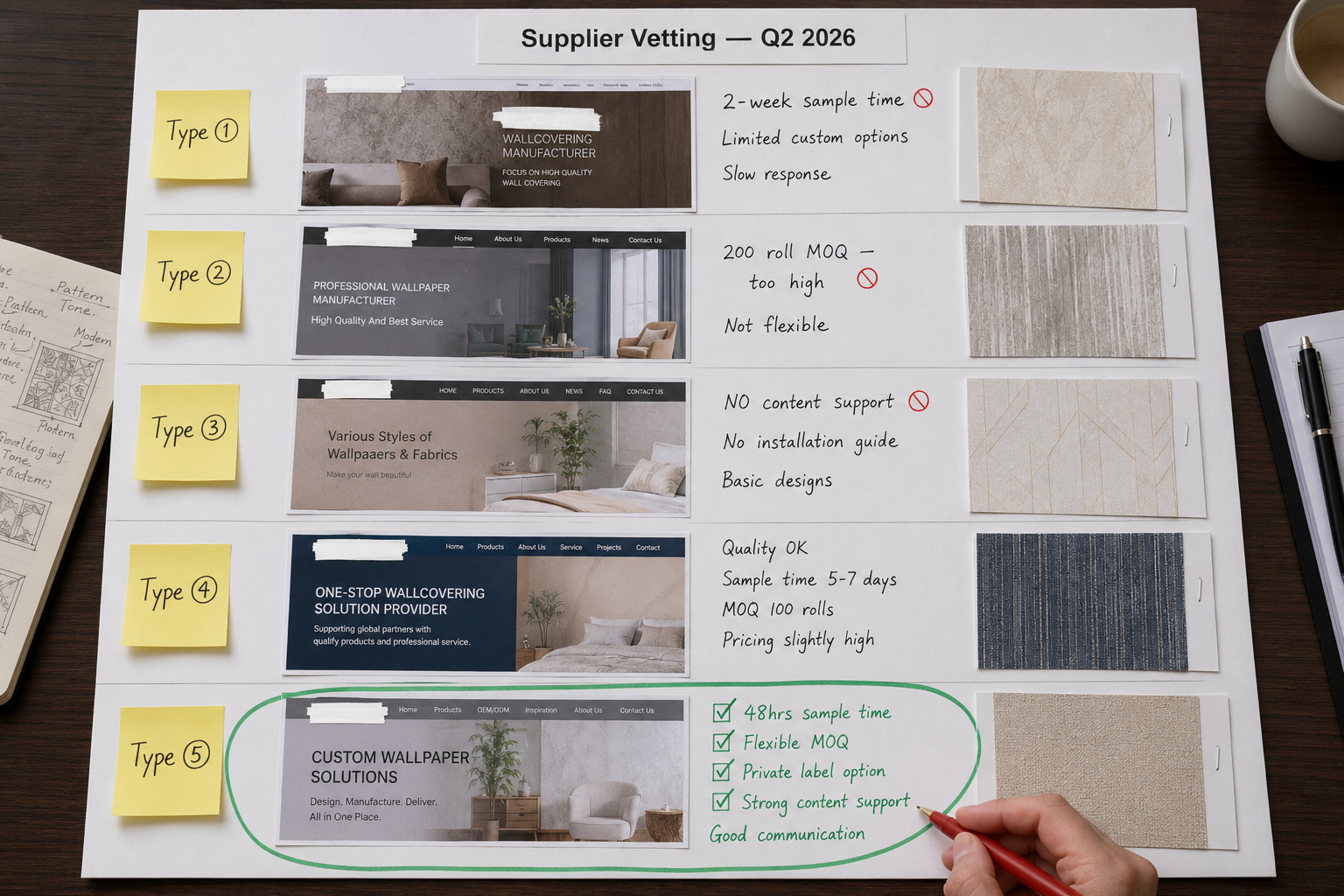
The private label promise is only as strong as the manufacturing partner behind it. A poor partner means inconsistent color across reorders, packaging that doesn't match the spec, content assets that never arrive, and a supply chain that creates problems instead of solving them. This checklist separates capable partners from ones that will cost you client relationships.
|
Question to Ask Supplier |
Green Light |
Walk Away |
|
Do you support 0-MOQ or low-MOQ sampling? |
Yes — single roll available |
500-roll minimum required first |
|
What is your sample turnaround? |
48 hours physical sample |
5+ business days |
|
Custom production lead time? |
15 days from order confirmation |
4–6 weeks quoted |
|
Color batch consistency spec (ΔE)? |
Written ΔE ≤ 2.0 tolerance |
No spec, no data |
|
Private label packaging included? |
Custom label + insert standard |
Extra charge, no design support |
|
Content assets provided? |
Product photos + renders included |
DIY or charged separately |
|
Design IP ownership? |
Your design is yours, no resell |
Vague or no IP clause |
|
On-time delivery rate documented? |
100% rate with data |
Verbal assurance only |
What JIFFDIFF's OEM/ODM Program Looks Like in Practice
JIFFDIFF's private label program is built around one principle: your brand should be market-ready before your first customer sees it. That means:
• 100+ new SKUs per month across the design families currently leading U.S. market sell-through — botanical, geometric, mural, texture, and heritage revival — available for ODM selection
• 12-person in-house design team available for OEM collaboration: your brief, our production, with design ownership fully in your hands
• 48-hour physical sample turnaround for every design under consideration — install it, photograph it, share it, before you commit to volume
• 15-day custom production from confirmed order to ship-ready, with documented 100% on-time delivery across our B2B partner base
• Content package delivery alongside product: styled flat-lays, spatial renders, size guides, and install documentation — so your brand looks complete on day one
JIFFDIFF's founding conviction was that beautiful spaces shouldn't require expensive contractors or a design degree to access. We built an OEM/ODM program around the same idea: a credible branded wallpaper line shouldn't require a factory relationship, a design studio, or a $50,000 investment. It should require a clear aesthetic point of view, a willing manufacturing partner, and the confidence to put your name on something you believe in.
Part 5 · FAQs — Complete Answers That Stop the Search
Frequently Asked Questions: Private Label Peel and Stick Wallpaper
These questions are drawn from Reddit (r/InteriorDesign, r/smallbusiness, r/ecommerce, r/Entrepreneur, r/WallpaperDesign) and Google's highest-volume searches on private label wallpaper sourcing. Each answer is written to be complete enough that you don't need to search again.
Q: Can an interior designer create their own private label wallpaper line?
Yes — through either OEM (you supply design files, manufacturer produces to spec) or ODM (you select and customize from an existing catalog); a capable manufacturing partner handles production, packaging, and fulfillment, while you retain the brand identity and client relationship.
Q: What is the minimum order quantity for private label peel and stick wallpaper?
The best B2B manufacturing partners offer 0 MOQ for sample validation and small-batch test orders, with volume pricing unlocking at 50–200 rolls per SKU — avoid any partner requiring a 500+ roll first order before you've validated demand with your actual customers.
Q: What's the difference between OEM and ODM wallpaper?
OEM means you supply original design files and own the IP entirely; ODM means you select and customize from the manufacturer's existing design library, which is faster to market but offers less exclusivity unless you negotiate colorway or regional exclusivity terms.
Q: How long does it take to launch a private label wallpaper brand?
With ODM, physical samples arrive in 48 hours, design validation takes 1–2 weeks, and branded volume production ships in 15 days from order confirmation — a first product launch is achievable within 4–6 weeks from initial supplier contact.
Q: Who owns the design on private label wallpaper?
For OEM: you own the design outright — require this in writing before production begins. For ODM: the base pattern belongs to the manufacturer's catalog, but your colorway, SKU naming, and branded packaging are yours; negotiate regional exclusivity to prevent identical products appearing under other brands in your market.
Q: Can I white-label wallpaper and sell it on Etsy or Shopify?
Yes — white label wallpaper with your branding can be sold through any direct channel; for Etsy, ensure your product listings accurately describe you as the brand (not the manufacturer), and use your own lifestyle photography rather than the manufacturer's stock images to differentiate.
Q: How do I ensure color consistency across private label reorders?
Require a written ΔE color tolerance specification (ΔE ≤ 2.0 is the professional benchmark) and confirm the manufacturer locks all rolls from a single order to one production batch — reorder consistency is what allows you to build a named collection that holds visual identity across multiple client projects.
Q: Do private label wallpaper manufacturers provide product photography?
The best B2B partners include styled product photography, spatial renders, and installation content as part of the delivery package — brands that launch with only manufacturer stock images look identical to every other reseller and lose the brand differentiation that private label is supposed to create.
Q: What profit margins are realistic for private label peel and stick wallpaper?
Wholesale unit cost for ODM at 50–200 roll volume typically runs $8–$18 per roll; retail price points of $30–$65 per roll are standard for branded direct-to-consumer channels, delivering 60–75% gross margin — the brand premium you build is what sustains that margin over time.
Ready to explore what a private label peel and stick wallpaper line could look like under your brand?
Contact the JIFFDIFF team — physical samples in 48 hours, design library access from day one, Low MOQ to start, and a full content package delivered alongside your first branded order.

Leave a comment
This site is protected by hCaptcha and the hCaptcha Privacy Policy and Terms of Service apply.