Selbstklebende Tapeten für gewerbliche Räume spezifizieren: Brandschutzklassen, Haltbarkeit und Mindestbestellmengen
Es geht nicht darum, ob selbstklebende Tapeten in gewerblichen Räumen eingesetzt werden sollten. Die Frage ist, in welchen gewerblichen Räumen – und was die Spezifikation tatsächlich erfordert, um sie dort zu platzieren.
Hier ist die Marktrealität: Laut einer triangulierten Forschungsanalyse aus dem Jahr 2026, die neun unabhängige Marktforschungsunternehmen, US-Branchenverbände und Bottom-up-Herstellerdaten umfasste, beträgt der amerikanische Tapetenmarkt insgesamt etwa 640 Millionen US-Dollar. Davon entfallen 333 Millionen US-Dollar – etwa 52 % – auf den kommerziellen Bereich (B-Seite). Innerhalb des kommerziellen Segments dominieren nicht eingeklebte Wandbekleidungen des Typs II mit ~90 % der B-Seite. Abziehbare Tapeten machen derzeit nur ~3 % des kommerziellen Volumens aus.
Diese 3 %-Zahl ist keine Obergrenze. Es ist eine Compliance-Lücke – eine, die Raum für Raum geschlossen werden kann, mit der richtigen Produktspezifikation, der richtigen Dokumentation und einem Lieferanten, der den Unterschied zwischen einem Produkt versteht, das kommerziell aussieht, und einem, das es tatsächlich ist. Dieser Leitfaden soll diese Lücke für Designer und Stager schließen, die bereits in gewerblichen Räumen arbeiten und eine Spezifikations-Roadmap benötigen, die sie einem Architekten, einer zuständigen Behörde oder einem Hotelbetriebsleiter vorlegen können.
Teil 1 · Der Marktkontext – Warum der kommerzielle Bereich sowohl Chance als auch Hindernis ist
Warum widersteht das kommerzielle Segment immer noch selbstklebenden Tapeten?
Der Widerstand ist nicht ästhetisch. Er ist strukturell – drei Regulierungsebenen, die geschrieben wurden, bevor moderne, handelsübliche PSA-Klebstoffsysteme existierten, und nicht aktualisiert wurden, um diese zu berücksichtigen.
Die drei strukturellen Fixpunkte – Aus der US-Tapetenforschungsbasis 2026
Die Marktforschungsbasis 2026 identifiziert drei spezifische Gründe, warum die kommerziellen Spezifikationen der B-Seite zu ~90 % nicht geklebt geblieben sind – und warum sich das für die meisten Hochleistungsanwendungen, unabhängig von Produktinnovationen, nicht ändern wird:
• Gewichtsanforderungen: CCC-W-408D / ASTM F793 Typ II spezifiziert ein Mindestgewicht von 20–32 oz pro 54" Laufmeter. Dieses schwere, stoffhinterlegte Vinylformat ist physisch inkompatibel mit vorab aufgetragenen Klebeschichten – das Materialgewicht verhindert eine gleichmäßige Klebstoffabdeckung, und jeder Klebstoff, der dick genug wäre, um dies auszugleichen, würde die Brandprüfung der Klasse A nicht bestehen.
• ASTM E84 Brandklasse A: PSA-Haftklebstoffe sind brennbare Polymere. In Hotelkorridoren, Krankenhausfluren und stark frequentierten Bildungsgebäuden – alles obligatorische Umgebungen der Klasse A – bestehen die meisten Verbraucher- und sogar kommerziell vermarkteten P&S-Produkte den Steiner-Tunnel-Flammenausbreitungstest nicht, wenn sie mit der Klebeschicht getestet werden.
• Chemische Desinfektionsmittelbeständigkeit in Krankenhäusern: Die FGI-Richtlinien verlangen, dass Wandflächen mit hohem Kontakt in Gesundheitseinrichtungen wiederholtem Kontakt mit Bleichmittel, quaternären Ammoniumverbindungen, Wasserstoffperoxid und alkoholbasierten Desinfektionsmitteln standhalten. PSA-Klebstoff-Deckschichten zersetzen sich bei diesem Reinigungsprotokoll typischerweise innerhalb von 6–12 Monaten – im Vergleich zu 7–15 Jahren bei korrekt spezifiziertem, nicht verklebtem Typ II.
Die klare Implikation für Spezifizierer: Selbstklebende Tapeten sind nicht das richtige Format für Krankenhausflure, Hauptzugangswege von Hotels oder Schulflure mit obligatorischen Anforderungen der Klasse A. Das Produkt scheitert nicht am Anforderungsprofil – das Anforderungsprofil eliminiert das Produkt. Das Verständnis dieses Unterschieds schützt Ihre berufliche Haftung und Ihre Kundenbeziehungen.
Wo selbstklebende Tapeten im kommerziellen Bereich Marktanteile gewinnen
Trotz der oben genannten strukturellen Einschränkungen zeigen drei spezifische kommerzielle Kontexte ein echtes Wachstum bei der Einführung von P&S – und das aus gutem Grund. Dies sind die Zonen, in denen die Compliance-Anforderungen weniger restriktiv sind, die Auffrischungszyklen schnell sind und die visuelle Wirkung des Produkts einen messbaren kommerziellen Wert schafft.
• Leichte gewerbliche Nutzung / Einzelhandel: Boutiquen, Schönheitssalons, Cafés und Pop-up-Stores für Direktvertrieb. Klasse B (FSI 26–75) ist in der Regel ausreichend; die einfache Entfernung ermöglicht saisonale oder Marken-Auffrischungszyklen; der Social-Content-Wert einer Feature-Wand macht P&S zu einer umsatzgenerierenden Designentscheidung, nicht nur zu einer Materialwahl.
• Hotelzimmer (nicht Korridore): Gästezimmer unterliegen in den meisten IBC-Anwendungen einem geringeren Brandschutzstandard als öffentliche Korridore. Dies ist die Öffnung für kommerziell spezifizierte P&S im Gastgewerbe – ein stoffhinterlegtes Vinylprodukt mit ASTM E84-Dokumentation speziell für das selbstklebende Format.
• Firmenbüros (Nicht-Hochhäuser, Akzentwände): In Standardbüroanwendungen ohne LEED-Klasse-A-Vorschriften können P&S mit NSF 342-Zertifizierung und Low-VOC-Dokumentation in die Spezifikationen aufgenommen werden. Wolf-Gordons WG Customs Lab hat dieses Segment angeführt; es bestätigt, dass die Akzeptanz auf der B-Seite in wissensbasierten Umgebungen zunimmt, in denen Designabsicht und IAQ wichtiger sind als überlieferte Beschaffungsgewohnheiten.
~$640M US-Tapetenmarkt 2026 (trianguliert) 9 Forschungsunternehmen + Industrieverbände + Hersteller-Bottom-up
~52% kommerzieller (B-Seite) Anteil = ~$333M Gegenvalidiert: GVR 52,5 % / Mordor 51,73 % / Spherical 50,9 %
~3% P&S-Anteil im kommerziellen Bereich = ~$10M Strukturelle Compliance-Obergrenze – Zone für Zone schließbar
Die Compliance-Architektur für Wandbekleidungen im kommerziellen Bereich in den USA wird von mehreren unabhängigen Standardisierungsorganen verwaltet. Für die umfassendste Referenz zu NSF/ANSI 342 – der einzigen unabhängigen Nachhaltigkeitszertifizierung speziell für Wandbekleidungen, die jetzt in LEED v4 Pilot-Credits akzeptiert wird – bietet die NSF International Standards-Seite nicht-kommerzielle, maßgebliche Dokumentation dessen, was zertifiziert ist, auf welcher Ebene und warum es für kommerzielle Spezifikationen wichtig ist.

Teil 2 · Der vollständige Compliance-Stack
Welche Standards gelten tatsächlich – und was fordern sie von einem P&S-Produkt?
"Konform" ist kein einzelner Standard. Es ist ein Stack – und welche Schichten des Stacks zutreffen, hängt ausschließlich von der Nutzungsart, der spezifischen Zone innerhalb des Raums, der staatlichen Gerichtsbarkeit und davon ab, ob das Projekt eine LEED- oder WELL-Zertifizierung anstrebt. Hier ist der vollständige Stack mit dem, was jeder Standard tatsächlich von einem selbstklebenden Tapetenprodukt verlangt.
|
Standard |
Behörde |
Wer braucht es |
Was es für P&S bedeutet |
|
ASTM E84 Klasse A |
ASTM International |
Hotels (Korridore), Krankenhäuser, Schulen, Büros |
FSI ≤ 25; PSA-Klebeschicht erschwert das Bestehen – immer Klebstoff-unterstützten Prüfbericht anfordern |
|
NSF/ANSI 342 |
NSF International |
LEED v4 Projekte; Marriott, Hilton, IHG |
Nachhaltigkeit über den gesamten Lebenszyklus; über 2.000 Wandbekleidungen zertifiziert; zunehmend in PIPs erforderlich |
|
CDPH / Abschnitt 01350 |
Kalifornisches Gesundheitsministerium |
Alle öffentlichen Gebäude in Kalifornien, Krankenhäuser, LEED-Gewerbebauten |
VOC-Emissionsstandard; alle großen B-Seiten-Marken bestehen; für LEED EQ Credits erforderlich |
|
CCC-W-408D / ASTM F793 Typ II |
Bund / ASTM |
Hotels, Gesundheitswesen, Unternehmen |
20–32 oz/54" Laufmeter; 16-Test-Konformitätsbatterie; Dicke schließt die meisten Verbraucher-P&S aus |
|
FGI-Krankenhausrichtlinien |
Facility Guidelines Inst. |
Krankenhäuser, ambulante Einrichtungen |
Chemische Desinfektionsmittelbeständigkeit (Bleichmittel, Quats, H₂O₂); PSA-Oberflächenschicht zersetzt sich in 6–12 Monaten |
|
WELL Building Standard |
IWBI |
Unternehmen / Wellness-Einrichtungen |
Innenraumluftqualität + VOC; NSF 342 überschneidet sich teilweise; wächst in Büro-Spezifikationen |
Die entscheidende Spezifikationsfalle: Tests im „selbstklebenden Format“
Dies ist der häufigste und kostspieligste Spezifikationsfehler in dieser Kategorie. Ein Hersteller liefert ein ASTM E84 Klasse A-Zertifikat für ein Tapetendesign – getestet in seinem unkaschierten Format, ohne die Klebeschicht. Der Spezifizierer akzeptiert das Zertifikat und fährt fort. Das Produkt wird mit seiner PSA-Rückseite installiert. Das installierte Produkt wurde in dieser Konfiguration nicht getestet.
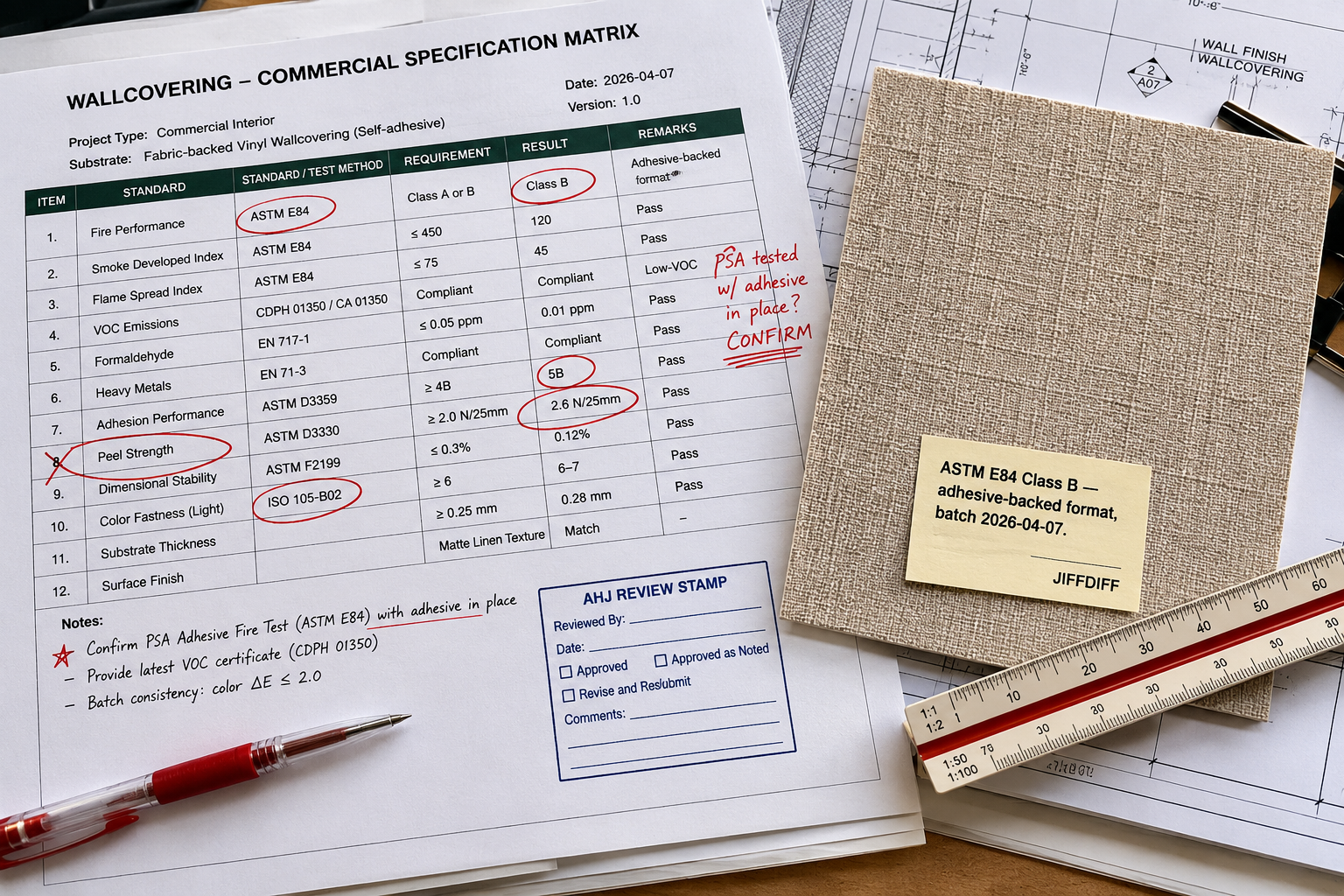
Für jedes Projekt, bei dem eine Brandschutzdokumentation erforderlich ist, muss der Prüfbericht ausdrücklich angeben, dass das Produkt mit dem vorhandenen Klebstoff auf einem Standarduntergrund gemäß ASTM E84-Protokoll getestet wurde. Jedes Zertifikat, das dies nicht spezifiziert, ist eine Compliance-Lücke, die bei der Überprüfung durch die AHJ oder bei der Inspektion nach der Installation auffallen wird.
JIFFDIFF-Spezifikationsstandard: Jede kommerzielle Spezifikationsbestellung enthält die ASTM E84-Dokumentation speziell für das selbstklebende Produktformat – nicht nur für das Designsubstrat. Dieser Unterschied ist auf jedem Konformitätszertifikat, das wir für kommerzielle B2B-Konten ausstellen, dokumentiert. Es ist keine optionale Ergänzung; es ist die Grundlage dessen, was die kommerzielle Spezifikation erfordert.
Teil 3 · Zone-für-Zone kommerzieller Anwendungsleitfaden
Welche Bereiche können spezifiziert werden – und was genau erfordert jede Zone?
Der oben genannte Compliance-Stack gilt in verschiedenen Zonen unterschiedlich stark. Anhand des Marktforschungsrahmens von 2026 und der dokumentierten Compliance-Anforderungen für das Gastgewerbe, das Gesundheitswesen und gewerbliche Spezifikationen in den USA, hier die Zonen-für-Zonen-Aufschlüsselung, die professionelle Spezifizierer benötigen.
|
Gewerbezone |
Min. Feuerwiderstandsklasse |
P&S-Machbarkeit |
JIFFDIFF Empfehlung |
|
Hotelzimmer |
Klasse B (Klasse A bevorzugt) |
⚠️ Bedingt |
Vinyl-P&S; ASTM E84-Test im selbstklebenden Format erforderlich |
|
Hotelkorridore / Lobbys |
Klasse A zwingend |
❌ Die meisten Verbraucher-P&S |
Nur P&S für gewerbliche Zwecke; Klebesystem muss Klasse A im vollständigen Format bestehen |
|
Büros (<5.000 qm) |
Klasse B typisch |
✅ Ja mit Spez. |
Textil-Rücken-Vinyl-P&S; NSF 342 bei LEED-Projekt; 48-Stunden-Probe + ΔE-Spezifikation |
|
Einzelhandelsgeschäfte / Boutiquen |
Klasse B oder A je nach Belegung |
✅ Gut geeignet |
Markante P&S-Akzentwände; Klasse B-Dokumentation auf Anfrage; geringe Mindestbestellmenge verfügbar |
|
Schönheitssalons / Wellness |
Typisch Klasse B |
✅ Ausgezeichnete Passform |
Hoher UGC-Wert; Vinyl mit Geweberücken; JIFFDIFF-Spezifikation beinhaltet Konformitätsdokumente |
|
Gesundheitswesen (Flure) |
Klasse A + FGI Chemikalienbeständigkeit |
❌ P&S nicht geeignet |
Nur ungeklebter Typ II; PSA-Oberfläche verschlechtert sich unter Krankenhausreinigungsprotokollen |
|
Café / Restaurant (nicht-Fluchtwege) |
Klasse B oder A nach AHJ |
✅ Starke Passform |
P&S liefert fertige Akzentwände; Klasse B-Dokumente Standard |
|
Bildungsräume |
Klasse A empfohlen |
⚠️ Zonen-spezifisch |
Nur trockene, feuchtigkeitsarme Bereiche; CDPH 01350 VOC-Zertifizierung erforderlich |
Die Haltbarkeitsspezifikation für hochfrequentierte Gewerbezonen
Brandschutz ist der erste Filter. Haltbarkeit ist der zweite. Für jede Gewerbezone mit hohem Verkehrsaufkommen und wöchentlicher oder häufigerer Reinigung sind die folgenden Substrat- und Klebstoffspezifikationen das professionelle Minimum für eine selbstklebende Tapetenspezifikation:
• Substrat: Vinyl mit Geweberücken, mindestens 0,25 mm Gesamtdicke; keine Produkte mit Papierrücken in kommerziellen Anwendungen
• Klebstoff: Kommerzieller Acryl-PSA, feuchtigkeitsgetestet bei 65 % + relativer Luftfeuchtigkeit; Abzugsfestigkeit dokumentiert nach 12, 24 und 36 Monaten
• Oberflächenbeschichtung: Abwaschbar nach Klasse 1 oder Klasse 2 gemäß ASTM D4828; getestet gegen quartäre Ammoniumverbindungen für Anwendungen in Salons, Gastronomie und im leichten Gesundheitswesen
• Nahtleistung: Stoßnaht mit Nahtrollerpresse; ΔE ≤ 2,0 Chargentoleranz für Multi-Panel- und Multi-Raum-Installationen
• Entfernungsprotokoll: Dokumentierte rückstandsfreie Entfernung nach 24–36 Monaten von ausgehärtetem, gestrichenem Trockenbau – der Standard für ein Produkt, das in einem kommerziellen Zyklus von 2–5 Jahren erneuert wird
Praxisbeispiel: Die Marktdaten von 2026 zeigen, dass die erfolgreichsten kommerziellen P&S-Anwendungen in Schönheitssalons, Einzelhandelsboutiquen und Cafés zu finden sind, wo der Erneuerungszyklus 12–24 Monate beträgt und die Design-Akzentwand eine Doppelfunktion als Marketinginstrument erfüllt. Eine Fallstudie eines Phoenixer Schönheitssalons – an anderer Stelle im kommerziellen Portfolio von JIFFDIFF dokumentiert – zeigt, dass eine P&S-Wandbildinstallation im Wert von 340 US-Dollar 8.353 US-Dollar an zusätzlichen monatlichen Einnahmen durch organische soziale Inhalte generierte, was einem ROI von 24,5x entspricht. Die Konformitätsspezifikation ermöglichte die Installation; die Designspezifikation generierte den Ertrag.
Teil 4 · MOQ, Beschaffung und der kommerzielle Beschaffungsprozess
Wie sieht die Beschaffung von P&S-Tapeten im kommerziellen Maßstab tatsächlich aus?
Die MOQ-Frage ist der Punkt, an dem die meisten Designprofis ihren ersten Fehler bei der kommerziellen Beschaffung machen: Sie gehen davon aus, dass ein Produkt in kommerzieller Qualität eine kommerzielle Verpflichtung erfordert, bevor sie die Spezifikation in einem realen Raum validiert haben. Der gegenteilige Ansatz ist sowohl möglich als auch professionell korrekt.
|
Projekttyp |
Empfohlene Mindestbestellmenge |
Angestrebte Lieferzeit |
JIFFDIFF Programm |
|
Einzelne Akzentwand (Salon/Café) |
0 MOQ – 1 Rolle Muster |
48 Std. Muster; 5–7 Tage Produktion |
Studio-Test → B2B-Upgrade-Pfad |
|
Einzelner Gewerberaum (<500 sqft) |
10–30 Rollen |
15 Tage Produktion |
Standard B2B; chargenbezogen; Inhalte inklusive |
|
Mehrere Räume (Hotel, Büro) |
50–200 Rollen |
15 Tage; Einzelchargenproduktion |
Chargenkonsistenzgarantie; ΔE ≤ 2,0 Spezifikation |
|
Kette / mehrere Standorte (5–12+ Standorte) |
200–500+ Rollen |
15 Tage pro Bestelleinheit |
OEM/ODM-Programm; Eigenmarke; dedizierter Account |
|
Individuelles Wandbild / maßgeschneidertes Design |
0 MOQ für Musterplatte |
48 Std. Muster; 15 Tage Produktion |
Komplette File-to-Install-Pipeline; Zusammenarbeit mit dem Designteam |
Die Anforderung an die Chargenkonsistenz für kommerzielle Projekte mit mehreren Räumen
Bei kommerziellen Projekten, die mehr als einen Raum umfassen – Hotelzimmer, Einzelhandelsketten mit mehreren Standorten, Salons mit mehreren Suiten – ist die Chargenkonsistenz keine Präferenz, sondern eine Spezifikationsanforderung. Die Marktforschung von 2026 bestätigt, dass Hotelmarken, die FF&E-Markenstandards (Marriott, Hilton, IHG, Hyatt) betreiben, explizit eine konsistente optische Erscheinung in allen Zimmern einer Immobilie zum Zeitpunkt der PIP-Überprüfung (Property Improvement Plan) verlangen.
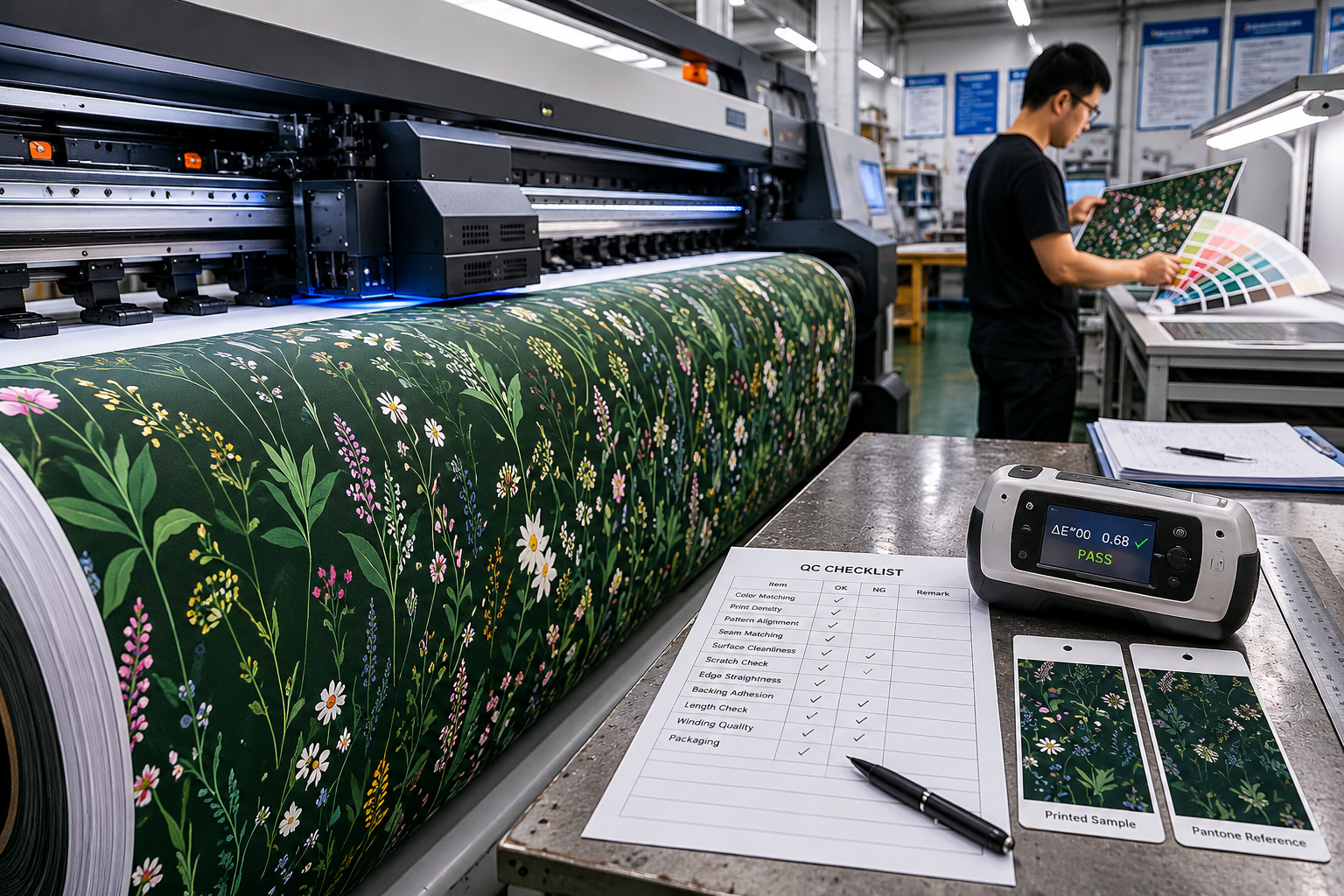
Was dies in Bezug auf die Beschaffung bedeutet: Alle Rollen für eine einzelne Immobilienbestellung müssen aus derselben Produktionscharge versandt werden, mit einer dokumentierten ΔE-Farbtoleranz von 2,0 oder darunter – dem Punkt, an dem Farbabweichungen für das menschliche Auge unter Standard-Handelsbeleuchtung nicht mehr wahrnehmbar sind. Das Batch-Lock-Protokoll von JIFFDIFF ist Standard für alle kommerziellen Bestellungen ab 10 Rollen: Die Chargennummer erscheint auf jedem Rollenetikett und jedem Kartonmanifest.
Dokumentationspaket – Was jede kommerzielle Bestellung beinhaltet
Eine kommerzielle Spezifikation ist nur so defensiv wie ihre Dokumentation. Für jede JIFFDIFF B2B-Kommercialbestellung enthält das Lieferpaket:
• ASTM E84 Brandschutzzertifikat – ausgestellt für das klebstoffbeschichtete Produktformat, nicht nur für das Designsubstrat
• NSF 342 oder gleichwertige Nachhaltigkeitsdokumentation – für LEED v4 oder WELL-orientierte Projekte
• CDPH Abschnitt 01350 VOC-Konformitätszertifikat – für Projekte in Kalifornien und alle Projekte, die LEED EQ-Punkte spezifizieren
• ΔE Chargentoleranzspezifikation – schriftliche ΔE ≤ 2,0 Garantie, Chargennummer auf allen Rollenetiketten
• Feuchtigkeitstestdaten des Klebstoffs – dokumentierte Haftleistung bei 65 % + relativer Luftfeuchtigkeit, Abzugskraft nach 12/24/36 Monaten
• Installations- und Entfernungsprotokoll-Dokumentation – Anforderungen an die Oberflächenvorbereitung im gewerblichen Bereich, Reinigungsverträglichkeit, Entfernungsverfahren
• Produktfotografie und Content-Assets – stilisierte Bilder, Raumrenderings und Spezifikationskarten, die zusammen mit dem Produkt geliefert werden
Bei JIFFDIFF haben wir unser kommerzielles Spezifikationsprogramm auf der Überzeugung aufgebaut: dass ein Designer, der seinen Namen unter eine Spezifikation setzt, eine Dokumentation verdient, die sein professionelles Urteilsvermögen schützt. Ein Produkt ohne Konformitätspaket ist kein kommerzielles Produkt – es ist ein Konsumprodukt, das hofft, dass niemand die richtigen Fragen stellt. Wir stellen die Fragen zuerst, damit unsere Partner es nicht müssen.
Teil 5 · FAQs – Antworten, die spezifisch genug sind, um die Suche zu beenden
Häufig gestellte Fragen: Spezifikation von selbstklebenden Tapeten für Gewerbeflächen
Entnommen von Reddit (r/InteriorDesign, r/smallbusiness, r/Architecture, r/CommercialDesign) und den meistgesuchten kommerziellen Tapetenspezifikationsanfragen bei Google – beantwortet mit der Präzision, die von professionellen Spezifikanten gefordert wird.
F: Kann selbstklebende Peel-and-Stick-Tapete ASTM E84 Klasse A für den gewerblichen Einsatz bestehen?
Einige gewerbliche P&S-Produkte aus Vinyl mit Stoffrücken können ASTM E84 Klasse A bestehen – aber nur, wenn sie im selbstklebenden Format getestet werden; verlangen Sie immer den Testbericht speziell für die PSA-Klebstoffversion, nicht nur für das Designsubstrat, da die meisten Konsumgüter Klasse A mit angebrachtem Klebstoff nicht bestehen.
F: Was ist die Mindestbrandschutzklasse, die für Tapeten in Hotelzimmern erforderlich ist?
Hotelzimmer erfordern typischerweise Klasse B (FSI 26–75) gemäß IBC Kapitel 8; Flure, Lobbys und Fluchtwege erfordern Klasse A (FSI 0–25) gemäß NFPA 101 Life Safety Code – bestätigen Sie immer die spezifische Klasse mit der örtlichen Behörde, bevor Sie eine kommerzielle Wandverkleidungsspezifikation festlegen.
F: Was ist NSF 342 und benötige ich es für kommerzielle Tapeten?
NSF/ANSI 342 ist die einzige Drittanbieter-Zertifizierung für Nachhaltigkeit von Wandbelägen in den USA, die den gesamten Produktlebenszyklus abdeckt; sie ist für den LEED v4 Certified Multi-attribute Products Pilot Credit erforderlich und wird zunehmend in Marriott-, Hilton- und IHG-Markenstandards für PIP-Renovierungen spezifiziert.
F: Welche Mindestbestellmenge (MOQ) sollte ich für kommerzielle Peel-and-Stick-Tapeten erwarten?
Professionelle B2B-Partner unterstützen 0 Mindestbestellmenge für die Bemusterung (48-Stunden-Lieferung physischer Muster), wobei die kommerzielle Produktion bei 10–30 Rollen für Einzelraumprojekte beginnt; Programme für Ketten mit mehreren Standorten beginnen typischerweise bei 200+ Rollen mit garantierter Einzelchargenproduktion – vermeiden Sie Anbieter, die 500+ Rollen verlangen, bevor sie ein physisches Muster liefern.
F: Können Peel-and-Stick-Tapeten in Krankenhäusern oder Gesundheitseinrichtungen verwendet werden?
Nicht in klinischen oder Korridorbereichen – PSA-Klebstoffschichten zersetzen sich innerhalb von 6–12 Monaten unter Krankenhausreinigungsprotokollen (Bleiche, quaternäre Ammoniumverbindungen, Wasserstoffperoxid); ungeklebter Typ II mit antimikrobieller Behandlung ist die korrekte Spezifikation für das Gesundheitswesen; P&S kann in Verwaltungs- oder Bürobereichen mit geringem Kontakt und Klasse-A-Dokumentation geeignet sein.
F: Wie stelle ich die Farbkonsistenz für eine Hotelinstallation mit 12 Zimmern sicher?
Fordern Sie die Produktion in einer einzigen Charge für alle gleichzeitig bestellten Zimmer an, schriftlich bestätigt mit Chargennummern auf Rollenetiketten und Kartonmanifesten; geben Sie im Kaufauftrag eine Farbtoleranz von ΔE ≤ 2,0 an – dies ist Standard im kommerziellen B2B-Programm von JIFFDIFF und sollte eine Grundvoraussetzung für jeden kommerziellen Hersteller sein.
F: Welches Substrat sollte ich für eine kommerzielle Peel-and-Stick-Tapete angeben?
Textilkaschiertes Vinyl mit einer Gesamtdicke von mindestens 0,25 mm und einer scheuerbeständigen Oberflächenbeschichtung der Klasse 1 oder Klasse 2; Produkte mit Papierkaschierung sollten in keiner gewerblichen Anwendung spezifiziert werden, unabhängig von der angegebenen Haltbarkeit; es ist eine Dokumentation des Klebstoffsystems anzufordern, die eine Feuchtigkeitsprüfung bei 65 %+ relativer Luftfeuchtigkeit zeigt.
F: Was ist der Unterschied zwischen den kommerziellen Wandbelägen Typ I, Typ II und Typ III?
Gemäß CCC-W-408D / ASTM F793: Typ I (≤19 oz/54" yd, leichte Beanspruchung – Hotelzimmer, Wartebereiche), Typ II (20–32 oz, Industriestandard – Lobbys, Gesundheitswesen, Büros; erfordert 16-Test-Konformitätsprüfung), Typ III (≥33 oz, starke Beanspruchung – Flughäfen, Transit, institutionell); die meisten gewerblichen Räume erfordern Typ II oder höher, wodurch Verbraucherqualität P&S allein aufgrund der Gewichtsspezifikation ausgeschlossen wird.
Sie spezifizieren selbstklebende Tapeten für ein gewerbliches Projekt und benötigen Konformitätsdokumente, Musterplatten oder ein B2B-Produktionsangebot? Kontaktieren Sie das JIFFDIFF-Team für gewerbliche Spezifikationen — physische Muster innerhalb von 48 Stunden, ASTM E84-Dokumentation im selbstklebenden Format, NSF 342- und CDPH 01350-Zertifizierung auf Anfrage sowie ein Spezifikationspaket, das Ihre zuständige Behörde tatsächlich genehmigen kann.

Hinterlasse einen Kommentar
Diese Website ist durch hCaptcha geschützt und es gelten die allgemeinen Geschäftsbedingungen und Datenschutzbestimmungen von hCaptcha.