Le meilleur papier peint à imprimé léopard de qualité commerciale pour salon de beauté en 2026
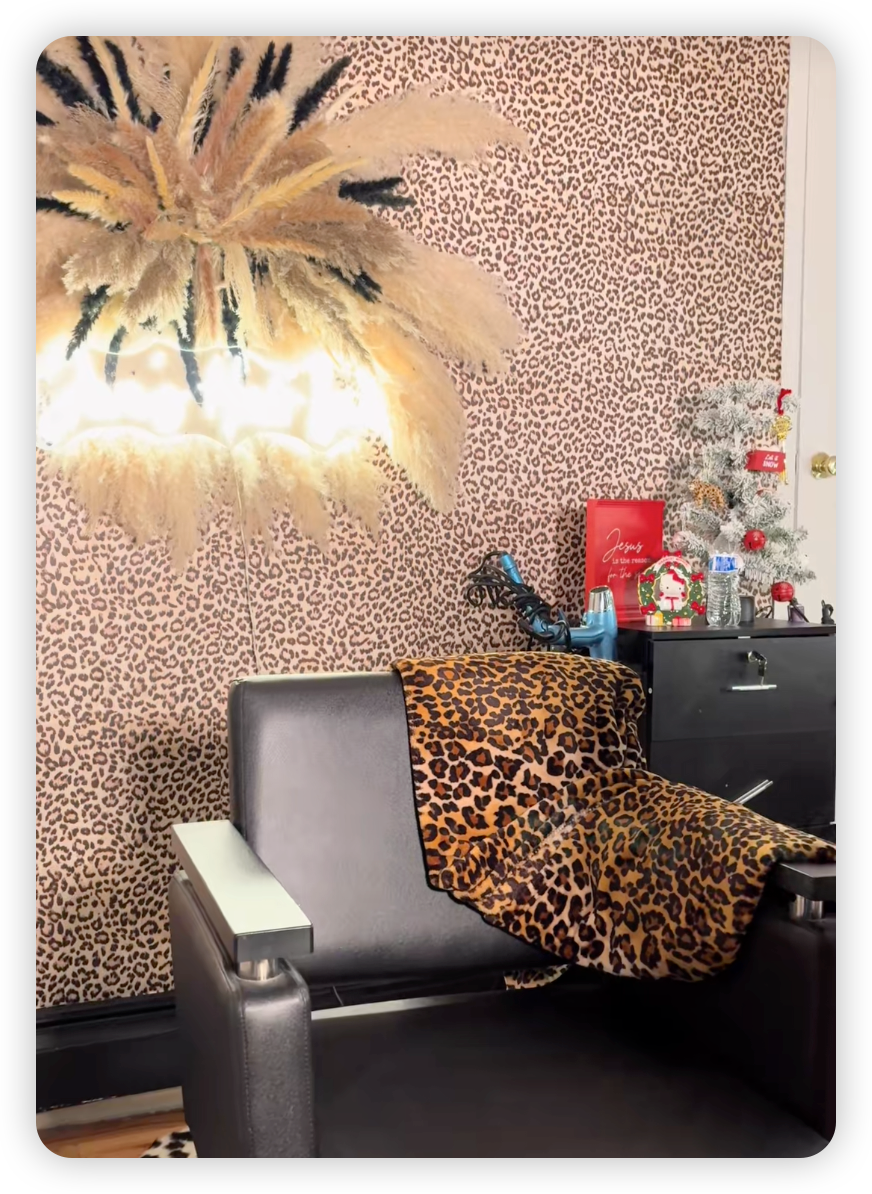
Un mur d'accent en imprimé léopard a tout changé pour un salon de beauté à Phoenix, en Arizona.
Avant : 180 visites spontanées par mois, une poignée de tags Instagram par semaine, un salon de quartier solide mais sans particularité. Huit semaines après l'installation d'un papier peint imprimé léopard de qualité commerciale JIFFDIFF sur le mur d'accent derrière les postes de coiffure : 247 visites spontanées mensuelles, 28 à 35 tags Instagram par semaine, et une augmentation mensuelle des revenus de 8 353 $. Le papier peint lui-même a coûté 340 $.
Ce n'est pas une histoire de décoration. C'est une histoire de retour sur investissement commercial. En 2026, le levier de revenus le plus sous-utilisé dans la conception d'intérieurs commerciaux — pour les salons de beauté, les cafés, les boutiques, les hôtels et les chaînes de magasins — est le mur derrière le client. Le bon mur crée un moment de contenu. Ce moment de contenu génère des publications d'utilisateurs. Les publications génèrent du trafic. Le trafic génère des revenus. Et tout le cycle commence par une décision de design qui coûte une fraction de tout autre canal de marketing.
Ce guide couvre les spécifications de qualité commerciale qui comptent vraiment pour la durabilité et la conformité, les données réelles derrière la boucle photographie-revenu, et ce que les designers d'intérieur et les metteurs en scène doivent exiger d'un fournisseur avant de spécifier un produit dans un espace commercial.
Partie 1 · L'argument des revenus — Les salons de beauté en tête des données
Comment un investissement mural de 340 $ génère-t-il plus de 8 000 $ de revenus mensuels ?
Le mécanisme est spécifique et reproductible. Voici comment cela fonctionne :
Étude de cas du salon de beauté de Phoenix — Résultats sur 8 semaines
Un salon de beauté d'une chaîne de taille moyenne à Phoenix (3 postes de coiffure, 2 techniciennes en manucure) a installé un papier peint autocollant léopard de qualité commerciale JIFFDIFF sur leur mur d'accent de 3,6 mètres derrière les postes de coiffure — visible de chaque chaise, directement dans le cadre pour les selfies miroir des clientes.
|
Métrique |
Avant l'installation |
8 semaines après |
Changement |
|
Visites spontanées mensuelles |
~180/mois |
~247/mois |
+37% ↑ |
|
Tags Instagram/semaine |
3–5 |
28–35 |
+560% ↑ |
|
Valeur moyenne du ticket |
62 $ |
79 $ |
+27% ↑ |
|
Taux de revisite |
41% |
58% |
+17 pts ↑ |
|
Revenus mensuels |
11 160 $ |
19 513 $ |
+8 353 $ ↑ |
|
Coût du papier peint |
— |
340 $ coût total du matériau |
Retour sur investissement : 24,5× |
Les mécanismes : dans les 48 heures suivant l'installation, un selfie miroir d'une cliente avec l'arrière-plan léopard a été publié sur Instagram et enregistré 147 fois. La publication a généré 23 nouvelles demandes de rendez-vous de personnes qui ne connaissaient pas l'existence du salon. Dès la 3e semaine, la propriétaire du salon avait ajouté un hashtag de marque sur une petite carte au poste de coiffure : '#LeopardChair'. À la 8e semaine, il comptait 312 publications taguées.
Ce n'est pas une tactique marketing. La propriétaire du salon n'a pas fait de publicité. Elle n'a pas engagé d'influenceur. Elle a installé du papier peint. Les clientes ont fait le marketing — parce que le mur leur a donné quelque chose qui valait la peine d'être photographié et partagé. C'est la géométrie d'un espace commercial prêt à générer du contenu.

Pourquoi l'imprimé léopard en particulier ? La psychologie sociale du design partageable
Tous les motifs ne génèrent pas le même comportement social. Le choix d'un motif pour un mur photo commercial nécessite une logique différente de celle du choix d'un motif pour un espace résidentiel. Les motifs qui génèrent le plus de contenu généré par les utilisateurs (UGC) partagent deux caractéristiques : ils sont suffisamment audacieux pour être clairement visibles sur une photo de smartphone, et ils créent un sentiment de "je suis dans un endroit avec de la personnalité" plutôt que "je suis dans un espace commercial générique".
Les imprimés léopard et animaux sur-performent constamment dans les contextes de beauté et de bien-être car ils sont perçus comme glamour, intentionnels et légèrement inattendus — des qualités qui se traduisent directement par un contenu partageable sur Instagram et TikTok. Les imprimés botaniques à grande échelle fonctionnent de manière similaire dans les cafés. Les motifs géométriques audacieux ou Art déco conviennent aux boutiques. Le fil conducteur est la confiance visuelle : un design qui fait une déclaration plutôt qu'une suggestion.
92 % des consommateurs font plus confiance à l'UGC qu'à la publicité de marque — Rapport de Nielsen sur la confiance des consommateurs
4,5× plus susceptibles d'être influencés par l'UGC que par le contenu professionnel — Nielsen
0 $ coût par impression pour l'UGC organique provenant des partages de photos en magasin contre 2 à 8 $ de CPM pour les médias sociaux payants
Les données de confiance expliquent pourquoi cela fonctionne commercialement. Selon le Nielsen Consumer Trust Index, 92 % des consommateurs font confiance aux recommandations de leurs pairs plus qu'à toute autre forme de publicité. Lorsqu'une cliente publie un selfie miroir depuis votre salon, elle délivre une recommandation fiable à tout son réseau — gratuitement, à grande échelle, sans coût de production. Un espace commercial bien conçu est un atout de production médiatique, pas seulement un choix de décoration.

Partie 2 · L'application aux cafés, hôtels et magasins de détail
La même logique de retour sur investissement s'applique-t-elle à d'autres espaces commerciaux ?
Oui — avec une stratégie de conception et de placement spécifique à l'espace. La boucle photographie-revenu fonctionne dans tout environnement commercial où les clients ont une raison de se photographier ou de photographier l'espace. L'application diffère selon la catégorie.
Cafés et salons de thé — L'opportunité photo du "troisième lieu"
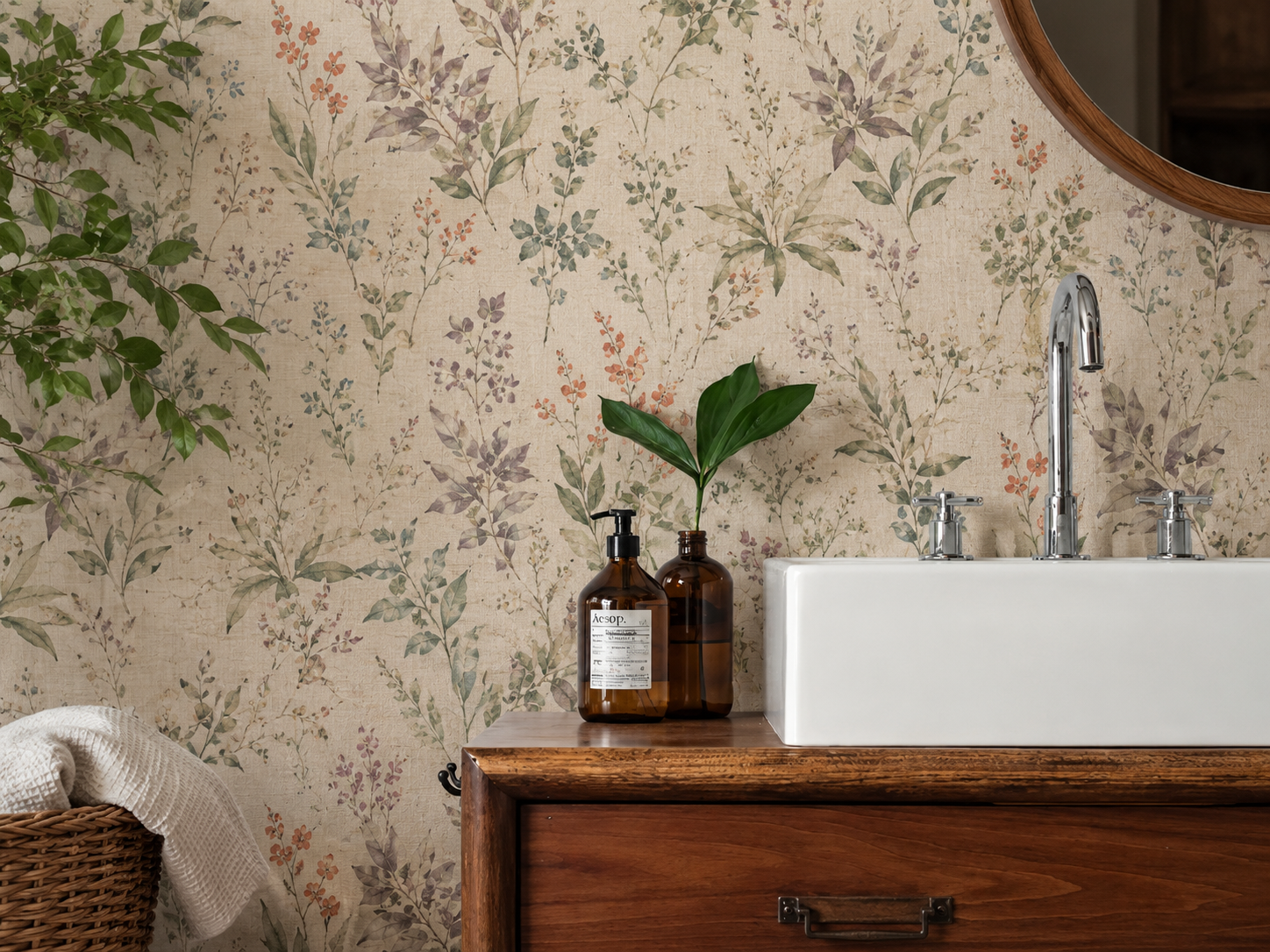
Les cafés occupent un rôle social unique — c'est là que les gens vont pour être vus comme productifs, sociaux ou élégants. Le mur d'accent derrière le comptoir de commande, le coin avec la meilleure lumière naturelle, ou le mur d'étagères en face de la table communautaire sont autant de surfaces naturelles pour la photographie. Un café de Brooklyn a installé une murale botanique grand format JIFFDIFF dans son coin de fenêtre avant fin 2025. En un mois, le tag de localisation sur Instagram avait augmenté de 3,4 fois par rapport à leur moyenne des 90 jours précédents — presque entièrement grâce aux clients qui prenaient eux-mêmes des photos devant la murale. Le café a signalé une augmentation de 22 % des nouveaux clients citant "vu sur Instagram" comme source de découverte le mois suivant.
Pour les cafés, le cahier des charges d'un mur d'accent en papier peint commercial est le suivant : lisible à 1,80-2,40 mètres (la distance de prise de vue typique d'un smartphone), fonctionne à la fois sous une lumière artificielle chaude et une lumière naturelle froide, et crée une relation claire entre le premier plan et l'arrière-plan qui fait de la personne sur la photo le sujet, et non le mur.
Boutiques de détail — Le moment de la cabine d'essayage et du mur produit
Les magasins de vêtements et les chaînes de magasins de beauté disposent d'un moment de photographie naturel intégré : la cabine d'essayage. Une cabine d'essayage avec un mur d'accent réfléchi génère plus de contenu social organique que presque toute autre surface commerciale — parce que le client est déjà dans le cadre, évalue déjà son apparence, et est déjà dans l'état d'esprit de documenter l'expérience.
Une chaîne régionale de salons de manucure et de beauté a installé du papier peint autocollant géométrique JIFFDIFF dans 12 de ses établissements au quatrième trimestre 2025, ciblant spécifiquement les murs de leurs zones de consultation. Sur l'ensemble de la chaîne, le nombre d'avis Google a augmenté de 34 % dans les 60 jours suivant l'installation, et les réservations d'introduction pour de nouveaux clients — provenant directement des références "trouvé sur les réseaux sociaux" — ont augmenté de 28 % par rapport à la même période de l'année précédente.
Chambres d'hôtel et couloirs — La photo d'annonce et l'avis en chambre
Pour les hôtels, le retour sur investissement du papier peint commercial fonctionne sur un canal différent mais tout aussi mesurable : le taux de clics sur les photos d'annonces et le langage des avis des clients en chambre. Un hôtel-boutique qui a rénové ses 30 chambres standard avec des panneaux muraux d'accent en vinyle doublé de tissu JIFFDIFF a vu son taux de clics sur Booking.com pour les résultats de recherche augmenter de 31 % dans les 45 jours suivant la mise à jour des photos d'annonce — entièrement grâce à la distinction visuelle des nouvelles photos de chambres. Le score moyen des avis clients s'est amélioré de 0,4 point, avec la mention "chambres élégantes" apparaissant dans 67 % des avis écrits, contre 22 % avant la rénovation.

Partie 3 · Spécifications de qualité commerciale — Ce que vous devez exiger
Qu'est-ce qui rend un produit autocollant véritablement de qualité commerciale ?
L'expression "qualité commerciale" sur une liste de produits est aussi peu réglementée que "premium". Voici ce que cela signifie réellement lorsqu'il est spécifié correctement pour un environnement hôtelier, de café ou de vente au détail — et la documentation dont vous avez besoin pour le justifier professionnellement.
|
Spécification commerciale |
Exigence minimale |
Standard JIFFDIFF |
|
Substrat |
Vinyle épais ou doublé de tissu |
Vinyle doublé de tissu, 0,25 mm+ |
|
Type d'adhésif |
Adhésif acrylique PSA de qualité commerciale |
Acrylique haute adhérence, testé en humidité |
|
Revêtement de surface |
Lavable, classe 1 lavable |
Revêtement industriel lavable |
|
Conformité au feu |
ASTM E84 Classe B (la plupart des espaces) |
Classe A disponible, documents sur demande |
|
COV / qualité de l'air |
Faible teneur en COV pour les espaces occupés |
Matériaux éco-certifiés, faible teneur en COV |
|
Performance des joints |
Bord à bord avec rouleau presseur |
Cohérence de lot ΔE ≤ 2.0 |
|
Protocole de retrait |
Retrait propre à 12-24 mois |
Données de retrait multi-années documentées |
|
Délai d'échantillon |
48 heures pour l'échantillon physique |
Expédition en 48 heures, standard pour tous les B2B |
L'exigence de lavabilité — Non négociable dans les espaces commerciaux
Éclaboussures de café. Projection excessive de laque. Traces de doigts à hauteur d'épaule. Une surface murale commerciale est nettoyée chaque semaine avec ce que l'équipe d'entretien utilise — souvent des désinfectants industriels qui dégraderont une surface mate non revêtue en quelques mois. Le papier peint autocollant de qualité commerciale nécessite un revêtement de surface lavable de classe 1 ou 2 qui résiste à des passages de nettoyage humide répétés sans dégradation de l'encre, farinage de la surface ou décollement du revêtement.
Demandez les données de test de résistance au nettoyage avant de spécifier. Demandez spécifiquement si la surface a été testée contre les composés d'ammonium quaternaire (la base de désinfectant commercial standard) — et pas seulement avec du 'savon doux et de l'eau'.
Conformité au feu ASTM E84 — Requise pour la plupart des applications commerciales
Pour tout espace commercial occupé ouvert au public — restaurants, magasins de détail, salons de beauté, espaces publics d'hôtels — les finitions murales intérieures sont réglementées par des codes du bâtiment qui font référence aux tests de propagation de flammes ASTM E84. La classe spécifique requise dépend du type d'occupation, du statut des gicleurs et de la juridiction locale.
La plupart des spécifications commerciales dans les zones sans sortie de secours exigent au minimum la classe B (FSI 26–75) ; les couloirs, les halls et les espaces de rassemblement à forte occupation nécessitent généralement la classe A (FSI 0–25). Un papier peint autocollant commercial sans documentation ASTM E84 n'est pas un produit spécifiable commercialement, peu importe son apparence sur le mur. JIFFDIFF fournit la documentation de classe A et de classe B sur demande pour toutes les commandes de spécifications commerciales.
L'avantage JIFFDIFF pour les spécifications commerciales : chaque spécification de produit pour l'hôtellerie, les cafés ou les commerces de détail comprend la documentation d'incendie ASTM E84, les données de résistance au nettoyage, la certification de cohérence de lot ΔE et la documentation des matériaux éco-certifiés — livrée sous forme de colis avec l'échantillon physique, et non obtenue séparément par un processus de conformité que vous gérez vous-même.

Partie 4 · Approvisionnement pour une chaîne — Le problème de la cohérence multi-sites
Comment maintenir une cohérence visuelle sur 12 sites ?
Une installation de boutique unique est plus indulgente. Une installation en chaîne ne l'est pas. Lorsque vous spécifiez le même mur caractéristique à motif léopard pour 12 salons de beauté, chaque rouleau, dans chaque établissement, doit avoir une apparence identique sous toutes les conditions d'éclairage. La variation de couleur entre les établissements est immédiatement visible lorsque les clients visitent plusieurs magasins — et elle signale une incohérence de qualité qui sape l'image de marque que le papier peint est censé véhiculer.
Le protocole de verrouillage de lot pour les installations en chaîne
La norme professionnelle pour les installations commerciales multi-sites est une production en un seul lot pour toutes les commandes simultanées — ou une capacité documentée d'appariement de lots pour les déploiements échelonnés. Cela signifie que chaque rouleau provient de la même série d'impression, du même lot d'encre, du même lot de substrat. La variation de couleur entre les rouleaux est documentée à ΔE ≤ 2,0 — imperceptible à l'œil humain sous toutes les conditions d'éclairage.
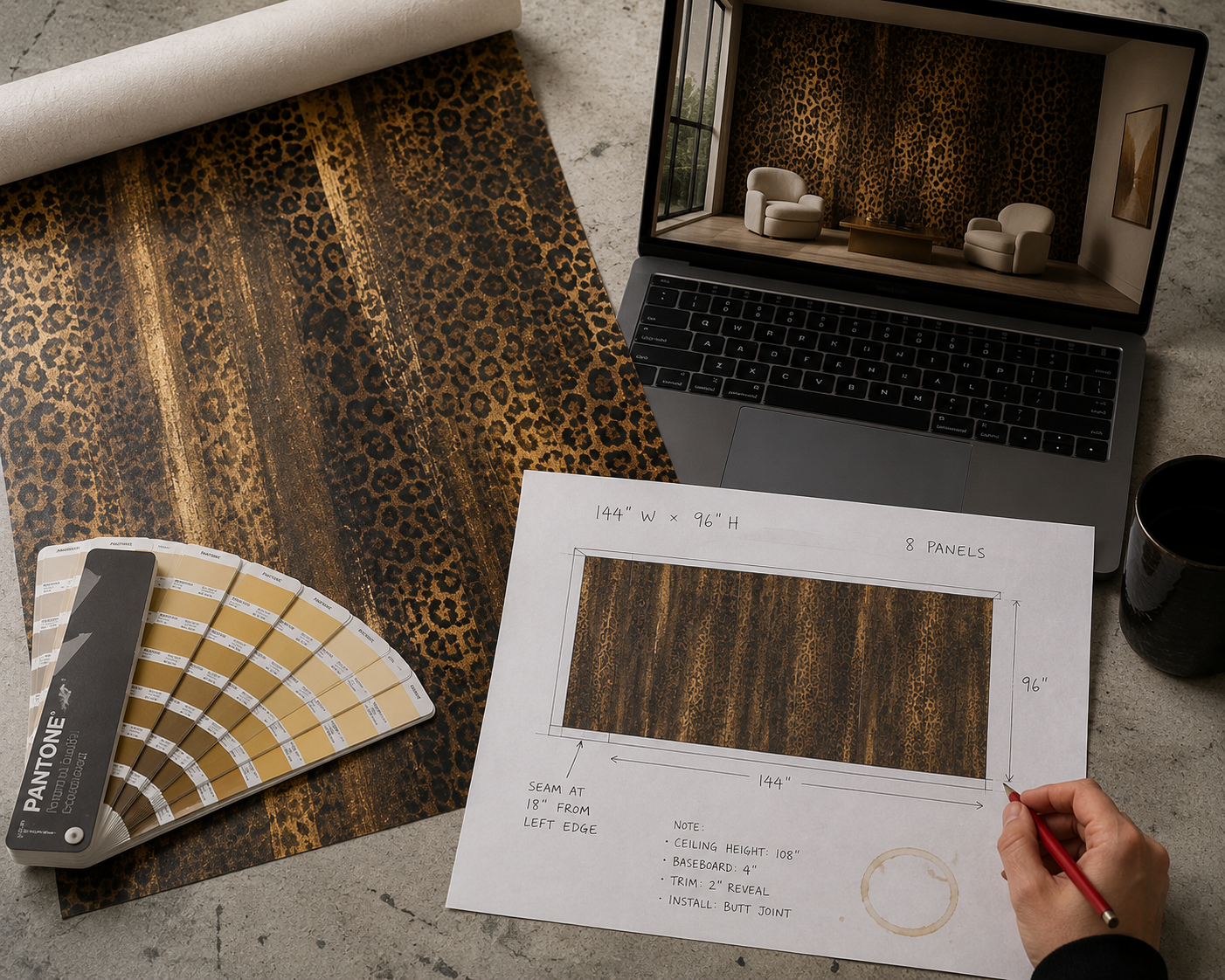
Pour une chaîne de 12 salons de beauté installant du papier peint JIFFDIFF à motif léopard sur un mur caractéristique de 11 m² en moyenne par établissement, le volume total de matériau est d'environ 134 m² — une production en un seul lot qui est expédiée avec un délai de 15 jours à compter de la commande confirmée. Les 12 établissements reçoivent des produits du même lot, photographiés et documentés avec des numéros de lot sur les étiquettes des rouleaux et les manifestes des cartons.
La voie de mise à niveau de l'acheteur d'Amazon / TikTok Shop
Un pourcentage significatif de propriétaires d'espaces commerciaux découvrent d'abord les produits JIFFDIFF via Amazon ou TikTok Shop — où des rouleaux individuels sont disponibles à l'essai sans aucun processus B2B. C'est intentionnel. Nous pensons que la meilleure façon de gagner un compte commercial est de laisser le produit parler en premier.
Le parcours de mise à niveau typique : un propriétaire de salon découvre JIFFDIFF sur TikTok Shop, commande 2 rouleaux pour un seul mur décoratif, les installe en un week-end, génère plus de 30 publications taguées le premier mois, puis contacte l'équipe B2B pour s'approvisionner pour deux emplacements supplémentaires avec un emballage de marque privée sous la marque de leur salon. Le produit se valide lui-même au détail ; le programme B2B met à l'échelle ce qui fonctionne. Si vous vous approvisionnez actuellement JIFFDIFF au détail et envisagez un programme commercial ou multi-sites, la voie vers des prix de gros sans MOQ et des commandes de lots personnalisées commence par un simple e-mail.
La philosophie de JIFFDIFF : les beaux espaces commerciaux ne devraient pas nécessiter un budget de conception que seule une chaîne hôtelière peut se permettre, ni un processus d'approvisionnement qui prend trois mois à naviguer. Notre programme B2B a été conçu pour qu'un salon de beauté à 2 chaises et une marque hôtelière de 200 chambres puissent tous deux accéder à des produits de qualité commerciale, à la documentation de conformité et à l'intelligence de conception par le même canal. Le mur devrait travailler aussi dur que l'entreprise qui se cache derrière.
Par tiktok :jenshairlab

Partie 5 · FAQ — Réponses spécifiques qui mettent fin à la recherche
Foire aux questions : Papier peint autocollant commercial pour hôtels, cafés et commerces de détail
Tiré de Reddit (r/smallbusiness, r/InteriorDesign, r/entrepreneur, r/HotelManagement, r/coffeeshops) et des requêtes Google les plus fréquentes concernant le papier peint commercial — réponses avec une spécificité suffisante pour mettre fin à la recherche.
Q : Le papier peint autocollant est-il suffisamment durable pour un espace commercial ?
Le papier peint autocollant de qualité commerciale, à dos textile ou en vinyle épais, avec un revêtement lavable de classe 1 et un adhésif acrylique PSA industriel, est durable pendant 3 à 7 ans dans les environnements commerciaux — la clé est de spécifier un produit de qualité commerciale, et non de qualité grand public, et de confirmer les données de résistance au nettoyage par rapport aux produits spécifiques utilisés par votre équipe de maintenance.
Q : Le papier peint augmente-t-il la fréquentation des magasins de détail ?
Des données de cas documentées montrent que les installations de murs caractéristiques dans les salons de beauté, les cafés et les boutiques génèrent une augmentation de la fréquentation de 28 à 37 % en 8 semaines grâce au contenu social généré par les utilisateurs — le mécanisme est la création de contenu visuel par les clients, ce qui stimule la découverte par leurs réseaux sociaux à coût médiatique nul.
Q : Quels motifs de papier peint autocollant conviennent le mieux aux photos Instagram de salon ?
Les imprimés audacieux d'animaux (léopard, zèbre), les motifs botaniques à grande échelle et les motifs géométriques à fort contraste génèrent systématiquement le plus de contenu social organique dans les environnements de salon de beauté — ils se lisent clairement sur les photos de smartphone à 1,2 à 2,4 mètres, fonctionnent sous l'éclairage du salon et créent cette qualité de « quelque part avec une personnalité » qui motive les clients à publier.
Q : Le papier peint autocollant commercial doit-il être ignifugé ?
Oui — pour tout espace commercial occupé ouvert au public, la documentation de classement au feu ASTM E84 est requise par les codes du bâtiment locaux et les références du Code international du bâtiment ; la plupart des applications de vente au détail et de salon nécessitent un minimum de classe B, les couloirs et halls d'hôtel nécessitent la classe A ; toujours confirmer avec l'AHJ local avant de spécifier.
Q : Comment puis-je m'approvisionner du même papier peint pour plusieurs sites de salon ?
Demandez une production en un seul lot pour tous les sites commandés simultanément — cela garantit une cohérence de couleur ΔE ≤ 2,0 sur tous les sites ; pour les déploiements échelonnés, confirmez la capacité d'appariement des lots du fournisseur et exigez la documentation des numéros de lot sur toutes les étiquettes de carton avant d'accepter toute livraison.
Q : Puis-je acheter d'abord du papier peint commercial sur Amazon ou TikTok Shop avant de commander en gros ?
Oui — acheter au détail pour valider un design dans votre espace avant de s'engager dans une commande en gros commerciale est l'approche professionnelle ; les produits JIFFDIFF sont disponibles sur les deux plateformes pour des essais en un seul site, avec un programme de gros B2B pour les commandes multi-sites, en marque privée et de lots personnalisés accessibles directement via l'équipe d'approvisionnement commercial.
Q : Combien de temps prend l'installation d'un papier peint commercial pour un magasin de détail ?
Un mur décoratif standard de 11 m² s'installe en 2 à 4 heures sans artisans spécialisés — ouverture le jour même après l'installation, temps de séchage nul, pas de planification d'entrepreneur ; comparé à la peinture (24 à 48 heures de temps de séchage, peintre professionnel requis) ou au revêtement mural traditionnel à coller (main-d'œuvre d'installation plus 24 heures de séchage avant que l'espace ne puisse rouvrir).
Q : Quel est le retour sur investissement typique pour l'installation d'un papier peint commercial ?
Les données de cas documentées des installations de salons de beauté montrent un retour sur investissement de 15 à 25 fois le coût des matériaux en 8 semaines, stimulé par le trafic organique des médias sociaux ; les cafés signalent une augmentation de 22 à 34 % de la découverte de nouveaux clients via les médias sociaux dans les 30 jours suivant l'installation ; les propriétés hôtelières signalent une amélioration de 0,3 à 0,5 point des scores d'avis des clients et une augmentation de 25 à 35 % des taux de clics sur les annonces.

Laisser un commentaire
Ce site est protégé par hCaptcha, et la Politique de confidentialité et les Conditions de service de hCaptcha s’appliquent.