
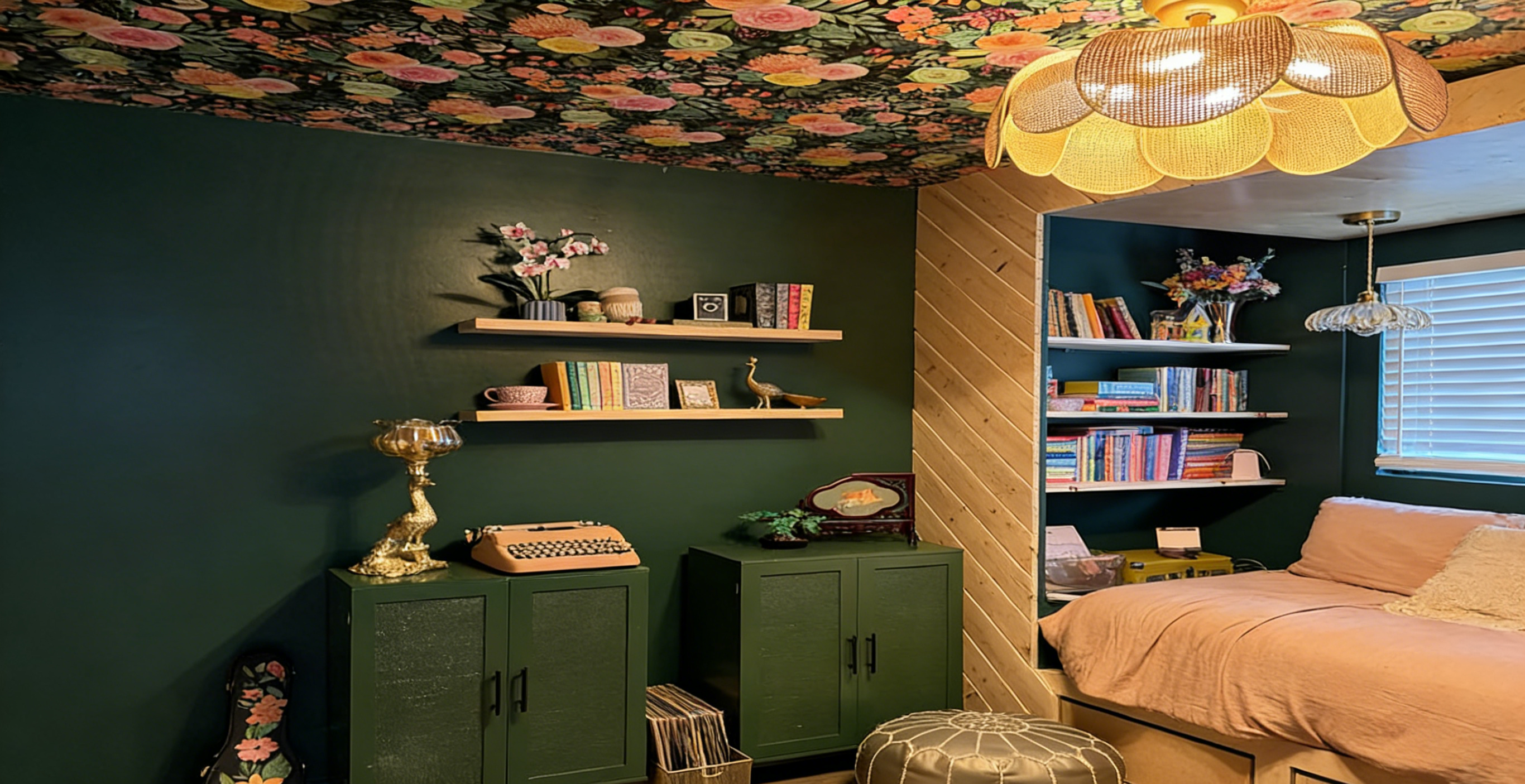
Papier peint au plafond? L'astuce des designers pour les petites pièces
La plupart des gens pensent que le papier peint doit être posé sur les murs.
Mais les designers d'intérieur font souvent quelque chose d'inattendu :
ils posent du papier peint au plafond.
Dans le monde du design, le plafond est connu comme « le cinquième mur ».
Et dans les petites pièces, la décoration de cette surface souvent négligée peut changer radicalement la perception de l'espace.
Un plafond bas peut paraître plus haut.
Une petite pièce peut sembler plus stylisée et intentionnelle.
Et un coin oublié peut soudainement devenir la partie la plus intéressante de l'espace.
Une fois que vous remarquerez cette astuce de design, vous commencerez à la voir partout.
Qu'est-ce que le papier peint de plafond ?
Le papier peint de plafond signifie simplement appliquer du papier peint au plafond au lieu (ou en plus) des murs.
Les designers d'intérieur utilisent souvent cette technique pour :
• ajouter un intérêt visuel
• créer un point focal
• faire paraître un petit espace plus haut
• équilibrer les pièces minimalistes
Parce que les plafonds sont généralement d'un blanc uni, même un motif subtil peut complètement transformer l'atmosphère de la pièce.
Pourquoi le papier peint de plafond fonctionne si bien dans les petites pièces
Les petites pièces semblent souvent exiguës parce que tout se passe au niveau des yeux.
Les meubles, les œuvres d'art, les étagères et la décoration sont tous en concurrence dans la même zone visuelle.
Lorsque du papier peint est ajouté au plafond, l'œil se dirige naturellement vers le haut.
Ce simple changement modifie la perception de la pièce.
Au lieu de se sentir confiné, l'espace semble soudainement :
• plus grand
• plus stratifié
• conçu avec plus d'intention
Les designers d'intérieur utilisent fréquemment cette technique dans :
-
les cabinets de toilette
-
les couloirs étroits
-
les buanderies
-
les coins lecture
-
les petites chambres
Ces espaces en bénéficient le plus car ils manquent généralement d'éléments décoratifs de grande taille.

Les meilleurs motifs de papier peint de plafond pour les petits espaces
Tous les motifs de papier peint ne conviennent pas au plafond.
Les designers ont tendance à choisir des motifs qui guident l'œil en douceur plutôt que de surcharger l'espace.
Voici quelques-uns des styles les plus efficaces.
Petits motifs répétitifs
De minuscules fleurs, des points ou des motifs délicats ajoutent de la texture sans alourdir le plafond.
Ils sont particulièrement efficaces dans les cabinets de toilette et les placards.
Motifs géométriques doux
Les motifs géométriques créent du rythme et du mouvement au plafond.
Ils conviennent bien aux intérieurs modernes car ils sont structurés tout en restant subtils.
Imprimés métalliques ou réfléchissant la lumière
Les motifs avec des accents métalliques réfléchissent la lumière et font paraître les plafonds plus lumineux et plus hauts.
C'est particulièrement utile dans les pièces avec une lumière naturelle limitée.
Motifs inspirés de la nature
Les feuilles, les nuages et les imprimés floraux adoucissent la pièce.
Ces motifs donnent souvent au plafond une sensation d'ouverture et de détente.
La règle de conception simple suivie par les professionnels
Les designers d'intérieur traitent rarement les plafonds au hasard.
Une règle d'équilibre simple aide à maintenir la cohésion de la pièce.
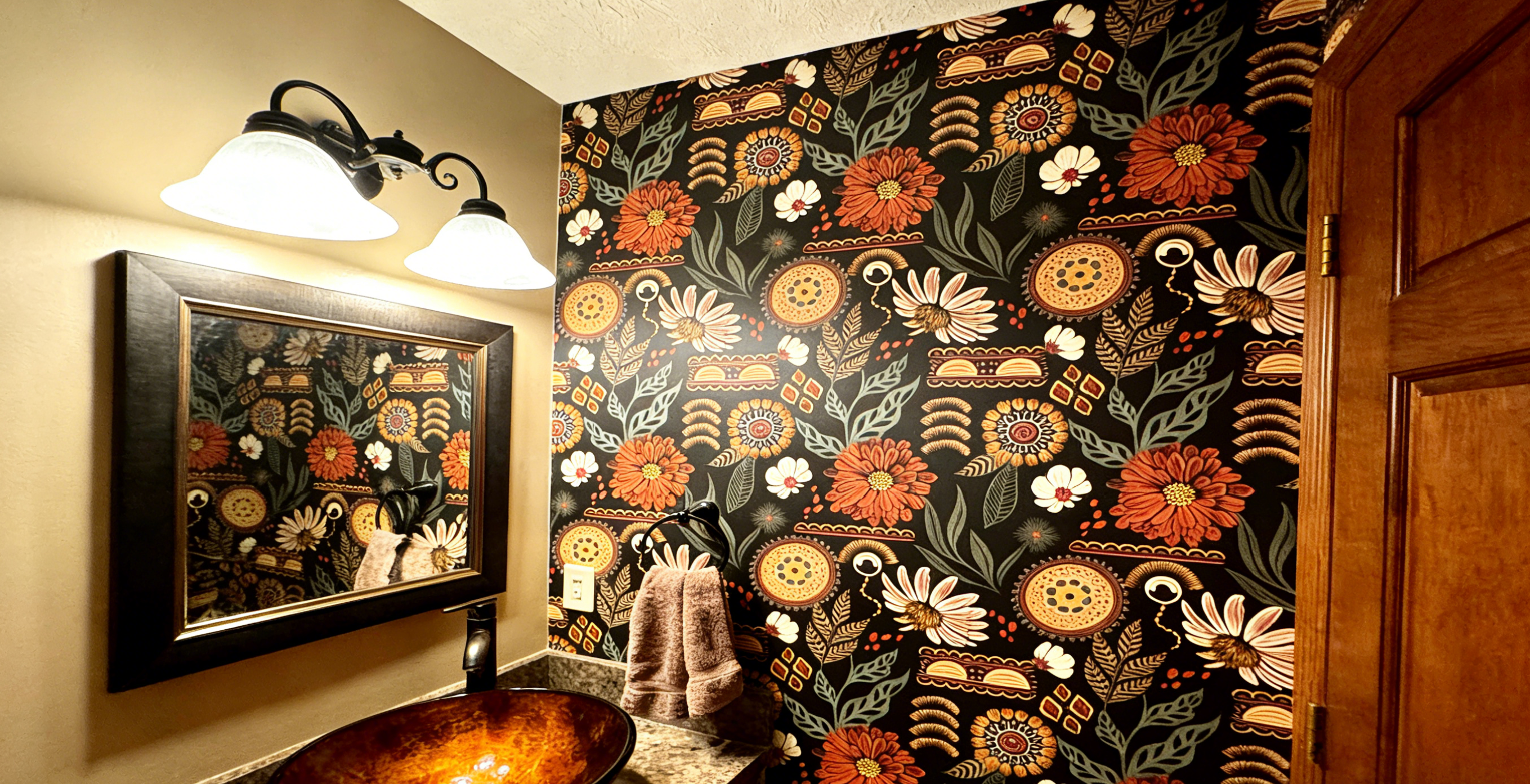
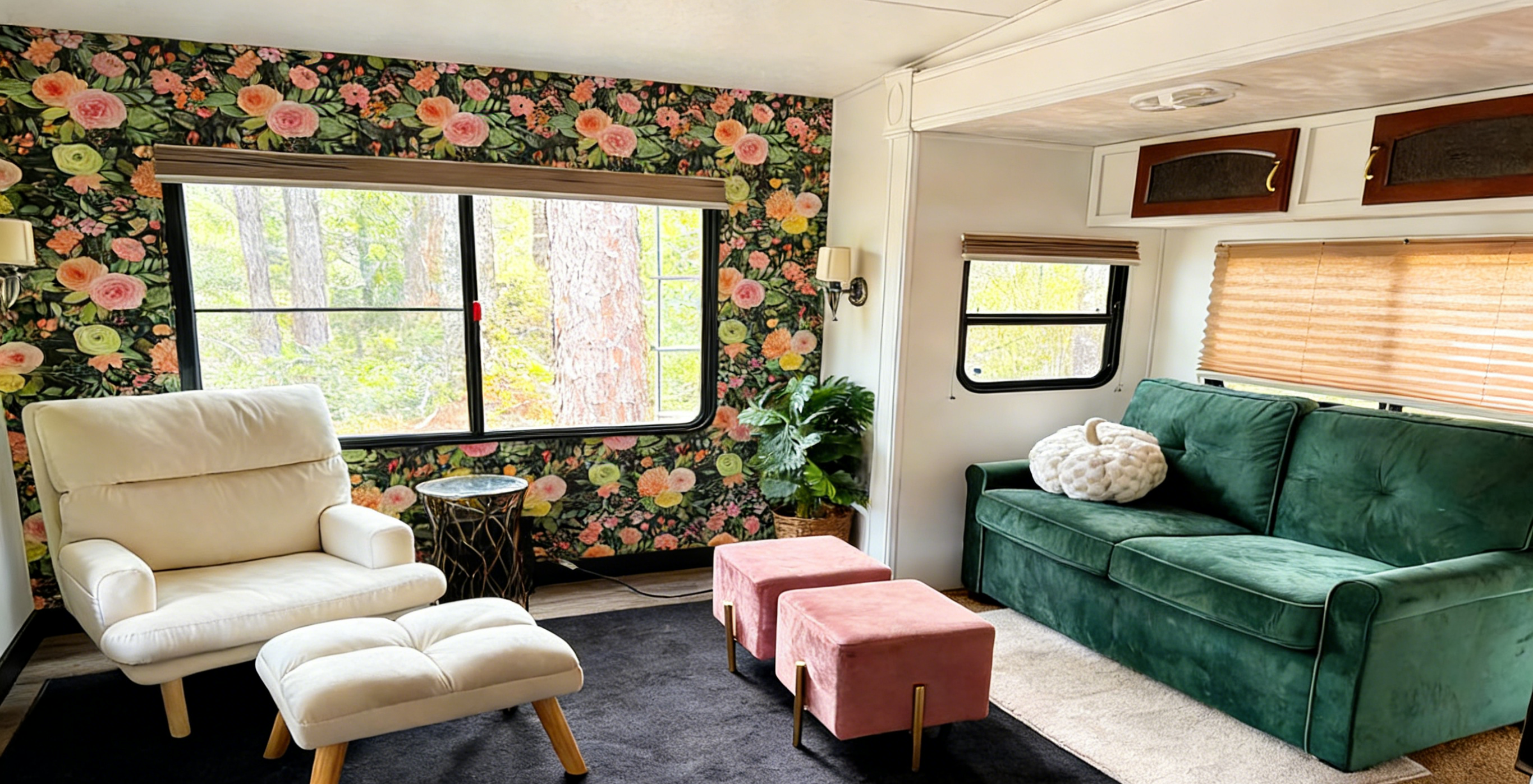
Si les murs sont unis → le plafond peut être audacieux.
Si les murs sont déjà à motifs → le plafond doit rester subtil.
Cela empêche le design de paraître chaotique.
Une autre astuce courante est l'harmonie des couleurs.
Le papier peint de plafond inclut souvent au moins une couleur déjà présente dans la pièce – issue du mobilier, des textiles ou de la peinture.
Cela aide à donner une sensation de connexion à l'ensemble.
Pièces où le papier peint de plafond a le plus grand impact
Certains espaces bénéficient plus du papier peint de plafond que d'autres.
Ce sont les pièces où les designers l'utilisent le plus souvent.
Cabinets de toilette
Les petites salles de bain sont idéales pour des choix de design audacieux.
Les invités regardent naturellement autour d'eux, faisant du plafond un point fort inattendu du design.
Entrées
L'entrée donne le ton à toute la maison.
Un plafond à motifs ajoute immédiatement du caractère et de la personnalité.
Coins lecture
Le papier peint au-dessus d'une chaise ou d'un banc confortable crée une atmosphère intime.
Il peut donner l'impression que l'espace est un refuge dédié.
Chambres d'enfants
Les motifs de plafond introduisent l'imagination sans surcharger les murs.
Les nuages, les étoiles ou les motifs ludiques fonctionnent particulièrement bien ici.
Couloirs
Les couloirs sont souvent vides ou transitionnels.
Un plafond à motifs ajoute du mouvement et un intérêt visuel.

Le papier peint de plafond est-il difficile à poser ?
De nombreux propriétaires pensent que le papier peint de plafond est compliqué.
En réalité, le processus est similaire à la pose murale.
Les facteurs clés sont :
• une surface lisse
• un adhésif approprié ou un support autocollant
• un alignement soigné du motif
Comme les plafonds sont généralement plus petits que les murs, l'installation peut en fait être plus rapide qu'un projet de pièce entière.
Pourquoi le papier peint de plafond devient de plus en plus populaire
Au cours des dernières années, les designers ont commencé à utiliser plus fréquemment le papier peint de plafond.
Il y a plusieurs raisons à ce changement.
Premièrement, les matériaux de papier peint modernes sont plus faciles à poser et à enlever.
Deuxièmement, les propriétaires sont de plus en plus à l'aise pour expérimenter de petits éléments de design.
Enfin, les médias sociaux ont sensibilisé les gens aux idées créatives en matière de design d'intérieur.
Le plafond n'est plus seulement une surface vierge.
Il devient une opportunité d'expression du design.
Le petit changement de design qui transforme une pièce
Un grand design intérieur vient souvent de la capacité à voir des espaces familiers d'une nouvelle manière.
Au lieu de traiter le plafond comme un espace vide, les designers l'utilisent pour ajouter de la profondeur et du caractère.
Dans les petites pièces en particulier, ce changement subtil peut faire une différence spectaculaire.
La pièce ne devient pas plus grande.
Mais elle semble plus grande, plus équilibrée et conçue avec plus de soin.
Et parfois, c'est tout ce dont un espace a besoin.
Conseils de design rapides si vous voulez essayer le papier peint de plafond
Si vous envisagez cette idée, commencez par ces quelques lignes directrices :
• choisissez des couleurs plus claires pour les plafonds très bas
• gardez les motifs petits dans les pièces minuscules
• coordonnez avec les couleurs existantes de la pièce
• testez une petite zone d'abord
Même un design subtil peut faire en sorte que le plafond soit une partie intentionnelle de la pièce.
Pourquoi les designers l'appellent le « cinquième mur »
Les murs façonnent une pièce.
Les sols l'ancrent.
Mais les plafonds la complètent.
Une fois que vous commencez à considérer le plafond comme le cinquième mur, une toute nouvelle surface de design s'ouvre.
Et parfois, les plus belles décisions de design sont celles que les gens n'osent pas souvent essayer.

Laisser un commentaire
Ce site est protégé par hCaptcha, et la Politique de confidentialité et les Conditions de service de hCaptcha s’appliquent.