Comment évaluer un partenaire grossiste de papier peint amovible : une liste de contrôle pour les petits acheteurs B2B
« Chaque choix derrière un bel espace est aussi un choix dans lequel nous voulons que les gens se sentent en confiance. »
— Valeur de la marque JIFFDIFF 02 · Choisir en toute confiance
La plupart des petits acheteurs B2B dans la catégorie du papier peint amovible se font avoir de la même manière : non pas avec le premier rouleau qu'ils commandent, mais avec le troisième, le quatrième et le cinquième. Le produit avait fière allure sur l'échantillon. Il avait même fière allure lors de la première installation. Et puis — quelque part entre la deuxième commande et un projet multi-propriétés — des problèmes sont apparus. Un décalage de couleur entre les lots. Un décollement des bords dans une salle de bain humide. Une livraison tardive pendant une période de photos pour une annonce. Un fichier personnalisé qui est mystérieusement apparu sous l'annonce d'une autre marque.
Ce n'est pas une histoire de défaut de fabrication. C'est une histoire de sélection de partenaire. Et c'est entièrement évitable — avec un cadre d'évaluation discipliné appliqué avant toute première commande.
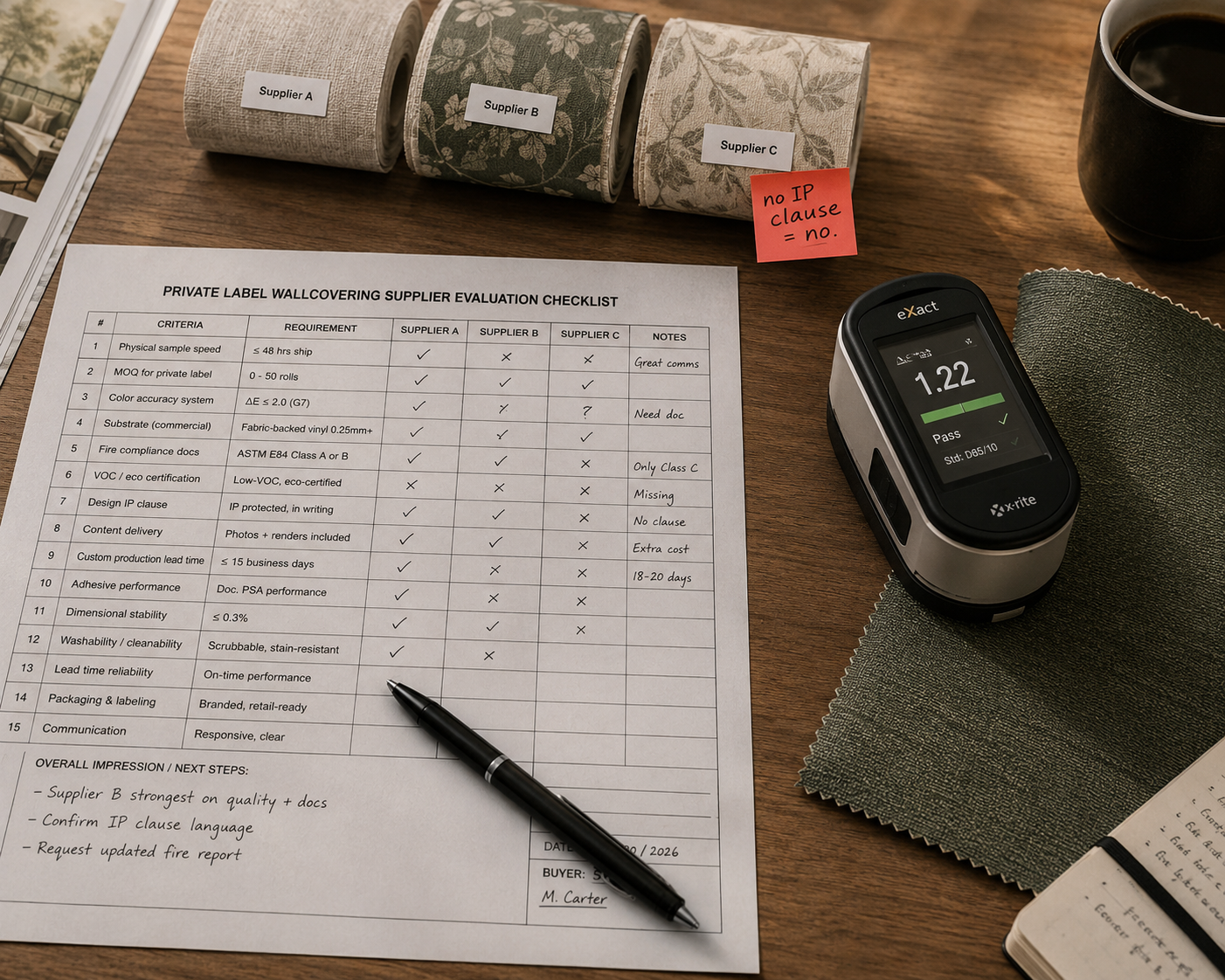
Ce guide est la liste de contrôle de 15 critères de JIFFDIFF pour évaluer tout partenaire grossiste en papier peint amovible : ce qu'il faut rechercher, ce qu'il faut demander, ce qu'il faut exiger par écrit et les signaux spécifiques qui séparent un partenaire de fabrication sur lequel vous pouvez bâtir une réputation d'un fournisseur dont les erreurs finiront par devenir les vôtres. Nous avons construit tout notre programme B2B autour du principe selon lequel
une relation de grossiste devrait rendre la sélection plus sûre — et non plus incertaine.
Partie 1 · Pourquoi la décision du partenaire se complique
Pourquoi le choix du mauvais partenaire grossiste en papier peint coûte-t-il plus cher que le produit ?
Un petit acheteur B2B — un home stager gérant 8 propriétés, un designer d'intérieur construisant une ligne de marque privée, un fondateur de DTC testant une première référence de papier peint — opère avec des marges structurellement plus serrées qu'un grand détaillant. Il n'y a pas d'équipe de contrôle qualité pour absorber les erreurs d'un fabricant. Il n'y a pas de budget de remplacement lorsqu'une expédition arrive en retard. Il n'y a pas de couverture de relations publiques lorsqu'un client se plaint d'un produit portant votre nom. Les échecs du partenaire grossiste deviennent vos échecs, multipliés par votre réputation.
Ceci est bien documenté dans la littérature plus large sur les achats. Les orientations de l'administration américaine des petites entreprises sur l'évaluation des fournisseurs identifient la fiabilité des fournisseurs, la constance de la qualité et la clarté contractuelle comme les trois variables ayant le plus grand impact sur la stabilité opérationnelle des petites entreprises — et non le prix unitaire, sur lequel les acheteurs ont tendance à se concentrer excessivement. Pour le papier peint amovible en particulier, les mêmes principes s'appliquent avec une variable supplémentaire : la nature visuelle du produit signifie que les défaillances de qualité sont immédiatement visibles pour le client final. Il n'est pas possible de cacher un décalage de couleur sur un mur.

Le coût réel d’une mauvaise décision de partenaire
Quantifiez-le. Pour un metteur en scène qui spécifie 6 installations de papier peint par trimestre, avec une dépense matérielle moyenne de 400 $ chacune, un taux de rappel de 15 % dû à des défauts de qualité représente :
• 3 600 $ de coût de produit de remplacement sur un an
• Plus de 16 heures de travail de réparation et de temps de réinstallation
• 2 à 3 relations clients à risque par an — chacune valant bien plus que la ligne de papier peint elle-même
• Des dommages à la réputation de la marque qui se répercutent sur chaque conversation de référence qui n'a pas lieu
La relation de vente en gros de papier peint n'est pas une transaction. C'est une extension de votre réputation professionnelle. Choisissez-la comme vous choisissez les personnes que vous embauchez — car le produit du fabricant vous représentera dans chaque espace où il apparaîtra.
Partie 2 · La liste de contrôle d'évaluation à 15 critères
Que devrait vérifier tout petit acheteur B2B avant de commander ?
Les 15 critères suivants sont organisés pour être utilisés directement — lors d'une conversation d'approvisionnement, dans une comparaison d'appel d'offres ou comme une discipline pour vos propres notes d'évaluation. Chaque critère a une réponse claire pour le « feu vert » et un signal clair pour « passer votre chemin ». Si un partenaire grossiste échoue sur plus de trois de ces critères, la relation créera plus de problèmes qu'elle n'en résoudra.
|
# |
Critère |
Feu vert |
Passer votre chemin |
|
1 |
Délai d'exécution des échantillons physiques |
48 heures, sans exception |
Plus de 5 jours ouvrables |
|
2 |
Format de l'échantillon |
Matériau de rouleau de production réel |
Petit échantillon ou preuve numérique seulement |
|
3 |
Quantité minimale de commande |
0 MOQ pour les échantillons ; faible MOQ pour les premières commandes |
500+ rouleaux avant tout échantillon |
|
4 |
Spécification de tolérance de couleur |
Cohérence des lots ΔE ≤ 2,0 par écrit |
Pas de spécification de tolérance ou « les couleurs s'accordent bien » |
|
5 |
Délai de production |
15 jours ouvrables à compter de la confirmation de commande |
Plus de 30 jours, délais vagues |
|
6 |
Taux de livraison à temps |
100 % documenté avec des données |
Assurance verbale uniquement |
|
7 |
Qualité du substrat |
Vinyle à envers textile, 0,25 mm+, lavable |
Papier fin, pas de spécifications divulguées |
|
8 |
Ingénierie des adhésifs |
PSA commercial, testé à 65 %+ HR |
« Fort » — pas de données |
|
9 |
Conformité au feu |
Documents ASTM E84 Classe A/B sur demande |
Non disponible |
|
10 |
Certifications COV / écologiques |
Faible teneur en COV, éco-certifié, documenté |
Aucune documentation |
|
11 |
Protection de la propriété intellectuelle des dessins |
Clause écrite : vos fichiers sont les vôtres |
Vague, pas de langage contractuel |
|
12 |
Support de marque privée |
OEM/ODM, emballage personnalisé inclus |
MOQ élevé uniquement, facturé en supplément |
|
13 |
Livraison de contenu |
Photos + rendus + documents d'installation inclus |
Facturé séparément ou absent |
|
14 |
Taux de rafraîchissement de la bibliothèque de motifs |
100+ nouveaux SKU par mois |
Statique ou trimestriel seulement |
|
15 |
Disponibilité multi-canal |
B2B direct + vente au détail (Amazon/TikTok Shop) |
B2B uniquement ou vente au détail uniquement |

Comment utiliser cette liste de contrôle en pratique
Trois règles de fonctionnement :
• Appliquez-le avant l'échantillonnage, pas après. Beaucoup de ces critères peuvent être découverts en une seule conversation de 20 minutes. Utilisez le script de la Partie 3 pour qualifier les fournisseurs avant de demander des échantillons — l'échantillonnage coûte cher en temps. Effectuez d'abord le filtrage facile.
• Évaluez les échecs, pas les réussites. Chaque partenaire grossiste affirmera satisfaire la plupart de ces critères. Ce qui importe, ce sont les critères qu'il ne peut pas satisfaire — ce sont les indicateurs des points où la relation échouera plus tard. Trois réponses ou plus indiquant qu'il faut « passer votre chemin » = passez votre chemin.
• Exigez une documentation, pas une assurance. « Nous pouvons le faire » et « voici notre spécification écrite » sont des engagements très différents. Pour les critères 4 (tolérance de couleur), 6 (livraison à temps), 9 (conformité au feu), 10 (COV) et 11 (propriété intellectuelle), exigez une documentation écrite avant toute première commande.
Partie 3 · Le script de qualification en 5 questions
Quelles questions révèlent le plus dans la première conversation ?
Lire une liste de contrôle de 15 critères lors d'une réunion de présentation de fournisseur n'est pas pratique. Poser cinq questions directes et écouter attentivement les réponses l'est. Voici les cinq questions qui effectuent le plus grand travail d'évaluation — mot pour mot, avec ce que chacune d'elles teste réellement, et à quoi ressemble une réponse confiante.
|
Demandez mot pour mot |
Ce que vous testez réellement |
Ce qu'une bonne réponse implique |
|
« Pouvez-vous expédier un échantillon physique dans les 48 heures ? » |
Maturité opérationnelle et priorité B2B |
« Oui — le même jour ouvrable à partir de la spécification approuvée » |
|
« Quelle est votre tolérance de couleur ΔE documentée par lot ? » |
Existence du système de gestion de la qualité |
"ΔE ≤ 2.0, inscrit dans notre fiche technique" |
|
"Quel est votre taux de livraison à temps cette année ?" |
Discipline opérationnelle et suivi des données |
"100%, documenté par envoi" |
|
"Que se passe-t-il si je dois commander à nouveau dans 6 mois – les couleurs correspondront-elles ?" |
Capacité de verrouillage des lots et fiabilité des commandes répétées |
"Lot unique lors de la première production ; réassorts assortis à ΔE ≤ 2.0" |
|
"Mes fichiers de conception restent-ils les miens, par écrit ?" |
Discipline en matière de PI et maturité des contrats B2B |
"Oui – la protection de la PI est standard dans notre accord B2B" |
Comment évaluer les réponses
Le modèle importe plus que le contenu. Écoutez attentivement :
• La spécificité — des chiffres, des dates, des spécifications écrites, des taux documentés. Un partenaire ayant une maturité opérationnelle répond avec des données. Un partenaire qui n'en a pas répond avec des assurances.
• La rapidité de la réponse — une réponse confiante à la question "quelle est votre tolérance ΔE" vient immédiatement. Un partenaire qui a besoin de "vérifier avec l'équipe de production" vous indique que son programme B2B n'inclut pas cette information au niveau de la première ligne.
• La volonté de le mettre par écrit — la question après la réponse verbale est "puis-je l'avoir par écrit ?" Si la réponse n'est pas oui, la réponse verbale ne compte pas.
Si vous posez les cinq questions et recevez des réponses confiantes, spécifiques et prêtes à être documentées pour les cinq, vous avez qualifié un partenaire digne d'être échantillonné. Si une seule question produit une réponse défensive, vague ou "laissez-moi vérifier", vous avez votre première donnée sur l'endroit où la relation sera source de frictions.
Partie 4 · Les drapeaux rouges à ne jamais ignorer
Quels signaux d'alerte doivent vous faire renoncer, même si le prix est bon ?
La plupart des erreurs d'approvisionnement commencent par un acheteur qui a vu un signal d'alerte et a décidé qu'il était négociable. Certains signaux d'alerte sont négociables – les prix, les délais pour un SKU spécifique, la personnalisation de l'emballage sur les premières commandes. Les quatre suivants ne le sont pas.
Drapeau rouge 1 : Pas d'échantillon physique, seulement des preuves numériques
Un partenaire grossiste qui ne peut pas ou ne veut pas envoyer d'échantillon physique vous dit l'une des trois choses suivantes : sa production n'est pas prête pour l'échantillonnage (un problème de maturité des processus), son modèle de marge ne peut pas absorber les coûts d'échantillon (un problème de prix qui resurgira), ou il n'est pas réellement un fabricant (une fausse déclaration fondamentale). Les trois prédisent une relation que vous ne devriez pas entamer. Renoncez.
Drapeau rouge 2 : "Nous ferons de notre mieux pour l'harmonisation des couleurs"
C'est la phrase spécifique qui a coûté plus cher aux acheteurs B2B que toute autre dans cette catégorie. Elle signale : pas de système de gestion des couleurs, pas de capacité de verrouillage des lots, pas de tolérance documentée, et pas de recours si le deuxième lot ne correspond pas au premier. Les réponses acceptables en 2026 sont "ΔE ≤ 2.0 avec verrouillage de lot garanti" ou "nous ne faisons pas de production à lots cohérents". Tout ce qui se situe entre les deux est un langage marketing couvrant un système de qualité qui n'existe pas.
Drapeau rouge 3 : Langage de PI vague ou absent
Si vos designs personnalisés ne peuvent pas être protégés par écrit, ils ne le seront pas en pratique. Un partenaire grossiste sans clause de propriété intellectuelle standard dans son accord B2B ne comprend pas l'exposition légale, ne la respecte pas, ou a déjà utilisé vos designs — aucun de ces cas n'est tenable pour un acheteur B2B qui construit une marque. Exigez une protection écrite de la propriété intellectuelle ou retirez-vous.
Drapeau rouge 4 : "C'est disponible avec une MOQ plus élevée" — pour un service B2B de base
Les échantillons physiques, la documentation sur la tolérance des couleurs, les engagements de livraison à temps et la protection de la propriété intellectuelle ne sont pas des « fonctionnalités B2B premium ». Ce sont des normes de service de base pour toute relation de gros en 2026. Un partenaire qui présente l'une de ces exigences comme un « déblocage à 500+ rouleaux » n'est pas configuré pour les petits acheteurs B2B — il est configuré pour les clients à volume de produits de base dont les besoins sont structurellement différents des vôtres. Trouvez un partenaire dont le modèle commercial correspond au vôtre.
Ces quatre drapeaux rouges sont aussi quatre moments où les réponses d'un partenaire révèlent s'il vous traite comme une transaction ou comme une relation. Le programme B2B de JIFFDIFF considère les quatre comme des normes de base : échantillons physiques en 48 heures, tolérance de couleur écrite ΔE ≤ 2.0, protection de la propriété intellectuelle par défaut par écrit, et service B2B complet à partir de 0 MOQ. Parce que — pour citer notre valeur fondatrice — chaque choix derrière un bel espace devrait inspirer confiance.
Partie 5 · La norme JIFFDIFF — comme point de référence
À quoi ressemble un partenaire grossiste en papier peint amovible conçu pour les petits acheteurs B2B ?
Cet article serait incomplet sans une référence honnête. JIFFDIFF a été construit spécifiquement autour des réalités opérationnelles des petits acheteurs B2B – décorateurs d'intérieur, designers, fondateurs de studios, marques DTC – parce que nous avons reconnu que le marché de gros était structurellement optimisé pour les clients à grand volume, laissant tous les autres compenser le manque de service avec leur propre temps et capital. Voici ce que cette conviction représente en termes de programme concrets – non pas comme un argument de vente, mais comme un point de calibration pour évaluer n'importe quel partenaire par rapport à ces normes.
Normes JIFFDIFF — Évaluées selon la liste des 15 critères
• Délai de livraison des échantillons physiques : 48 heures, véritable matériau de rouleau de production — sans exception, sans surtaxe
• MOQ : 0 MOQ sur les échantillons et la validation en petits lots ; les prix de volume évoluent avec la quantité commandée, pas avec l'accès au service
• Tolérance des couleurs : ΔE ≤ 2.0, spécification B2B écrite, gestion des couleurs calibrée G7 sur toute la production
• Délai de production : 15 jours ouvrables à compter de la commande confirmée, avec 100 % de livraisons documentées dans les délais pour l'ensemble de la base de partenaires B2B actifs
• Support : Vinyle enduit de tissu, 0,25 mm+, lavable, matières premières éco-certifiées conformes aux faibles COV
• Adhésif : PSA acrylique de qualité commerciale, testé en humidité à 65 % HR et plus, protocole de retrait documenté à 12-24 mois
• Conformité au feu : Documentation de test ASTM E84 Classe A et Classe B fournie sur demande pour toute commande de spécification commerciale
• Protection de la propriété intellectuelle : Clause écrite standard : vos designs vous appartiennent, pas de reproduction, pas de revente, pas de licence à d'autres acheteurs
• Livraison de contenu : Photos de produits stylisées, rendus de pièces et documentation d'installation livrés avec les commandes de produits
• Bibliothèque de designs : Plus de 100 nouvelles SKU par mois de notre équipe de conception interne de 12 personnes, calibrées aux données du marché américain
• Accès multicanal : B2B direct + Amazon rouleau unique + TikTok Shop — afin que l'essai et la mise à l'échelle ne nécessitent pas de relations différentes
Chez JIFFDIFF, nous pensons qu'un partenariat en gros devrait être le moment où votre décision d'approvisionnement devient plus sûre, et non plus compliquée. Chaque norme opérationnelle ci-dessus existe parce que nous avons construit notre programme autour de trois valeurs : rendre la beauté plus accessible, rendre chaque choix plus confiant et rendre le changement que vous voulez initier – possible à initier aujourd'hui. Pour les petits acheteurs B2B, cela se traduit par un partenaire qui élimine les frictions de votre travail plutôt que d'en ajouter.

Partie 6 · FAQ — Réponses spécifiques qui mettent fin à la recherche
Foire aux questions : Évaluation des partenaires grossistes en papier peint amovible
Tiré de Reddit (r/InteriorDesign, r/smallbusiness, r/HomeStaging, r/ecommerce, r/dropship) et des requêtes d'approvisionnement en papier peint B2B les plus volumineuses de Google — répondues avec une spécificité opérationnelle pour les petits acheteurs B2B.
Q : Que devraient rechercher les petits acheteurs B2B chez un fournisseur de papier peint amovible en gros ?
Les 15 critères de base sont : expédition d'échantillons physiques en 48 heures, 0 MOQ pour l'échantillonnage, tolérance de couleur ΔE ≤ 2.0 écrite, délai de production de 15 jours, livraison 100 % à temps documentée, support en vinyle à dos textile, adhésif PSA commercial avec test d'humidité, documents de conformité au feu ASTM E84, certification faible COV, protection IP de conception écrite, support de marque privée et OEM/ODM, livraison de contenu avec les commandes, rafraîchissement mensuel du catalogue de plus de 100 nouvelles SKU, et accès multicanal (B2B direct + Amazon + TikTok Shop).
Q : Quelle est la quantité minimale de commande pour le papier peint autocollant en gros pour une petite entreprise ?
La norme professionnelle de 2026 est de 0 MOQ pour la validation d'échantillons et les commandes d'essai en petits lots, avec des paliers de prix en volume débloqués à partir de 50 à 200 rouleaux — tout partenaire grossiste exigeant plus de 500 rouleaux avant un échantillon n'est pas configuré pour les petits acheteurs B2B et devrait être dépriorisé quel que soit le prix unitaire.
Q : Comment vérifier la qualité d'un fabricant de papier peint en gros avant de commander ?
Demandez un échantillon physique (pas de preuve numérique) dans les 48 heures, demandez la spécification documentée de tolérance de couleur ΔE par écrit, installez l'échantillon dans un environnement d'application réel, effectuez un test d'adhérence et de stabilité des couleurs de 7 jours, et confirmez que le fournisseur fournit la documentation ASTM E84 et COV sur demande — une assurance verbale sans documentation écrite n'est pas une vérification.
Q : Quelles questions devrais-je poser à un fournisseur de papier peint en gros lors du premier appel ?
Cinq questions révèlent la maturité opérationnelle : (1) Pouvez-vous expédier un échantillon physique dans les 48 heures ? (2) Quelle est votre tolérance de couleur ΔE documentée par lot ? (3) Quel est votre taux de livraison à temps cette année ? (4) Si je commande à nouveau dans 6 mois, les couleurs correspondront-elles ? (5) Mes fichiers de conception restent-ils les miens, par écrit ? Des réponses spécifiques fondées sur des données indiquent une préparation B2B ; des réponses vagues prédisent des frictions relationnelles.
Q : Comment protéger ma propriété intellectuelle lors de l'approvisionnement en gros de papier peint imprimé sur mesure ?
Exigez une clause de propriété intellectuelle écrite dans l'accord B2B avant de soumettre tout fichier de conception — spécifiquement : le fabricant ne peut pas reproduire, concéder sous licence, revendre ou utiliser vos conceptions pour un autre acheteur ; cela devrait être une clause contractuelle standard pour toute production OEM sur mesure, et non négociée projet par projet ; refusez de soumettre des fichiers sans cela par écrit.
Q : Les petits acheteurs B2B devraient-ils s'approvisionner en papier peint amovible sur Alibaba ?
Alibaba peut convenir aux importateurs expérimentés dotés de capacités de contrôle qualité internes commandant plus de 200 rouleaux de produits de base ; pour les décorateurs d'intérieur, les designers et les fondateurs de DTC ayant besoin de designs actuels, de supports de contenu, de cohérence des lots et d'un support de marque privée, les lacunes opérationnelles génèrent des coûts qui dépassent toute économie sur le prix unitaire — les fabricants B2B à service complet comme JIFFDIFF comblent ces lacunes en tant que service standard.
Q : Pourquoi la cohérence des couleurs est-elle si importante dans l'approvisionnement en papier peint en gros ?
La variation de couleur entre les rouleaux devient visible sur les murs — une installation de 12 pieds avec deux lots de couleurs légèrement différentes crée une jointure horizontale qu'aucun client n'acceptera ; pour les décorateurs et designers qui commandent à nouveau pour le même projet ou pour des propriétés différentes, la cohérence des lots (ΔE ≤ 2.0 écrit) est la différence entre un travail de qualité professionnelle et des défauts de qualité visibles.
Q : Un petit acheteur B2B peut-il obtenir du papier peint autocollant de marque privée sans une MOQ élevée ?
Oui — les fabricants à service complet comme JIFFDIFF prennent en charge les OEM/ODM sous marque privée à partir de 0 MOQ au stade de l'échantillon et de 50 rouleaux pour les premières commandes de production ; les seuils élevés de MOQ pour les marques privées (500+) sont un positionnement d'usine de produits de base, et non la norme B2B pour les petits acheteurs en 2026.
Q : Combien de temps devrait prendre la réception d'un échantillon de papier peint en gros en 2026 ?
48 heures à compter du fichier ou de la spécification approuvée est la référence professionnelle de 2026 pour l'expédition d'échantillons physiques ; tout délai au-delà de 5 jours ouvrables indique que le fabricant n'est pas configuré opérationnellement pour les flux de travail de service B2B et créera probablement des frictions à chaque étape ultérieure de la relation.

Laisser un commentaire
Ce site est protégé par hCaptcha, et la Politique de confidentialité et les Conditions de service de hCaptcha s’appliquent.