Passer au contenu

Panier

Votre panier est vide

Article: OEM vs. Stock Wallpaper Suppliers: How to Avoid Color Batch Variance and Find a Partner That Scales With You

OEM vs. Stock Wallpaper Suppliers: How to Avoid Color Batch Variance and Find a Partner That Scales With You
B2B pricing

OEM vs. Stock Wallpaper Suppliers: How to Avoid Color Batch Variance and Find a Partner That Scales With You

A wallpaper does more than cover a wall — it quietly renews the atmosphere of a space.

— JIFFDIFF

Color batch variance is the silent professional risk in design business sourcing. It looks the same in the supplier's catalog. It looks the same in the first sample. It only reveals itself on the client's wall — when the third roll doesn't quite match the first two, when a reorder for the next phase of a project doesn't blend with the original install, when 8 of your 12 staged properties have one shade of sage and 4 have another. By the time you notice, the project is committed, the client has signed off, and the cost of fixing it lands on your studio's margins or your professional reputation.

This guide is about the two structural choices that determine whether color batch variance happens to you — or doesn't. OEM (Original Equipment Manufacturer) sourcing and stock catalog sourcing operate by fundamentally different logics: different production scheduling, different color management infrastructure, different reorder protocols, different scaling paths. Most design businesses encounter both at different stages and never explicitly choose which model to scale into. This article makes the choice explicit, with the technical specifications you need to make it deliberately.


Part 1  ·  Why Batch Variance Happens — The Production Reality


What's Actually Causing the Color Shift Between Wallpaper Batches?


To understand why OEM and stock sourcing produce different batch consistency outcomes, you need a quick technical foundation. Color batch variance in wallpaper manufacturing is not random — it's the predictable outcome of specific production variables that some suppliers manage actively and others don't manage at all.

The Five Variables That Drive Batch-to-Batch Color Shift


 Substrate variation: Different paper or vinyl batches have slightly different base color — a 'white point' shift of even Lab b* +1 to -1 changes how every printed color reads on top of it. A supplier without substrate verification protocols can ship batches that look different before ink ever touches them.

 Ink lot variation: Pigment formulations vary between production lots, particularly for spot colors and deep saturated tones. A reorder from a new ink lot of the same SKU can read differently under standard lighting.

 Press calibration drift: Digital printing heads, paste systems, and curing units drift over time. Without G7-calibrated quality control measuring against a fixed digital standard at intervals, drift accumulates between production runs.

 Environmental factors: Humidity and temperature during printing affect ink behavior. Ink viscosity changes with press heat. A run on a 95°F afternoon prints differently than one at 72°F.

 Substrate-coating interaction: Matte and gloss finishes refract light differently from the same printed color. If the surface coating batch changes (different gloss level, different chemistry), color reading changes regardless of ink accuracy.


These variables exist in every printing operation. The difference between professional and amateur manufacturing is whether the supplier measures and controls them. The International Organization for Standardization (ISO) 12647-2 is the international printing standard that establishes how color tolerance should be measured and what acceptable ΔE ranges actually mean in professional production. Suppliers operating to this standard manage color as a measurable production specification. Suppliers without this discipline manage color by hope.


Part 2  ·  ΔE Tolerance — What the Numbers Actually Mean


How Much Color Variation Is Actually Acceptable — and What Does the Spec Look Like?


ΔE is the standard unit for measuring color difference in commercial printing. Lower numbers mean less visible difference between two colors. But ΔE on a spec sheet only matters if you know what each number actually translates to in real-world visual experience.

ΔE Range

Visual Perception

Wallpaper Impact

Acceptable?

ΔE < 1

Imperceptible

Identical across batches

Excellent ✅

ΔE 1–2

Trained eye only

Effectively invisible

Professional ✅

ΔE 2–3

Noticeable, close inspect.

Detectable on same wall

Acceptable ⚠️

ΔE 3–5

Clearly visible

Visible batch shift

Problematic ❌

ΔE > 5

Different colors entirely

Customer complaints

Unacceptable ❌


ΔE ≤ 2.0   professional B2B benchmark for wallpaper batch tolerance  JIFFDIFF written specification


ΔE 5   ISO 12647-2 commercial printing standard  industry minimum, often inadequate for design business


ΔE > 5   clearly visible color difference  unacceptable for any professional installation


Why ΔE ≤ 2.0 Is the Specification That Matters for Design Business Sourcing


The industry minimum tolerance under ISO 12647-2 is ΔE < 5. This is the broad commercial printing standard — designed for tolerable color variation in mass-produced consumer materials. For design business wallpaper sourcing, where the same SKU may install across multiple rooms of the same project, multiple properties of the same staging portfolio, or multiple installation phases of the same renovation, ΔE < 5 is operationally inadequate. A color shift visible to the human eye between rolls on the same wall is the professional failure mode you cannot recover from.

The professional B2B standard is ΔE ≤ 2.0 — the threshold below which color difference becomes imperceptible to the human eye under standard D50 lighting conditions. This is the specification JIFFDIFF documents for all B2B production, achieved through G7-calibrated color management and continuous spectrophotometer measurement against fixed digital standards.

The most expensive sourcing mistake: accepting ΔE 5 as 'within industry standard' for a multi-location project where color consistency is part of the brief. The supplier is technically correct that ΔE 5 meets ISO 12647-2. They are also setting up a client complaint that your studio will absorb. Specify ΔE ≤ 2.0 in writing before any order — and walk away from suppliers who cannot meet it.


Part 3  ·  OEM vs. Stock — The Structural Difference


How Do These Two Models Actually Compare — and Which One Scales With You?


OEM and stock sourcing are not the same business model with different price points. They are different production systems, different color management infrastructures, different reorder protocols, and different growth paths. Understanding the structural differences is what determines whether your studio's wallpaper sourcing supports growth or constrains it.

Factor

Stock Supplier (Catalog)

OEM Manufacturing Partner

Design source

Manufacturer's existing library — shared

Your designs or customized catalog selection

Color batch consistency

Whatever the manufacturer happens to deliver

Documented ΔE tolerance, batch-lock available

Reorder color matching

May or may not match previous batch

Single-batch protocol + documented batch numbers

Brand exclusivity

Same SKU sold to anyone with a purchase order

Your custom designs are yours, IP-protected

Lead time predictability

Depends on distributor's inventory cycle

15-day production from confirmed order, documented

Sample turnaround

Often 1–2 weeks via distributor channels

48-hour physical sample shipping standard

Content / photography

Generic manufacturer images, no studio assets

Studio-quality content delivered with order

Scaling capability

Static catalog, no studio program path

Designed to scale: trial → volume → private label


Stock Catalog Sourcing — Where It Works and Where It Breaks


Stock supplier sourcing works for single-project specification where exact color consistency across reorders is not required. A residential designer specifying a single accent wall in a single home with no plans to reorder can use stock catalog sourcing without serious risk. The wallpaper does what it needs to do for that project. The supplier model is fit-for-purpose.

Stock catalog sourcing breaks when you scale. Multi-property staging portfolios, multi-location commercial chains, recurring residential studio work that reorders the same SKUs across multiple client projects — none of these can be reliably served by stock catalog suppliers who do not control batch consistency at the production level. The first sign of failure is usually a reorder that doesn't match the original install. By the time it surfaces, your studio is mid-project, and the recovery options are all expensive.


OEM Sourcing — The Model Designed to Scale


OEM sourcing operates by a different production logic. Your designs (or your customized catalog selections) are produced specifically for you, in single-batch runs, with documented ΔE color tolerance, with batch numbers traceable through to every carton. Reorders are protocol-managed: production scheduled to maintain consistency with prior batches, color references stored as fixed digital standards rather than 'matching the last run.'

This isn't a premium add-on — it's a fundamentally different operational system. A studio that sources through OEM is building on infrastructure that can support its growth. A studio that sources through stock catalogs is operating on infrastructure that limits how far it can scale before color inconsistency becomes a constant background risk.


The strategic question for any design business: where do you want to be in three years? If the answer involves multi-project consistency, brand-aligned custom designs, or a studio collection under your own name, the OEM model is the only structural path that supports it. The decision to scale into OEM is a decision to operate on production infrastructure that doesn't fail at the moments your studio's reputation is at stake.


Part 4  ·  What Scaling With JIFFDIFF Actually Looks Like


How Does JIFFDIFF's OEM Program Specifically Solve Batch Variance and Scale Constraints?


JIFFDIFF's B2B program was built around the operational realities that cause most design businesses to outgrow their sourcing relationships. The specific capabilities that prevent color batch variance and support scaling are not aspirational claims — they are documented production protocols.

The Production Protocols That Prevent Batch Variance


 G7-calibrated color management — spectrophotometer measurement against fixed digital standards at every production interval, with deviation tracked and corrected in real time during the run, not at the end

 ΔE ≤ 2.0 written tolerance — documented for every B2B order, with batch ΔE measurement records available on request for any production run

 Single-batch production locking — for multi-roll, multi-panel, multi-location orders, all rolls produced from one ink lot, one substrate batch, one calibration run

 Batch number documentation — every carton labeled with batch number for traceability; reorder protocols include batch-matching to prior production for consistency across staged deliveries

 Substrate white point verification — incoming materials verified before production begins, eliminating the most common cause of cross-batch color drift

 Production-scale physical samples — 48-hour sample shipping at production scale (not swatch size), so the field test reflects actual product behavior, not approximation


The Scaling Path JIFFDIFF Was Built For


The 4-stage growth path for design businesses sourcing through JIFFDIFF is built into the operational model — not a marketing framework retrofitted onto a manufacturer:

 Stage 1 (Validation): Single-roll Amazon or TikTok Shop purchase for $25–$50, real install in real project, validate quality before any B2B commitment

 Stage 2 (Project specification): 48-hour B2B physical sample for specific project dimensions and colorway, ΔE ≤ 2.0 documented for the installation

 Stage 3 (Volume build): ODM at 10–50 rolls with content package included, batch-locked production for the order, studio pricing

 Stage 4 (OEM studio program): Full custom production from designer artwork, private label packaging under your studio brand, design IP protected in writing, multi-shipment phased delivery for portfolio rollouts


The Underlying Conviction


At JIFFDIFF, we believe a wallpaper does more than cover a wall — it quietly renews the atmosphere of a space. For design businesses, that conviction translates into a specific operational commitment: a sourcing relationship that scales with your studio rather than capping it. We started with the belief that beautiful spaces shouldn't be expensive, complicated, or out of reach. For B2B partners, that means batch consistency at every order, IP protection at every custom production, and an operational system designed so that the same color sage in your first project will still match the same color sage in your hundredth — because consistency is what allows a studio to become a brand.


Part 5  ·  FAQs — Specific Answers That Stop the Search


Frequently Asked Questions: OEM vs. Stock Wallpaper Sourcing and Color Batch Consistency


Drawn from Reddit (r/InteriorDesign, r/designbusiness, r/ecommerce, r/Manufacturing) and Google's highest-volume queries on wallpaper batch consistency and OEM sourcing.

Q: What's the difference between OEM and stock wallpaper sourcing?


Stock sourcing means buying from a manufacturer's existing catalog with no customization or batch consistency control; OEM (Original Equipment Manufacturer) sourcing means production scheduled specifically for you with documented color tolerance, single-batch production, IP protection, and scaling capability for studio programs.

Q: What is acceptable ΔE color tolerance for wallpaper between batches?


The professional B2B standard is ΔE ≤ 2.0 — the threshold below which color difference is imperceptible to the human eye under standard D50 lighting; broader commercial printing under ISO 12647-2 allows ΔE up to 5, which is inadequate for design business sourcing where multi-roll or multi-location consistency matters.

Q: How do I ensure color consistency when reordering wallpaper for a project phase?


Require single-batch production for the full order in writing, request batch number documentation on every carton, and confirm the supplier's reorder protocol uses fixed digital color standards rather than 'matching the last run' — JIFFDIFF's batch-lock and batch-tracking protocols are standard for all multi-phase project orders.

Q: Why does wallpaper from the same SKU look different between rolls?


Batch variance from different production runs is the most common cause — driven by substrate white point shifts, ink lot variations, press calibration drift, and environmental conditions during printing; the solution is sourcing from a supplier with G7-calibrated color management and single-batch production locking, not assuming consistency on SKU name alone.

Q: Can stock wallpaper suppliers guarantee color matching across reorders?


Most cannot — stock suppliers operate by inventory turnover rather than batch-managed production; for any project requiring reorder consistency, source from an OEM manufacturer with documented ΔE tolerance and batch-locking protocols, or accept the risk that future orders may not match.

Q: What is G7-calibrated color management and why does it matter for wallpaper?


G7 is the industry-standard color management methodology that uses spectrophotometer measurement against fixed digital references to maintain color accuracy across production runs; G7-calibrated wallpaper production delivers consistent ΔE results across time, which is what makes professional batch consistency possible.

Q: How do I move from stock to OEM wallpaper sourcing as my design business grows?


The scaling path: validate stock SKUs through retail trial (Amazon, TikTok Shop) at $25–$50 per roll, move to B2B ODM customization at 10–50 rolls with studio pricing and content delivery, then transition proven designs to full OEM production with private label packaging and IP protection — JIFFDIFF supports the entire path from one channel.

Q: What happens if the wallpaper color doesn't match on my reorder?


If sourced from a non-OEM stock supplier, typically nothing — color variation within commercial printing tolerance is the supplier's stated position and not actionable; OEM partners with written ΔE ≤ 2.0 tolerance commitments include batch matching protocols and remediation paths in their B2B agreements, which is the protection your studio actually needs.

Read more

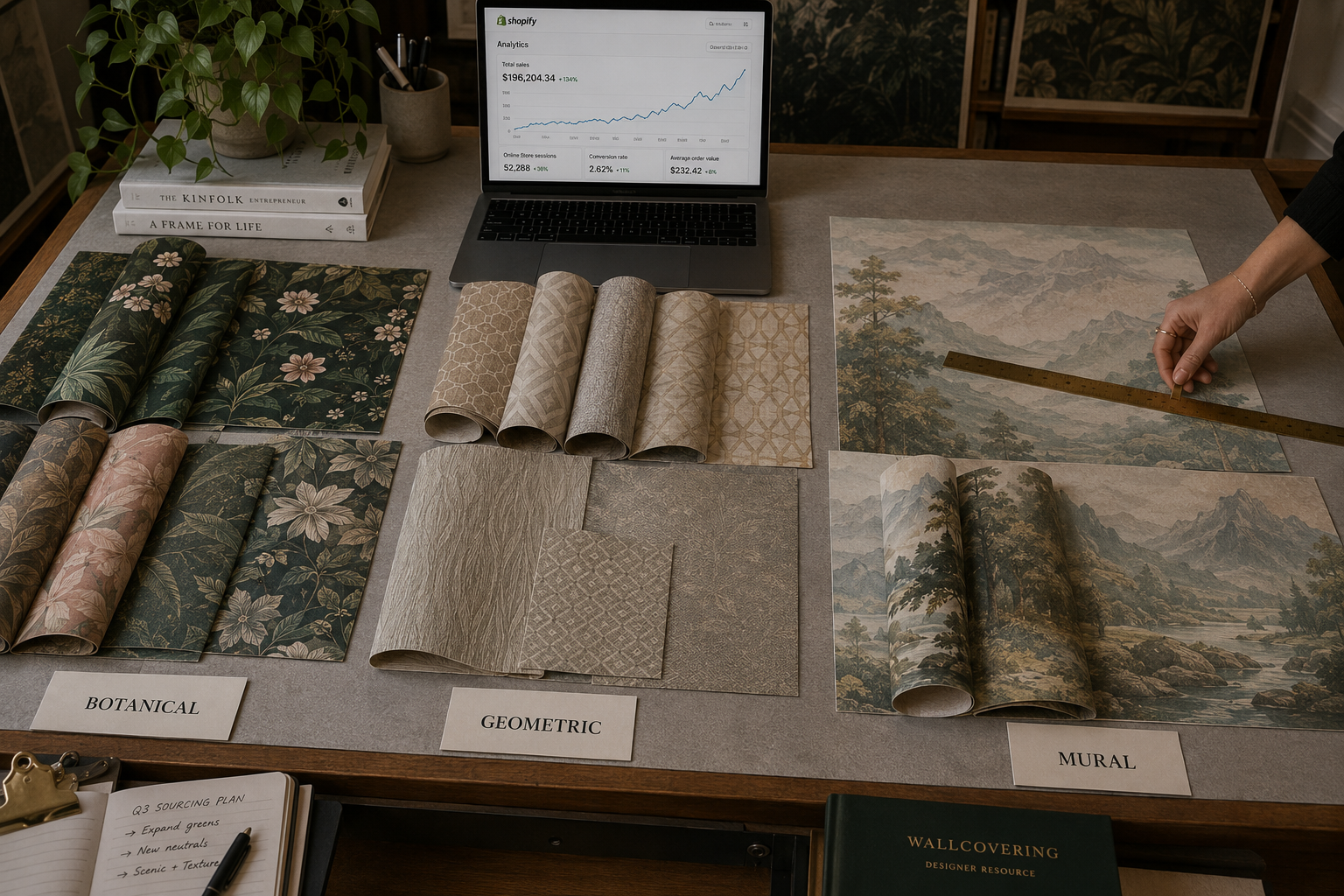
How to Source Botanical, Geometric, and Mural Wallpaper in Bulk for Your Design Business
B2B pricing

How to Source Botanical, Geometric, and Mural Wallpaper in Bulk for Your Design Business

This article gives interior designers, home stagers, and studio founders a 2026 bulk sourcing framework for the three highest-velocity wallpaper categories in design business sourcing: botanical, g...

En savoir plus
How to Source Botanical, Geometric, and Mural Wallpaper in Bulk for Your Design Business
B2B pricing

How to Source Botanical, Geometric, and Mural Wallpaper in Bulk for Your Design Business

This article gives interior designers, home stagers, and studio founders a 2026 bulk sourcing framework for the three highest-velocity wallpaper categories in design business sourcing: botanical, g...

En savoir plus