Papier peint pelable et autocollant pour hôtes Airbnb : Comment s'approvisionner, fixer les prix et rafraîchir votre propriété entre les séjours des clients
En 2026, le marché d'Airbnb est plus concurrentiel que jamais.
Alors que le taux d'occupation moyen aux États-Unis oscille entre 50 et 54 %, les propriétés qui se distinguent par leur tarif journalier moyen (ADR) et leurs scores d'évaluation ne sont pas celles qui proposent les prix les plus bas. Ce sont celles qui sont photogéniques, bien conçues et qui se démarquent nettement d'un appartement meublé générique. Un mur d'accent fort est l'un des moyens les plus rapides et les moins chers de créer cette distinction. Et le papier peint pelable et adhésif est le seul format qui vous permet de le rafraîchir entre les séjours des clients sans faire appel à un entrepreneur.
Ce guide est destiné aux hôtes Airbnb et aux gestionnaires de locations saisonnières qui recherchent un cadre pratique pour l'approvisionnement et la tarification, et non une inspiration de design générique. Nous aborderons la manière d'évaluer un fournisseur B2B de papier peint, les coûts réels pour un portefeuille multi-propriétés, et comment utiliser les cycles de rafraîchissement de design comme levier de réservation et de revenus.
Partie 1 · Le modèle économique
Pourquoi le design mural a-t-il un impact mesurable sur les revenus d'Airbnb ?
Il ne s'agit pas de théorie esthétique, mais de données de réservation. L'analyse du marché d'Airbnb en 2026 montre constamment que la qualité du design a une relation directe et mesurable avec l'ADR et le taux d'occupation. Les chiffres à comprendre :
10–25 % augmentation de l'ADR grâce à un design intérieur intentionnel dans les marchés américains concurrentiels
11,2 % pouvoir de tarification supplémentaire par augmentation d'un point du score d'évaluation des clients
22 % augmentation du taux de clics sur les annonces présentant des éléments visuels locaux ou distinctifs
64 % de revenus annuels supplémentaires pour les Superhôtes par rapport aux hôtes standards (Airbnb, 2024)
Le mécanisme est simple. Les décisions des clients sont prises en 3 à 5 secondes de navigation photo. Un mur d'accent mémorable — le bon motif botanique dans la chambre, une fresque géométrique derrière le canapé — crée ce moment qui arrête le défilement et transforme un chercheur en réservateur. Une fois le client sur place, le même élément de design influence le langage de l'évaluation qui justifie votre tarif la saison prochaine.
Pour un contexte plus approfondi sur la manière dont l'algorithme d'Airbnb pondère la qualité des annonces et l'expérience des clients, le Centre de ressources Airbnb pour les hôtes fournit des conseils fiables sur les facteurs qui influencent la visibilité des annonces et la performance des réservations, directement depuis la plateforme.
Partie 2 · Le calcul des coûts pour les exploitants de locations saisonnières
Combien coûte réellement un rafraîchissement adhésif pour un portefeuille ?
La comparaison des coûts pertinente pour un hôte Airbnb n'est pas entre le papier peint pelable et adhésif et le papier peint traditionnel. C'est entre le papier peint pelable et adhésif et la peinture – car la peinture est l'option de rafraîchissement par défaut que la plupart des exploitants utilisent entre les baux. Voici comment le calcul se décompose réellement pour un mur d'accent de chambre standard (environ 9,3 à 11,1 m²) :
Rafraîchissement par la peinture
• Matériaux : 40 $ à 80 $ (peinture de qualité supérieure + apprêt)
• Main-d'œuvre : 200 $ à 400 $ (peintre professionnel, minimum 1 pièce / demi-journée)
• Temps d'arrêt : 24 à 48 heures de séchage avant l'accès des clients
• Résultat : Mur neutre – même aspect que toutes les autres locations
Rafraîchissement avec du papier peint pelable et adhésif
• Matériaux (prix de gros B2B) : 120 $ à 280 $ pour un mur d'accent de 9,3 à 11,1 m²
• Main-d'œuvre : 0 $ — installable soi-même en 2 à 4 heures, aucun spécialiste requis
• Temps d'arrêt : 0 heure — l'adhésif est immédiat ; la pièce est prête à accueillir les clients le jour même
• Résultat : Moment visuel distinctif qui se photographie bien pour la mise à jour de l'annonce sans coût supplémentaire
Calcul du portefeuille : Un exploitant gérant 8 Airbnb qui rafraîchit les murs d'accent chaque année dépense environ 2 400 $ à 4 800 $ en peinture et main-d'œuvre par cycle. Le même rafraîchissement en papier peint auto-adhésif coûte 960 $ à 2 240 $ en matériaux, sans frais de main-d'œuvre et avec un délai d'exécution le jour même. L'impact sur le design est catégoriquement différent dans les photos d'annonce.
Le coût de retrait est l'endroit où l'avantage du papier peint pelable et adhésif se multiplie sur plusieurs cycles. Le retrait professionnel du papier peint traditionnel à la colle coûte de 0,60 $ à 3,00 $ par pied carré en main-d'œuvre – soit 60 $ à 360 $ par mur d'accent, à chaque cycle, avant le début de la prochaine installation. Le papier peint auto-adhésif de qualité se décolle à la main en 15 à 30 minutes sans endommager le mur et sans main-d'œuvre professionnelle.
Partie 3 · Comment s'approvisionner en produits adaptés
Que devraient rechercher les hôtes Airbnb chez un fournisseur de papier peint B2B ?
Le papier peint grand public est conçu pour une seule installation. Une propriété Airbnb peut subir 3 à 5 cycles de rafraîchissement de design sur cinq ans, avec 150 à 200 nuitées de clients par an. C'est une exigence de durabilité matériellement différente, et la plupart des produits grand public ne sont pas conçus pour cela.
Voici la liste de contrôle d'évaluation des fournisseurs qui compte pour l'approvisionnement en locations saisonnières (STR) :
|
Ce qu'il faut vérifier |
Pourquoi c'est important pour Airbnb |
Réponse « feu vert » |
|
Échantillon physique en 48 heures |
Test l'adhérence réelle sur votre mur |
Expédition sous 48 heures, sans excuses |
|
Test d'humidité adhésive |
Salles de bain + vapeur = risque de décollement des bords |
|
|
Tolérance de couleur ΔE (≤2,0) |
Cohérence multi-pièces |
Spécification écrite fournie |
|
Production en un seul lot |
Même couleur d'une pièce à l'autre |
Confirmé par commande |
|
Données de retrait à 12-24 mois |
Protège les murs entre les baux |
Retrait propre documenté |
|
Photos / contenus inclus |
Vous avez besoin de photos accrocheuses pour vos annonces |
Inclus dans le forfait B2B, pas un extra |
|
0 MOQ / petit lot disponible |
Tester avant de s'engager sur 15 pièces |
Un seul rouleau ou 0 MOQ confirmé |

Le test d'échantillons en 48 heures
Avant de passer une seule commande en gros, demandez des échantillons physiques à chaque fournisseur que vous évaluez. Installez-les dans une propriété réelle — idéalement sur le mur adjacent à la salle de bain, celui qui est le plus exposé à l'humidité. Laissez-les pendant deux à trois semaines, pendant une occupation normale par des clients. S'il y a un décollement des bords, des bulles ou un défaut d'adhérence pendant cette période, vous aurez identifié le problème avant qu'il ne se produise dans 15 pièces.
Un fournisseur qui ne peut pas expédier un échantillon physique dans les 48 heures suivant votre demande a déjà démontré quelque chose d'important concernant sa préparation opérationnelle. Chez jiffdiff, les échantillons sont expédiés sous 48 heures en standard — parce qu'un acheteur qui a touché le produit prend de meilleures décisions d'approvisionnement, et cela protège les deux parties de la relation.
Partie 4 · Stratégie de conception pour la performance des locations saisonnières
Quels designs génèrent réellement des réservations – et à quelle fréquence faut-il rafraîchir ?
Tous les designs de papier peint ne sont pas égaux dans la photographie d'annonces Airbnb. Les motifs qui retiennent l'attention et incitent à la réservation en 2026 présentent des caractéristiques visuelles spécifiques, et ils sont différents de ce qui est beau dans un showroom.
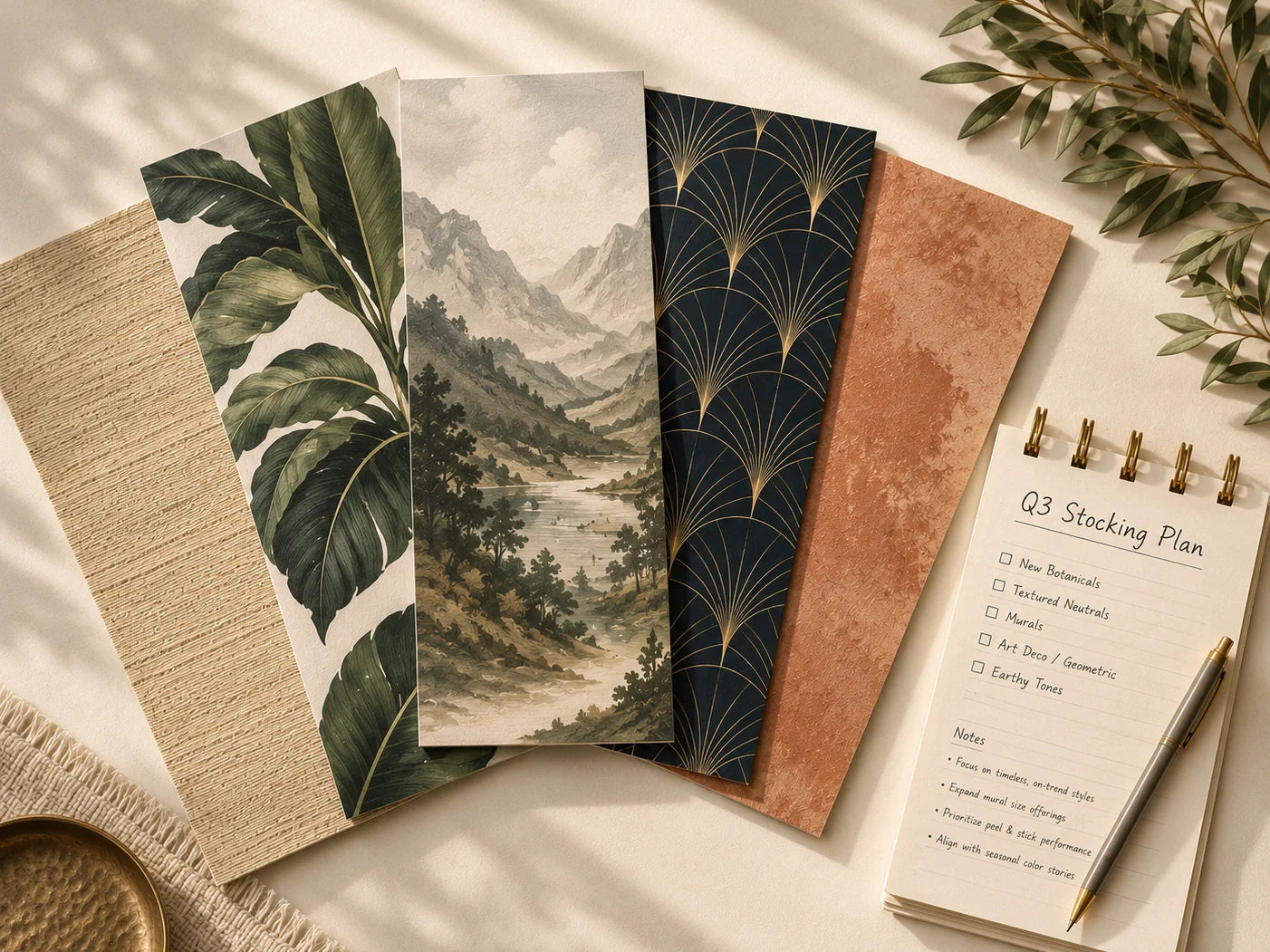
Designs photogéniques et générateurs de réservations
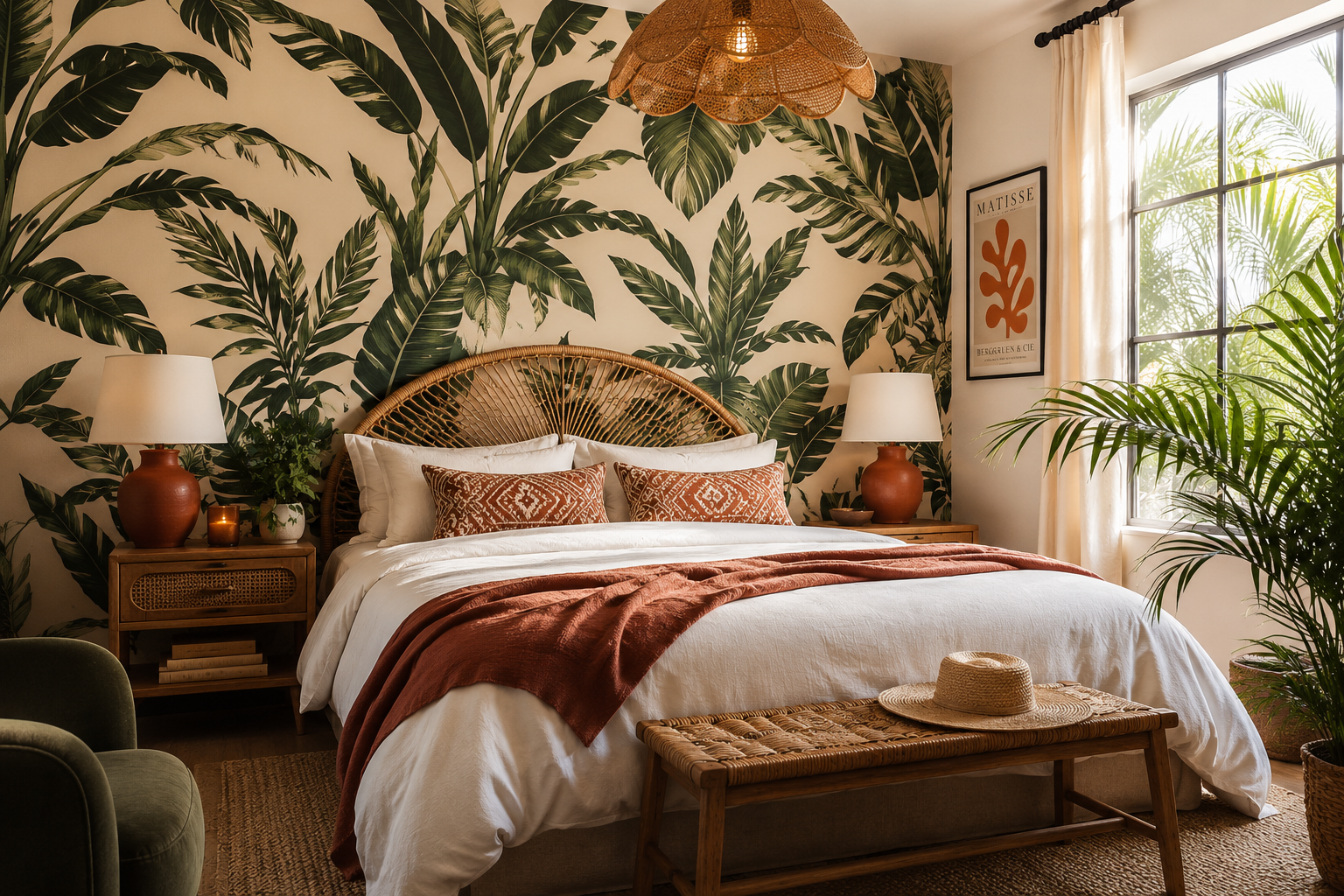
• Botanique / floral (grande échelle) : Contraste visuel élevé dans les photos d'annonces ; communique « ce n'est pas une location générique ». Fonctionne dans les chambres et les salons. La catégorie la plus performante dans les données de design STR pour 2025-2026.
• Géométrique (bleu sarcelle, terre cuite, sauge) : Fort impact architectural sur des angles plus larges ; fonctionne dans les salons et les salles à manger où le mur entier est souvent dans le cadre.
• Texturé / aspect herbe tissée : Ajoute une richesse tactile qui communique la qualité dans les gros plans ; donne une impression de « design » plutôt que de « fait maison » dans les photos d'annonces.
• Mural / format de mur d'accent : Un seul panneau accrocheur derrière le lit ou le canapé ; l'amélioration la plus simple et la plus percutante avec le retour sur investissement le plus clair en termes de performance des photos d'annonces.
Fréquence de rafraîchissement : Le cycle idéal pour les locations saisonnières
La plupart des consultants en design de locations saisonnières recommandent un cycle de rafraîchissement visuel de 12 à 18 mois pour les propriétés à forte occupation, non pas parce que le papier peint se détériore, mais parce que la fraîcheur des photos d'annonces est corrélée à la visibilité de l'algorithme sur la plateforme. Une nouvelle photo principale génère un pic de clics qui se traduit directement par des réservations.
Le modèle pratique : conserver le thème de design principal pendant 12 à 18 mois, puis rafraîchir un ou deux points visuels clés (le mur d'accent de la chambre, le panneau décoratif du salon) avec un nouveau motif. Le coût total d'un rafraîchissement de design ciblé – un à deux murs – est de 200 à 500 $ en matériaux au prix de gros B2B. La mise à jour de la photo d'annonce est gratuite. L'impact sur les réservations est mesurable en 30 jours.
Important pour les exploitants multipropriétés : commandez tous les rouleaux pour une seule propriété du même lot de production. La cohérence des couleurs d'une pièce à l'autre est importante pour les propriétés qui accueillent des groupes – les clients qui dorment dans des chambres différentes remarqueront si le même design semble différent sur des murs différents. Confirmez la production en un seul lot par écrit avant toute commande en volume.
FAQ — Ce que demandent les hôtes Airbnb
Foire aux questions sur le papier peint pelable et adhésif pour les propriétés de location à court terme
Extraites de Reddit (r/airbnbhosts, r/ShortTermRentals, r/realestateinvesting) et des principales requêtes de recherche Google sur le design d'intérieur et l'approvisionnement en papier peint pour les locations à court terme.
Q : Le papier peint pelable et adhésif tiendra-t-il réellement avec des invités qui vont et viennent ?
Oui — un papier peint auto-adhésif de qualité à dos en tissu ou en vinyle épais résiste bien à un trafic normal de clients ; le mode de défaillance est toujours une erreur d'installation ou une préparation de mur incompatible, et non la qualité du produit en utilisation normale.
Q : Comment enlever le papier peint pelable et adhésif sans endommager les murs de la location ?
Décollez lentement à un angle bas de 15 à 30 degrés, chauffez les bords tenaces avec un sèche-cheveux à basse température et ne déchirez jamais — les adhésifs PSA de qualité se retirent proprement des cloisons sèches peintes sans arracher la peinture lorsqu'ils sont retirés correctement.
Q : Est-il sûr de poser du papier peint pelable et adhésif dans une salle de bain ou une zone très humide ?
Des variantes spécifiquement formulées et résistantes à l'humidité peuvent fonctionner près des salles de bain ; vérifiez toujours que le fournisseur a testé l'adhérence à plus de 65 % d'humidité relative, et évitez d'installer directement sur des murs en contact avec des éclaboussures d'eau.
Q : Quelle quantité de papier peint est nécessaire pour un mur d'accent de chambre Airbnb standard ?
Un mur d'accent de chambre standard de 3,6 mètres de long avec un plafond de 2,4 mètres de haut nécessite environ 9,3 à 11,1 mètres carrés de papier peint ; ajoutez 10 à 15 % pour l'ajustement des motifs et les chutes, et commandez toujours à partir du même lot.
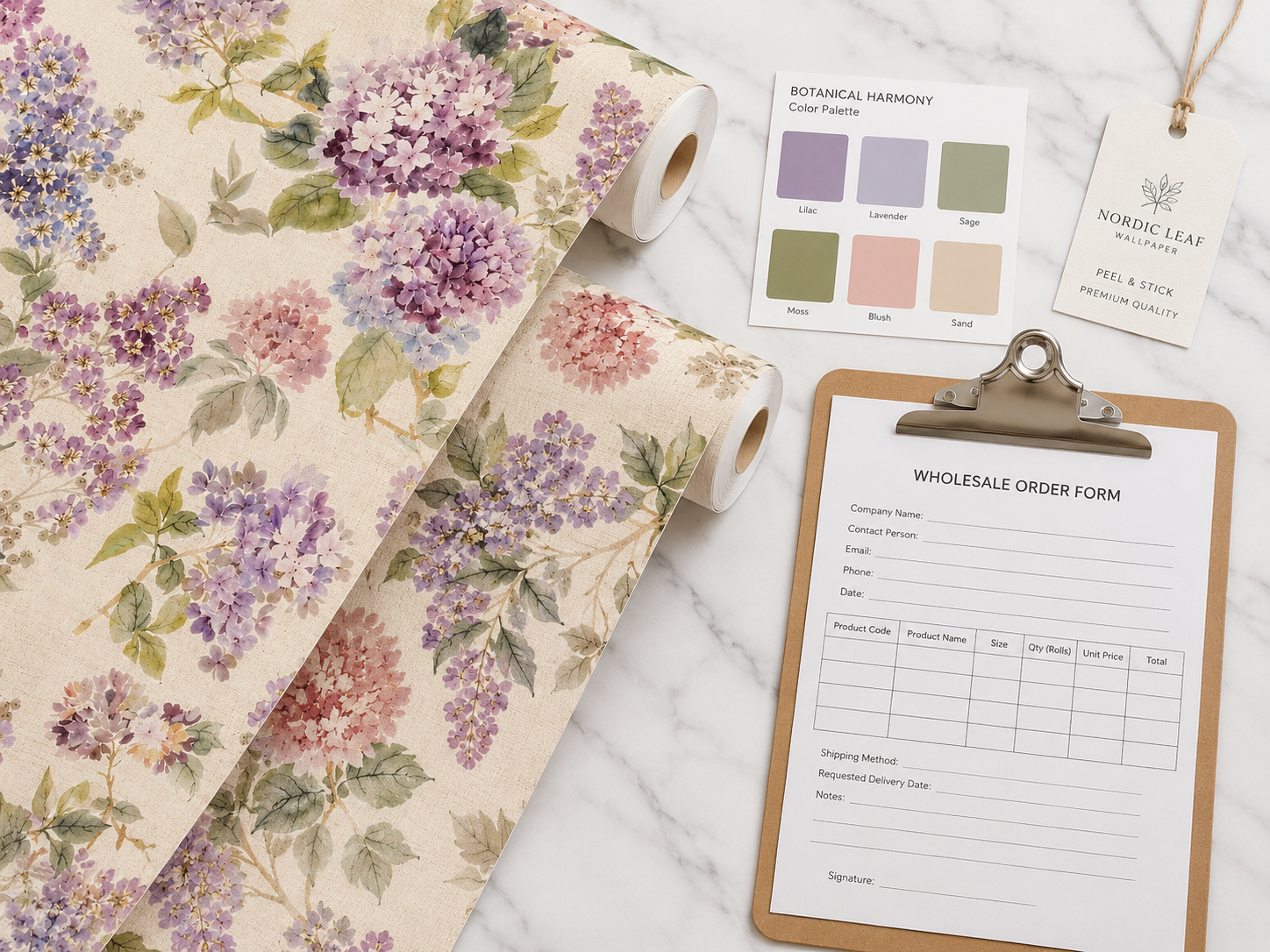
Q : Où les hôtes Airbnb s'approvisionnent-ils en papier peint autocollant en gros ?
Les fabricants B2B offrant un échantillonnage sans quantité minimale de commande, un délai de 48 heures pour les échantillons physiques et une production constante par lot sont la norme à rechercher ; évitez les détaillants grand public pour tout approvisionnement multi-unités, car les prix et la constance des lots sont tous deux inférieurs.
Q : À quelle fréquence dois-je rafraîchir mon papier peint Airbnb ?
Le papier peint autocollant de qualité supérieure dure 5 à 7 ans dans des conditions de location à court terme normales, mais la plupart des hôtes expérimentés rafraîchissent les murs d'accent tous les 12 à 18 mois pour maintenir les photos de l'annonce à jour et la visibilité de l'algorithme sur la plateforme.
Q : Puis-je utiliser du papier peint autocollant dans une propriété locative sans l'autorisation du propriétaire ?
Cela dépend entièrement de votre bail ; la plupart des papiers peints amovibles n'endommagent pas les murs lors du retrait, mais vérifiez toujours votre contrat de location et envisagez de documenter l'installation avant et après avec des photos.

Laisser un commentaire
Ce site est protégé par hCaptcha, et la Politique de confidentialité et les Conditions de service de hCaptcha s’appliquent.