Top 5 fournisseurs de papier peint autocollant en gros en 2026
Évalué pour les acheteurs B2B : ce que chaque type fournit réellement
Publié : Mai 2026 Auteur : Équipe de renseignement sur l’approvisionnement JIFFDIFF
Pour : Designers d'intérieur · Home Stagers · Marques de commerce électronique · Opérateurs STR
La recherche d’un fournisseur de papier peint autocollant en gros en 2026 donne des centaines de résultats et presque aucune différenciation utile.
Chaque fournisseur promet une livraison rapide, une excellente qualité et des prix compétitifs. Les fournisseurs qui répondent à leurs propres affirmations sont une liste beaucoup plus courte. Pour les home stagers qui développent une trousse de produits, les designers d'intérieur qui cherchent à ajouter une gamme de produits de marque privée ou les acheteurs au détail qui s'approvisionnent pour un catalogue, la différence entre un bon et un mauvais partenaire de fabrication ne se manifeste pas dans le discours, mais au moment où l'échantillon arrive avec trois semaines de retard, la couleur ne correspond pas à l'épreuve numérique, ou il n'y a pas de photographie de produit incluse pour votre annonce.
Ce guide ne classe pas les marques spécifiques par leur nom. Au lieu de cela, il répertorie les cinq types de fournisseurs distincts opérant sur ce marché actuellement, ce que chacun d'entre eux livre réellement en pratique, à qui chacun convient véritablement, et les critères d'évaluation que les acheteurs B2B professionnels utilisent pour évaluer tout partenaire avant d'engager des capitaux. À la fin, vous saurez exactement quel type de fournisseur correspond à votre modèle commercial – et quoi demander avant de commander un seul rouleau.
Partie 1 · Le cadre de sélection
Quels critères chaque acheteur B2B devrait-il utiliser pour évaluer un fournisseur ?
Avant de cartographier les cinq types de fournisseurs, il est utile d’établir ce que « vérifié » signifie réellement pour un acheteur B2B dans cette catégorie. Les critères ci-dessous sont ceux que les acheteurs en gros expérimentés — et non les débutants — utilisent pour prendre des décisions d’approvisionnement. Ce sont également les critères pour lesquels les fournisseurs sont le plus souvent en deçà de leurs propres affirmations marketing.
Selon le guide de Shopify pour trouver des fournisseurs en gros, les caractéristiques d'un partenaire B2B fiable incluent des niveaux de prix transparents, une qualité de produit vérifiable, une communication réactive et la capacité d'évoluer avec votre entreprise — des normes qui s'appliquent également à l'approvisionnement en papier peint, quel que soit le canal ou la catégorie.
Les 8 critères qui séparent les véritables partenaires B2B des promesses marketing
• Rapidité de l'échantillon (cible : 48 heures). Le délai d'exécution d'un échantillon par un fournisseur est un test en direct de l'ensemble de son infrastructure opérationnelle. S'il faut deux semaines pour envoyer un échantillon, il faudra six semaines pour exécuter une commande en gros.
• Flexibilité du MOQ. Les vrais partenaires B2B prennent en charge un MOQ de 0 ou faible pour la validation initiale, puis augmentent le volume. Des exigences de MOQ élevées et rigides avant toute étape d'échantillonnage indiquent un fabricant optimisé pour les clients à volume, et non pour les marques en croissance.
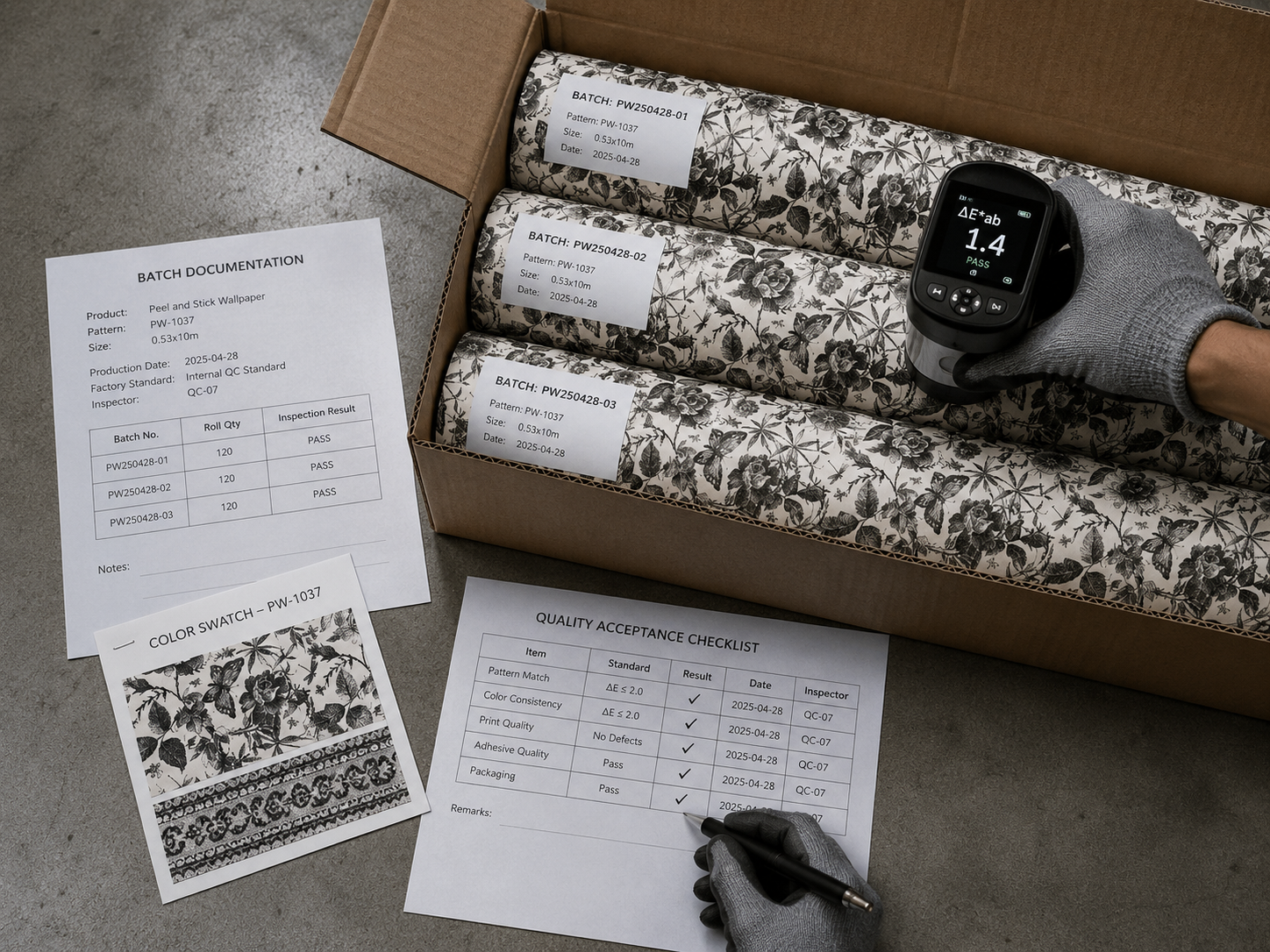
• Cohérence des lots de couleurs (ΔE ≤ 2,0). Demandez la spécification documentée de la tolérance de couleur. Sans cela, vous acceptez des variations visuelles à chaque nouvelle commande — un problème qui s'aggrave sur les projets multi-pièces et les travaux pour des clients récurrents.
• Actualité du design (plus de 100 nouvelles SKU/mois). Pour les catégories sensibles aux tendances, un catalogue statique est un inconvénient. Les fournisseurs qui vous aident à rester à jour sont ceux qui mettent à jour leurs bibliothèques de designs mensuellement.
• Livraison de contenu. La photographie de produits stylisée, les rendus spatiaux, les guides de tailles et la documentation d'installation doivent être livrés avec le produit, et non vendus séparément ou laissés à la charge de l'acheteur.
• Capacité de marque privée / OEM. Pour les designers et les stagers qui construisent une marque, la capacité d'étiqueter le produit sous leur propre nom, de conserver la propriété intellectuelle et de personnaliser l'emballage est une exigence de base, et non un ajout haut de gamme.
• Documentation de certification. Conformité aux COV, GREENGUARD ou équivalent, ASTM E84 pour les spécifications commerciales — disponible sur demande, et non soumise à un processus de vente.
• Taux de livraison à temps (cible : 100 %, documenté). Demandez le taux et la source des données. Les assurances verbales ne constituent pas une spécification.
Partie 2 · Les 5 types de fournisseurs — Ce que chacun livre réellement
Quel type de fournisseur en gros correspond à votre modèle B2B ?
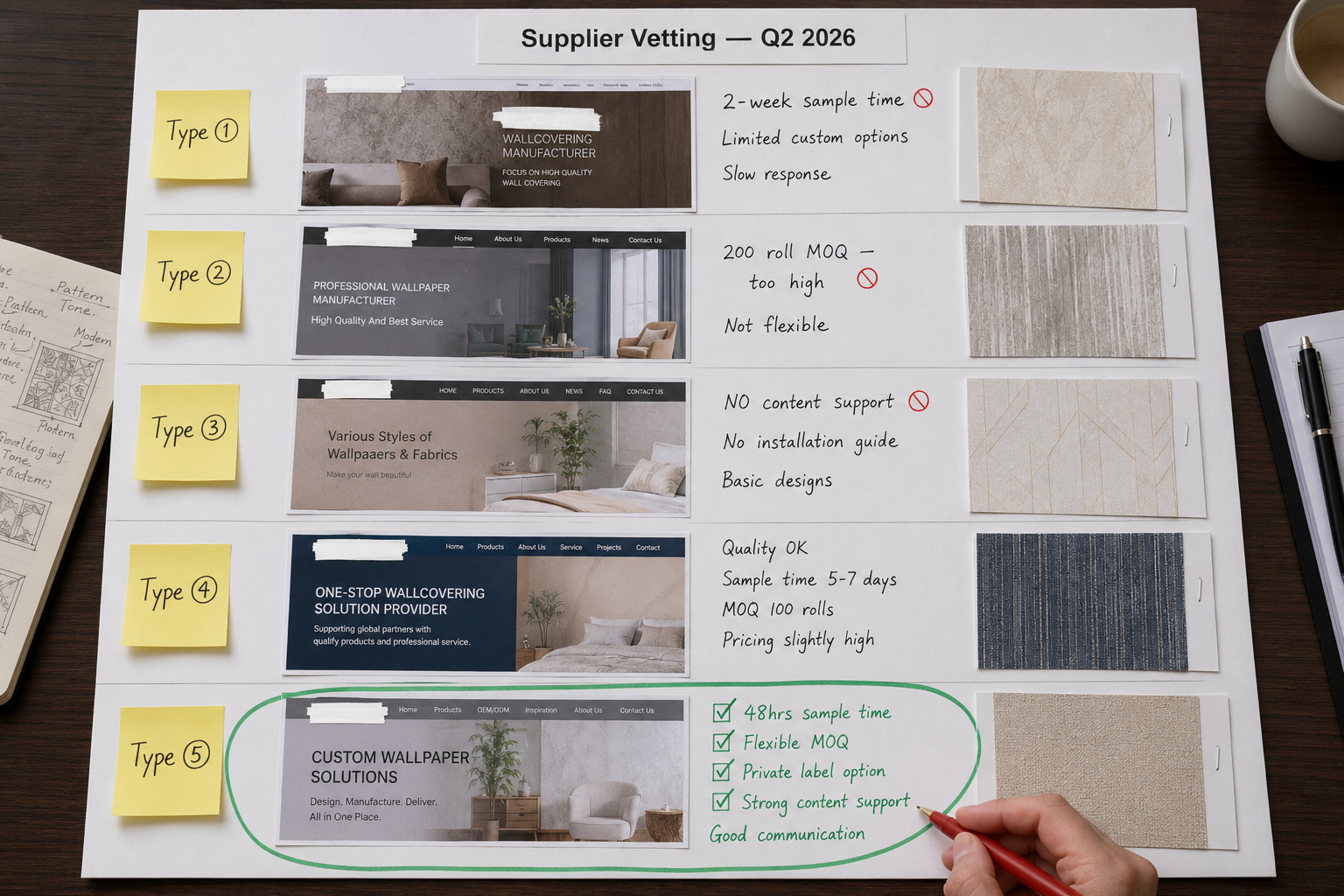
Le marché des papiers peints autocollants en gros en 2026 compte cinq archétypes de fournisseurs distincts. Comprendre chacun d'eux permet d'éviter l'erreur d'approvisionnement la plus courante : choisir un fournisseur dont le modèle ne correspond pas à vos besoins commerciaux réels, puis découvrir l'inadéquation six semaines après le début d'un projet.
|
Type de fournisseur |
MOQ |
Rapidité d'échantillonnage |
Contenu |
Idéal pour |
|
① Fabricant B2B à service complet |
0–Faible |
48 heures ✅ |
Inclus ✅ |
Tous les segments B2B |
|
② Impression à la demande |
0 |
3–5 jours |
Minime |
Personnalisation ponctuelle |
|
③ Distributeur commercial |
50–200 |
1–2 semaines |
Aucun |
Réapprovisionnement du stock |
|
④ Vente en gros Alibaba |
200–500 |
2–4 semaines |
Aucun |
Jeu purement tarifaire |
|
⑤ Hybride POD + OEM |
0–100 |
3–7 jours |
Partiel |
Constructeurs de marques DTC |
① Fabricant B2B à service complet — La norme professionnelle
C’est le type de fournisseur que la plupart des acheteurs B2B sérieux recherchent et le plus difficile à trouver. Un fabricant à service complet contrôle la conception, la production, le contrôle qualité, l’emballage et la livraison de contenu à partir d’un système intégré unique. Les caractéristiques déterminantes sont : une livraison d’échantillons physiques en moins de 48 heures, une tolérance de couleur ΔE documentée, une mise à l’échelle de la production de 0 au volume, une capacité OEM/ODM et une livraison de contenu parallèlement au produit.
L'infrastructure de conception est aussi importante que l'infrastructure de fabrication pour ce type de fournisseur. Une équipe de conception interne de 12 personnes générant plus de 100 nouvelles SKU par mois signifie qu'un acheteur B2B ne sera jamais confronté au problème de décalage de tendance qui accompagne l'approvisionnement à partir d'un catalogue statique. La bibliothèque de motifs est toujours à jour, les couleurs reflètent les données esthétiques réelles du marché américain, et de nouveaux designs sont disponibles pour validation avant qu'ils n'atteignent leur apogée sur le marché général.
Délais de livraison : échantillon physique en 48 heures. Production personnalisée en 15 jours à partir de la confirmation de commande. Livraison à temps documentée à 100 %. C'est le type qui prend en charge les home stagers, les designers d'intérieur, les acheteurs au détail et les marques de commerce électronique à tout volume — d'un simple rouleau de test à une série complète de catalogues de marque privée.
C'est le modèle JIFFDIFF. Près de 20 ans d'expérience sur le marché américain, une équipe de conception interne de 12 personnes, une capacité d'usine à la porte sur l'ensemble de la chaîne de production, et un programme de partenariat B2B conçu pour les marques à chaque étape — du premier rouleau de marque privée d'un designer au catalogue saisonnier d'un détaillant national. Tout ce qui est décrit dans ce type est ce que nous livrons, spécifiquement.
② Fournisseur d'impression à la demande (POD) — Idéal pour les commandes personnalisées uniques
Les fournisseurs POD produisent des rouleaux individuels à la demande — pas de commande minimum, production immédiate, livrés directement au client final. Pour un designer qui a besoin d'une seule impression murale personnalisée pour un projet client, ce modèle est vraiment utile. Pas d'inventaire, pas d'engagement initial, grande flexibilité de format.
Les limites pour l'approvisionnement en gros B2B sont significatives. La production POD est optimisée pour la vitesse d'impression, pas pour l'ingénierie de produit : les systèmes adhésifs sont généralement de qualité standard, la cohérence des lots n'est pas une exigence conçue (puisque chaque commande est une seule exécution), et il n'y a pas d'infrastructure pour la marque privée, l'emballage de marque ou la livraison de contenu. Pour un professionnel du design qui construit une ligne de produits ou un décorateur qui a besoin d'un produit cohérent sur plusieurs propriétés, le POD crée plus de problèmes qu'il n'en résout.
Limitation du POD pour les stagers professionnels : si vous vous procurez le même design pour six projets clients différents, vous recevrez six lots de couleurs potentiellement différents issus de six tirages distincts. Sur une seule installation, c'est gérable. Sur un projet multi-pièces, ou sur un portefeuille de propriétés mises en scène, la variation de lot est visible et a un impact sur votre travail professionnel.
③ Distributeur commercial — Réapprovisionnement fiable, personnalisation limitée
Les distributeurs commerciaux agissent comme des intermédiaires en matière de stocks — ils achètent auprès des fabricants en volume, entreposent les produits et les vendent aux acheteurs B2B avec une marge. La proposition de valeur est l'immédiateté : les produits sont expédiés dans les 1 à 5 jours ouvrables à partir du stock de l'entrepôt, sans délai de production nécessaire.
Les limites sont structurelles. Les distributeurs commerciaux ont un catalogue fixe qui reflète ce que le fabricant a choisi de produire — pas nécessairement ce que vos clients veulent en 2026. La personnalisation, la marque privée et la capacité OEM sont généralement indisponibles. L'actualité du design dépend entièrement de la fréquence à laquelle le fabricant met à jour le catalogue du distributeur. Et le prix comprend la marge du distributeur en plus de celle du fabricant, ce qui affecte votre capacité à être compétitif au détail.
Idéal pour : les acheteurs B2B expérimentés qui savent exactement quels designs spécifiques ils ont besoin et qui commandent des SKU éprouvés, plutôt que d'en découvrir de nouveaux.
④ Fabricant grossiste Alibaba — Leader en matière de prix, qualification requise
L'approvisionnement direct en usine via Alibaba offre le prix unitaire le plus bas du marché, généralement entre 3 et 12 $ par rouleau en volume. Pour les acheteurs qui comprennent le processus d'approvisionnement, peuvent vérifier les usines de manière indépendante et sont prêts à gérer eux-mêmes le contrôle qualité et la logistique, les aspects économiques peuvent être convaincants.
La charge de qualification est réelle. La plupart des usines sur Alibaba sont optimisées pour la production de masse de produits de base, et non pour le service à faible MOQ, axé sur le design et le contenu, dont les acheteurs B2B du secteur de la décoration intérieure ont réellement besoin. Les MOQ commencent généralement à 200-500 rouleaux par design. Des délais d'échantillonnage de 2 à 4 semaines sont courants. La cohérence des couleurs est irrégulière lors des réapprovisionnements, à moins que vous n'ayez les ressources nécessaires pour effectuer votre propre processus de contrôle qualité. Et il n'y a pas de contenu, pas de conception d'emballage et pas d'infrastructure de support de marque.
Idéal pour : les importateurs expérimentés dotés de capacités internes de contrôle qualité qui s'approvisionnent en designs de produits de base en grandes quantités, où le prix est la variable de décision principale.

Partie 3 · Faire correspondre le type de fournisseur à votre profil d'entreprise
Quel type de fournisseur vous convient le mieux là où vous en êtes ?
Le bon fournisseur n'est pas le meilleur fournisseur dans l'absolu — c'est celui dont le modèle opérationnel correspond à votre étape commerciale actuelle, à votre profil client et à votre volume. Voici la correspondance directe.
|
Votre profil |
Ce dont vous avez besoin d'un fournisseur |
Type de fournisseur idéal |
|
Home stager, 1 à 10 propriétés |
Faible MOQ, échantillons rapides, actualité du design |
① Fabricant B2B à service complet |
|
Architecte d'intérieur, travail sur projet |
Couleur personnalisée, échantillons en 48h, clarté de la propriété intellectuelle |
① Fabricant B2B à service complet |
|
Marque DTC / boutique Shopify |
0 MOQ, éléments de contenu, option dropship |
① ou ⑤ Hybride |
|
Acheteur de détail, chaîne de magasins |
Prix de volume, cohérence des lots, marque privée |
① Fabricant B2B à service complet |
|
Opérateur Airbnb / STR, 5 à 20 unités |
Prix de gros, APS durable, rafraîchissement rapide |
① ou ③ Distributeur |
|
Client unique de fresque murale sur mesure |
Impression unique, pas de MOQ, toutes dimensions |
② Impression à la demande |
Un exemple pratique : L'architecte d'intérieur qui développe une gamme de produits
Une architecte d'intérieur avec 3 ans d'expérience client, une esthétique reconnaissable, et des clients réguliers qui demandent où acheter les pièces qu'elle spécifie. Elle souhaite lancer 6 designs de papier peint sous marque privée — 3 botaniques, 2 géométriques, 1 format fresque murale — sous le nom de son studio.
Le bon type de fournisseur : Fabricant B2B à service complet. Elle a besoin d'échantillons physiques en 48 heures pour tester les designs dans les espaces clients réels avant de s'engager. Elle a besoin d'une clarté de la propriété intellectuelle sur ses couleurs personnalisées. Elle a besoin d'un emballage de marque sous le nom de son studio. Elle a besoin de photographies de produits livrées avec le produit — pas d'une séance photo séparée à organiser et à financer. Elle a besoin d'un MOQ de 0 pour la validation initiale et d'une production en 15 jours lorsqu'une commande est confirmée.
Le mauvais type de fournisseur : tous les autres. Un fournisseur d'impression à la demande ne peut garantir la cohérence des lots pour ses projets clients. Un distributeur commercial ne peut pas faire de marque privée. Alibaba ne peut pas fournir le soutien de contenu ou la collaboration de design dont elle a besoin. L'hybride ne peut pas fournir d'adhésif de qualité commerciale et de documentation d'installation. Seul le fabricant à service complet couvre tout.
La conviction fondatrice de JIFFDIFF : la marque d'un designer ne devrait pas nécessiter une relation d'usine, une équipe logistique ou un investissement en stock à six chiffres pour être lancée. Le bon partenaire de fabrication rend la première collection sous marque privée aussi réalisable que la spécification d'un meuble — juste avec votre nom dessus, et l'infrastructure pour réapprovisionner quand ça se vend.
Partie 4 · L'appel de vérification du fournisseur en 10 minutes
Quelles sont les 5 questions qui révèlent tout ce que vous devez savoir dès la première conversation ?
Avant toute demande d'échantillon, avant toute conversation sur les prix, posez ces cinq questions. Les réponses révéleront le type de fournisseur avec lequel vous traitez réellement — quelle que soit la description de leur site web.
• « Pouvez-vous envoyer un échantillon physique dans les 48 heures ? » Si la réponse est oui et qu'ils s'y conforment, vous avez affaire à une opération B2B mature. Si la réponse implique des qualifications, des délais ou des frais d'échantillon, vous avez affaire à un fabricant optimisé pour la production qui ne priorise pas le service B2B.
• « Quelle est votre tolérance de couleur ΔE documentée par lot ? » Un fournisseur qui comprend cette question et a une réponse écrite opère à un niveau professionnel. Celui qui répond « nos couleurs sont très précises » ne gère pas la couleur comme une spécification de production.
• « Incluez-vous la photographie de produit et le contenu avec vos commandes B2B ? » La réponse est oui ou non. Toute élaboration sur ce qui est disponible à l'achat séparément est un non. Un fournisseur qui comprend que le contenu fait partie du produit pour les acheteurs e-commerce et de mise en scène le fournit par défaut.
• « Pouvez-vous prendre en charge la marque privée, et qui possède la propriété intellectuelle du design ? » Écoutez la spécificité : oui à la marque privée est une évidence. La question de la propriété intellectuelle sépare les fournisseurs qui ont réfléchi à la relation avec la marque de ceux qui ne l'ont pas fait.
• « Quel est votre taux de livraison à temps documenté ? » « Nous livrons toujours à temps » n'est pas un taux documenté. Un chiffre avec une source de données l'est. S'ils ne peuvent pas répondre avec un chiffre, ils ne le suivent pas, ce qui vous dit tout sur leur discipline opérationnelle.
Les réponses à ces cinq questions vous diront si vous parlez à un Fabricant à service complet de Type ①, ou à l'un des quatre autres. La bonne réponse aux cinq questions est : oui à l'échantillon physique en 48 heures, spécification ΔE écrite, contenu inclus, marque privée prise en charge avec clarté de la propriété intellectuelle, et un taux de livraison documenté spécifique. Si vous obtenez les cinq bonnes réponses, passez à l'échantillonnage.
Partie 5 · FAQ — Réponses spécifiques qui mettent fin à la recherche
Foire aux questions : Fournisseurs de papier peint peel and stick en gros
Tiré de Reddit (r/ecommerce, r/smallbusiness, r/InteriorDesign, r/dropship, r/Entrepreneur) et des requêtes Google les plus volumineuses sur la vérification des fournisseurs de papier peint B2B.
Q : Où les architectes d'intérieur se procurent-ils du papier peint auto-adhésif en gros ?
Le canal d'approvisionnement le plus performant pour un usage B2B professionnel est un fabricant à service complet offrant un MOQ de 0 ou faible, des échantillons physiques en 48 heures, un support OEM/marque privée et une livraison de contenu — et non des distributeurs commerciaux (prix plus élevés, pas de personnalisation) ou Alibaba (MOQ élevé, pas de contenu, contrôle qualité incohérent).
Q : Quelle est la quantité minimale de commande pour le papier peint auto-adhésif en gros ?
La norme B2B professionnelle en 2026 est un MOQ de 0 pour la validation d'échantillons et les tests en petites séries, avec une tarification au volume débloquée à partir de 50 à 200 rouleaux ; tout fournisseur exigeant plus de 500 rouleaux avant l'étape d'échantillonnage n'est pas configuré pour le segment des acheteurs de marques en croissance.
Q : Comment vérifier la qualité d'un fournisseur de papier peint en gros avant de commander ?
Demandez un échantillon physique (pas une épreuve numérique) livré à votre porte dans les 48 heures, demandez la spécification documentée de la tolérance de couleur ΔE, installez l'échantillon dans un espace réel, effectuez un test d'adhérence de 7 jours, et évaluez à la fois la qualité du produit et le temps de réponse de la communication — ce dernier est un indicateur de fiabilité opérationnelle.
Q : Que dois-je rechercher chez un fournisseur de papier peint en marque privée ?
Clarté de la propriété intellectuelle du design (vos fichiers restent les vôtres), emballage de marque inclus dans le programme B2B, cohérence des lots pour les réapprovisionnements (spécification ΔE écrite), livraison de contenu avec le produit, et capacité OEM/ODM avec un faible MOQ — si l'une de ces conditions n'est pas confirmée avant la première commande, la promesse de marque privée est incomplète.
Q : Est-il sûr de s'approvisionner en papier peint auto-adhésif sur Alibaba pour le B2B ?
Pour les importateurs expérimentés dotés de capacités de contrôle qualité internes commandant des designs de produits de base en volumes de plus de 200 rouleaux, les prix d'Alibaba peuvent fonctionner ; pour les décorateurs d'intérieur, les designers d'intérieur ou les marques DTC qui ont besoin de nouveauté de design, d'actifs de contenu, de marque privée et de cohérence des lots, les lacunes opérationnelles sont importantes et coûtent généralement plus cher à compenser que les économies de prix ne le justifient.
Q : Combien de temps faut-il pour la production de papier peint en gros, de la commande à la livraison ?
La référence B2B professionnelle est de 15 jours ouvrables de la confirmation de commande à l'expédition pour une production personnalisée ; tout délai supérieur à 30 jours indique des contraintes de capacité ou une mauvaise gestion du flux de travail — confirmez toujours le délai documenté et le taux de livraison à temps avant de vous engager sur un calendrier de projet.
Q : Les fournisseurs de papier peint en gros fournissent-ils des photographies de produits ?
Les meilleurs fabricants à service complet incluent la photographie de produit stylisée, les rendus spatiaux, les guides de taille et la documentation d'installation en standard dans le package de livraison B2B ; les distributeurs commerciaux et les usines Alibaba ne fournissent généralement ni l'un ni l'autre — laissant à l'acheteur le soin de financer sa propre photographie, ce qui ajoute 500 $ à 2 000 $ en coûts de lancement par UGS.
Q : Quelles certifications dois-je exiger d'un fournisseur de papier peint en gros ?
Minimum : documentation de conformité aux COV et GREENGUARD ou équivalent pour la qualité de l'air intérieur ; pour les spécifications commerciales : classement au feu ASTM E84 Classe A ou B ; pour le positionnement écologique : certification des matériaux FSC ou équivalent — demandez toujours les rapports d'essai originaux délivrés par le laboratoire, et non les références marketing aux certifications.

Laisser un commentaire
Ce site est protégé par hCaptcha, et la Politique de confidentialité et les Conditions de service de hCaptcha s’appliquent.