How to Find a Reliable Removable Wallpaper Factory in China
The factory exists. The website looks professional. The catalog is beautiful. Then the first order arrives six weeks late, the colors don't match the digital sample, and the 'flexible MOQ' turns out to mean 300 rolls minimum — per colorway.
Sourcing a peel and stick wallpaper factory from China is one of the highest-leverage decisions a home stager, interior designer, or product brand can make — and one of the most frequently made wrong. Not because Chinese manufacturing is unreliable. China produces the vast majority of the world's premium self-adhesive wall coverings and is home to manufacturing capabilities that don't exist anywhere else at comparable price points. The problem is the gap between the factories who can genuinely serve a growing B2B buyer and those optimized entirely for high-volume commodity production that has no room for design collaboration, content support, or the kind of service relationship that builds a brand.
This guide is the sourcing framework that experienced B2B buyers use: the right questions, the red flags that surface in the first conversation, the vetting stages that protect your investment before a single bulk order is placed, and the specific operational benchmarks that separate a partner worth committing to from one that will cost you time and credibility.

Part 1 · Why China — and Why It's More Complex Than It Looks
What Makes China the Right Source — and Where Does Sourcing Go Wrong?
China accounts for the majority of global peel and stick wallpaper production for structural reasons that have nothing to do with price alone: concentrated manufacturing clusters in Guangdong, Zhejiang, and Hubei provinces have developed integrated supply chains for substrate materials, adhesive chemistry, digital printing, and packaging that simply don't exist at comparable scale anywhere else. The best Chinese factories combine 15–20 years of manufacturing experience with design infrastructure, quality control systems, and U.S. market export knowledge that a buyer couldn't replicate by diversifying to other regions.
The complexity is on the service side, not the manufacturing side. According to the International Trade Administration — the U.S. Department of Commerce's official export and sourcing resource — the most common challenges in China sourcing involve communication gaps, quality control inconsistency, and intellectual property protection. These aren't manufacturing problems. They're partner selection problems. The right factory relationship eliminates all three. The wrong one amplifies them.
The Two Types of China Wallpaper Factory — and Why It Matters
The market contains two fundamentally different factory types operating under similar descriptions:
• Volume-optimized commodity manufacturers: Producing 100,000+ square meters per day for large retail chains and commodity e-commerce. MOQs start at 200–500 rolls per design. Design catalog is static. No content support, no private label infrastructure, no B2B service layer. Fast, cheap, impersonal.
• Design-led B2B manufacturing partners: Producing across the full volume spectrum — from 0 MOQ sampling to full contract production runs — with integrated design teams, quality control documentation, content delivery, and OEM/ODM capability. These factories are fewer in number and require more diligent identification, but they're the ones that build 5–10 year sourcing relationships with growing brands.
The surface-level mistake: assuming a factory's website quality predicts its B2B service capability. Some of the most professionally presented factory sites in this category represent commodity producers who will quote you a 500-roll MOQ after three email exchanges. The vetting process described in Part 2 is what surfaces the difference before you've committed time or capital.

Part 2 · The Vetting Framework
What Questions Actually Reveal Whether a Factory Can Serve Your Business?
The factory vetting process for a design-forward B2B buyer has four stages. Each stage is a filter. The ones who make it through all four are the ones worth building a relationship with.
Stage 1: The First Response Window (Hours 0–24)
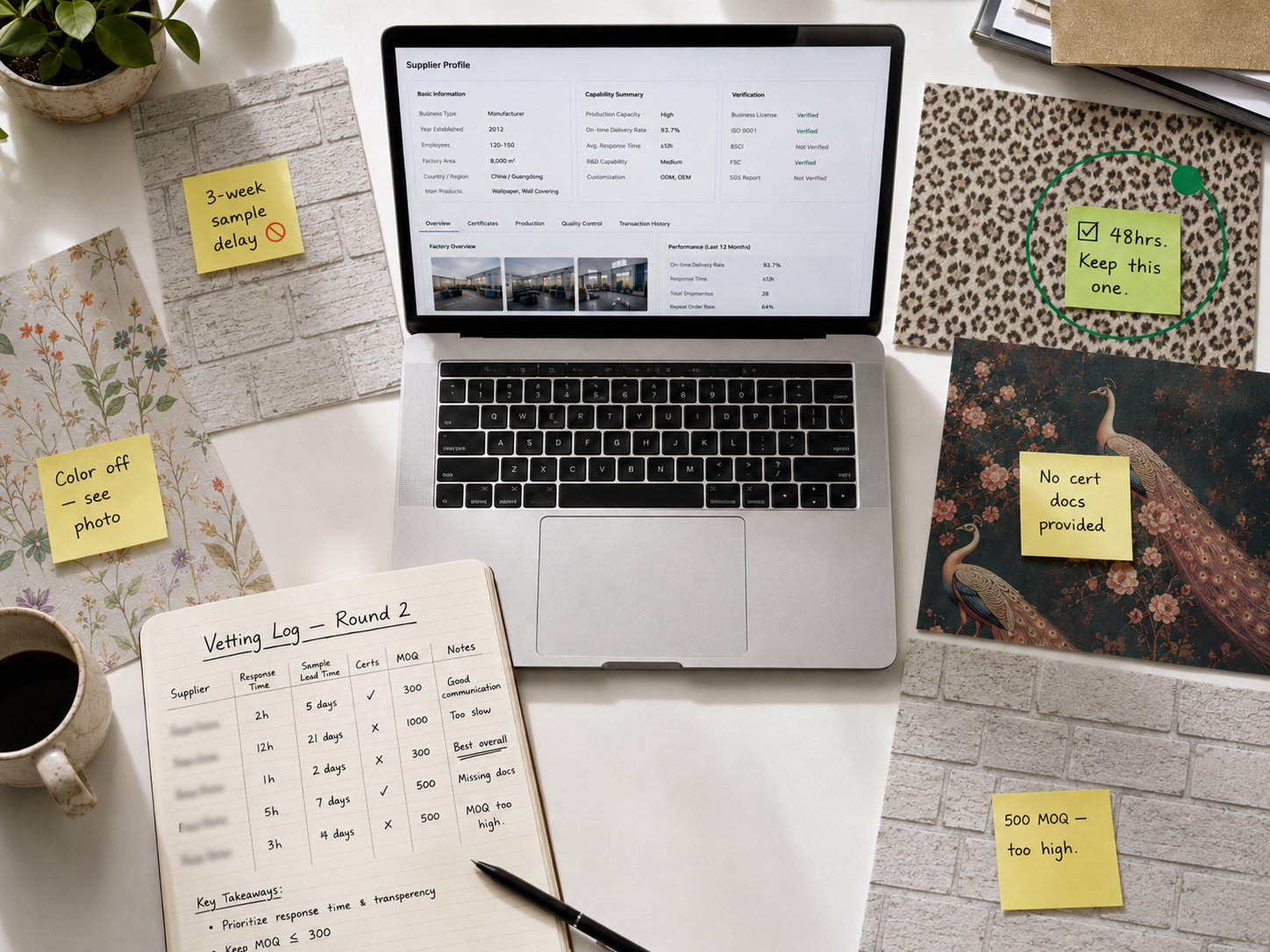
A factory's response time to an initial inquiry is one of the most reliable proxies for their B2B service infrastructure. A commodity producer serving thousands of buyers has little incentive to prioritize a small brand builder's first email. A design-led B2B manufacturer understands that the first response sets the tone for the entire relationship.
Benchmark: a substantive response within 5 hours during their business hours. Not an auto-reply. Not a catalog link. A response that answers your actual questions, asks clarifying questions about your use case, and feels like a person read your message.
Stage 2: The 48-Hour Sample Test
Request a physical sample of a specific design with a specific size requirement. This is not a catalog swatch — it's a roll-format or close-to-roll-format sample of the product you're evaluating. The benchmark is 48-hour ship time from request confirmation.
When the sample arrives, evaluate:
• Color accuracy versus the digital proof — photograph under controlled lighting and compare
• Adhesive performance on your actual wall substrate — install and test for 72 hours
• Substrate quality — weight, texture consistency, and print resolution at normal viewing distance
• Packaging integrity — how the roll arrives reflects the factory's logistics standards
Stage 3: The Documentation Request
After sample approval, request the technical documentation that should accompany any professionally managed product line:
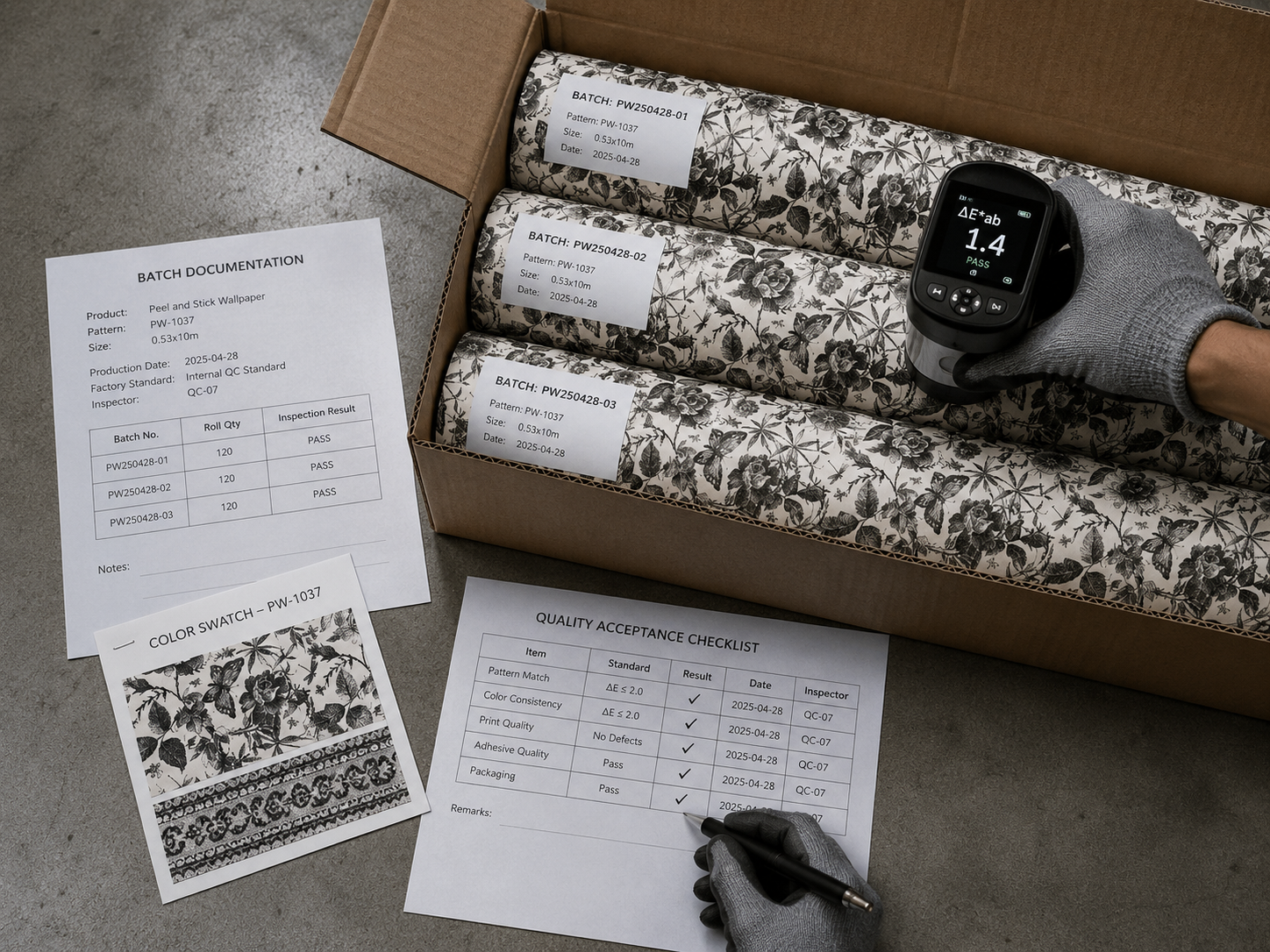
• ΔE color tolerance specification: A written number (ΔE ≤ 2.0 is the professional standard) with a description of the measurement protocol
• GREENGUARD or equivalent VOC certification: Original lab-issued certificate with certificate number, not a general company 'eco-friendly' claim
• ASTM E84 fire rating (if commercial specification): Test report for the specific adhesive-backed product format, not the substrate design alone
• ISO or quality management certification: ISO 9001 confirms documented quality control processes, not just quality claims
Stage 4: The Business Terms Conversation
Before any volume order, the following terms should be in writing — not verbal assurance:
• IP ownership clause: Your design files cannot be used, reproduced, or sold to other buyers without your explicit permission
• MOQ confirmation: The specific MOQ for the specific product configuration you're ordering — not the generic catalog MOQ
• Lead time SLA: '15 business days from order confirmation' is a contract term; '4–6 weeks' is a verbal estimate
• Batch number requirement: All rolls in a single order must carry the same batch number on label and shipping documentation
JIFFDIFF's approach to this conversation: we don't ask buyers to trust us on these points — we document them. Our B2B partner agreements include IP protection, ΔE specifications, lead time SLAs, and batch tracking as standard terms, not negotiated exceptions. Nearly 20 years of manufacturing for U.S. market buyers has made clear that the relationship only works when the expectations are written down.

Part 3 · Red Flag vs. Green Light Reference
What Do Reliable Factories Say — vs. What You Should Walk Away From?
The following table reflects the actual language you'll encounter in supplier conversations. Both columns represent real answers to real questions. The difference between them is the difference between a commodity producer and a B2B manufacturing partner.
|
What You Ask |
�� Red Flag Answer |
✅ Green Light Answer |
|
Send a physical sample? |
'We can arrange it in 2–3 weeks' |
'Ships within 48 hours — confirm your address' |
|
Your ΔE color tolerance? |
'Our colors are very accurate' |
'ΔE ≤ 2.0, documented per batch' |
|
MOQ for first order? |
'Minimum 500 rolls per design' |
'0 MOQ for samples, 50+ for volume pricing' |
|
Who owns the design IP? |
'We keep files for reorder efficiency' |
'Your files are yours — we sign an NDA' |
|
On-time delivery rate? |
'We always deliver on time' |
'100% documented across B2B client base' |
|
Content / photography? |
'We can connect you with a photographer' |
'Styled imagery included in our B2B package' |
|
ASTM / GREENGUARD certs? |
'We can get those if you need them' |
'Test reports available on request today' |
|
Custom production lead time? |
'About 4–6 weeks usually' |
'15 business days from order confirmation' |
The most expensive factory conversation is the one that sounds good, moves fast, and reveals its limitations three weeks after the order is confirmed. Use this table in the first two conversations — not after the sample is approved.
Part 4 · The Complete Pre-Order Vetting Checklist
What Should Be Confirmed Before You Place a First Bulk Order?
This checklist compresses the four stages into a single working document. Every row should be marked confirmed before a volume commitment is made. A gap in any row is a risk you're absorbing — not a detail to resolve after the order is placed.
|
Vetting Stage |
What to Verify |
Why It Protects You |
|
Stage 1: Initial Contact |
Response time under 5 hours |
Proxy for operational discipline |
|
Stage 1: Initial Contact |
Website has real factory imagery, not stock |
Confirms manufacturing identity |
|
Stage 2: Sample Request |
Physical sample arrives within 48 hours |
Live test of logistics capability |
|
Stage 2: Sample Request |
Adhesive lab data available on request |
Confirms product engineering depth |
|
Stage 3: Quality Review |
ΔE tolerance spec in writing |
Protects batch consistency on reorders |
|
Stage 3: Quality Review |
Certifications issued by named 3rd party |
GREENGUARD/ASTM — not self-declared |
|
Stage 4: Business Terms |
IP ownership confirmed in writing |
Prevents design replication to competitors |
|
Stage 4: Business Terms |
Lead time SLA in the contract, not verbal |
Protects project timelines |
|
Stage 5: First Order |
Batch number on label + shipping carton |
Enables reorder color matching |
The MOQ Conversation Done Right
MOQ is the most frequently misrepresented specification in China factory sourcing — and the one that creates the most first-order surprises. The issue isn't that high-MOQ factories are dishonest; it's that their published MOQs often refer to standard catalog designs, not custom colorways, not private label configurations, not your specific substrate and adhesive combination.
The right conversation: 'What is the MOQ for a custom colorway of this design, produced in this substrate, with this packaging?' That's your actual order configuration — and the MOQ for that specific combination may be different from anything published on their website or Alibaba profile.
A factory built for B2B design-led buyers will answer this question specifically and immediately. A volume-optimized factory will redirect you to their standard catalog and quote you a number that has nothing to do with your actual needs.
What JIFFDIFF's 0 MOQ model means in practice: you can order a single roll of any design for sample validation, scale to a test batch of 10–50 rolls with your branding applied, and move to volume production in 15 days from order confirmation. The same factory, the same quality system, the same color management, across every order size. That's what 0 MOQ actually means when it's not a marketing claim.
Part 5 · FAQs — Sourcing From China: Direct Answers
Frequently Asked Questions: Finding a Removable Wallpaper Factory in China
Compiled from Reddit (r/ecommerce, r/smallbusiness, r/Entrepreneur, r/dropship, r/AmazonSeller) and Google's most-searched queries on China factory sourcing for B2B wallpaper buyers.
Q: How do I find a reliable peel and stick wallpaper manufacturer in China?
Start with a 48-hour physical sample test and a documentation request (ΔE spec, certifications, IP terms) — a factory that responds to both within 48 hours and delivers on the sample timeline is demonstrating real B2B service capability; one that deflects either question is not the right partner regardless of how strong their catalog looks.
Q: What is a realistic MOQ from a Chinese wallpaper factory?
Volume-optimized commodity factories typically require 200–500 rolls per design as a first order; design-led B2B manufacturers built for growing brands offer 0 MOQ for sampling and 50–100 rolls for small-batch commercial orders — always confirm the MOQ for your specific product configuration, not the generic catalog minimum.
Q: How long does shipping take from a Chinese wallpaper factory to the US?
Sea freight typically runs 15–25 days port-to-port from major Chinese manufacturing hubs to US ports; air freight is 5–7 days but significantly more expensive per roll — for sample orders, air freight is standard; for volume orders, sea freight is the cost-effective mode and should be factored into your project timelines.
Q: Can a Chinese factory make private label wallpaper with my brand?
Yes — both OEM (your design files, factory produces to spec) and ODM (you select from their catalog and customize colorway/packaging) are standard capabilities at design-led B2B manufacturers; confirm IP ownership in writing before sending any proprietary design files, and require that your colorway is not sold to other buyers.
Q: How do I verify a Chinese wallpaper factory before ordering?
Request a physical sample within 48 hours, ask for the ΔE color tolerance specification and certification documentation, confirm IP terms and lead time SLAs in writing, and verify that all rolls in any order will carry the same batch number — a factory that handles all five of these requests clearly and promptly is demonstrating B2B operational maturity.
Q: Is it safe to source wallpaper from Alibaba?
Alibaba provides access to a wide range of factories but requires the same vetting process as any other channel — Trade Assurance orders provide payment protection, but not quality or service guarantees; treat every Alibaba contact as an unvetted factory until they've passed the four-stage vetting framework regardless of their Gold Supplier status.
Q: What certifications should a Chinese wallpaper factory have?
Minimum: GREENGUARD or equivalent VOC certification for indoor air quality, and ISO 9001 for quality management systems; for U.S. commercial specifications: ASTM E84 fire rating test report for the adhesive-backed product format; always request the original lab-issued documents with certificate numbers, not company-generated summaries.
Q: What is the typical production lead time from a Chinese factory?
15 business days from order confirmation is the professional benchmark for custom production at a well-organized manufacturer; anything quoted as '4–6 weeks' or with significant ambiguity should be converted to a written SLA before order placement — verbal lead time commitments are not binding in any practical sense.

Commenta
Questo sito è protetto da hCaptcha e applica le Norme sulla privacy e i Termini di servizio di hCaptcha.