Quel est le coût réel du papier peint autocollant en gros en 2026 ? (Chiffres réels)
Un papier peint fait plus que couvrir un mur – il renouvelle discrètement l'atmosphère d'un espace.
— JIFFDIFF
La plupart des articles sur les prix de gros du papier peint autocollant vous donnent un chiffre et s'arrêtent là. 5 $ le rouleau. 12 $ le rouleau. 35 $ le rouleau. Les titres varient ; le problème sous-jacent est le même — aucun de ces chiffres ne vous dit ce que vous paierez réellement lorsque l'inventaire arrivera dans votre entrepôt, ce que vous perdrez à cause des incohérences de lots de couleurs, les coûts de production de contenu que vous absorberez séparément, ou ce que votre coût réel par unité deviendra après que les réalités opérationnelles se soient manifestées.
Ce guide est la référence tarifaire honnête pour 2026. Nous couvrirons les prix de gros B2B réels par niveaux de volume et de qualité de produit, les coûts cachés qui déterminent votre coût réel par rouleau (souvent 30 à 50 % plus élevé que le prix unitaire indiqué), ce que chaque niveau de prix offre en termes de substrat, de gestion des couleurs et de support de contenu, et les décisions opérationnelles spécifiques qui protègent votre marge contre les variables de prix que la plupart des acheteurs ne voient pas avant d'être déjà engagés.
Partie 1 · La carte tarifaire réelle — Par volume et niveau de qualité
Quel est le coût réel du papier peint autocollant en gros par rouleau en 2026 ?
En 2026, la catégorie du papier peint autocollant couvre une gamme de prix de 5 à 10 fois selon les niveaux de qualité, avec la plus grande variation cachée dans la même tranche de volume. Un devis « de gros » de 4 $ par rouleau et un de 12 $ par rouleau peuvent être techniquement exacts — ils décrivent simplement des produits fondamentalement différents. Le tableau ci-dessous est la carte tarifaire réelle, organisée par niveau de volume et de qualité, avec les équivalents de détail pour le contexte.
|
Niveau de volume |
Importation générique |
Vinyle standard |
Vinyle premium |
OEM personnalisé |
|
1 rouleau (échantillon) |
s/o (MOQ élevé) |
8 $–14 $ |
15 $–22 $ |
18 $–28 $ |
|
10–49 rouleaux |
s/o |
7 $–12 $ |
12 $–18 $ |
14 $–22 $ |
|
50–199 rouleaux |
3 $–5 $ |
5,50 $–9 $ |
9 $–14 $ |
11 $–17 $ |
|
200–499 rouleaux |
2,50 $–4 $ |
4,50 $–7,50 $ |
7,50 $–11 $ |
9 $–14 $ |
|
500+ rouleaux |
1,80 $–3,20 $ |
3,80 $–6 $ |
6 $–9 $ |
7 $–11 $ |
|
Équivalent au détail |
20 $–28 $ |
30 $–45 $ |
45 $–65 $ |
55 $–95 $ |
Ce que chaque niveau de qualité offre réellement
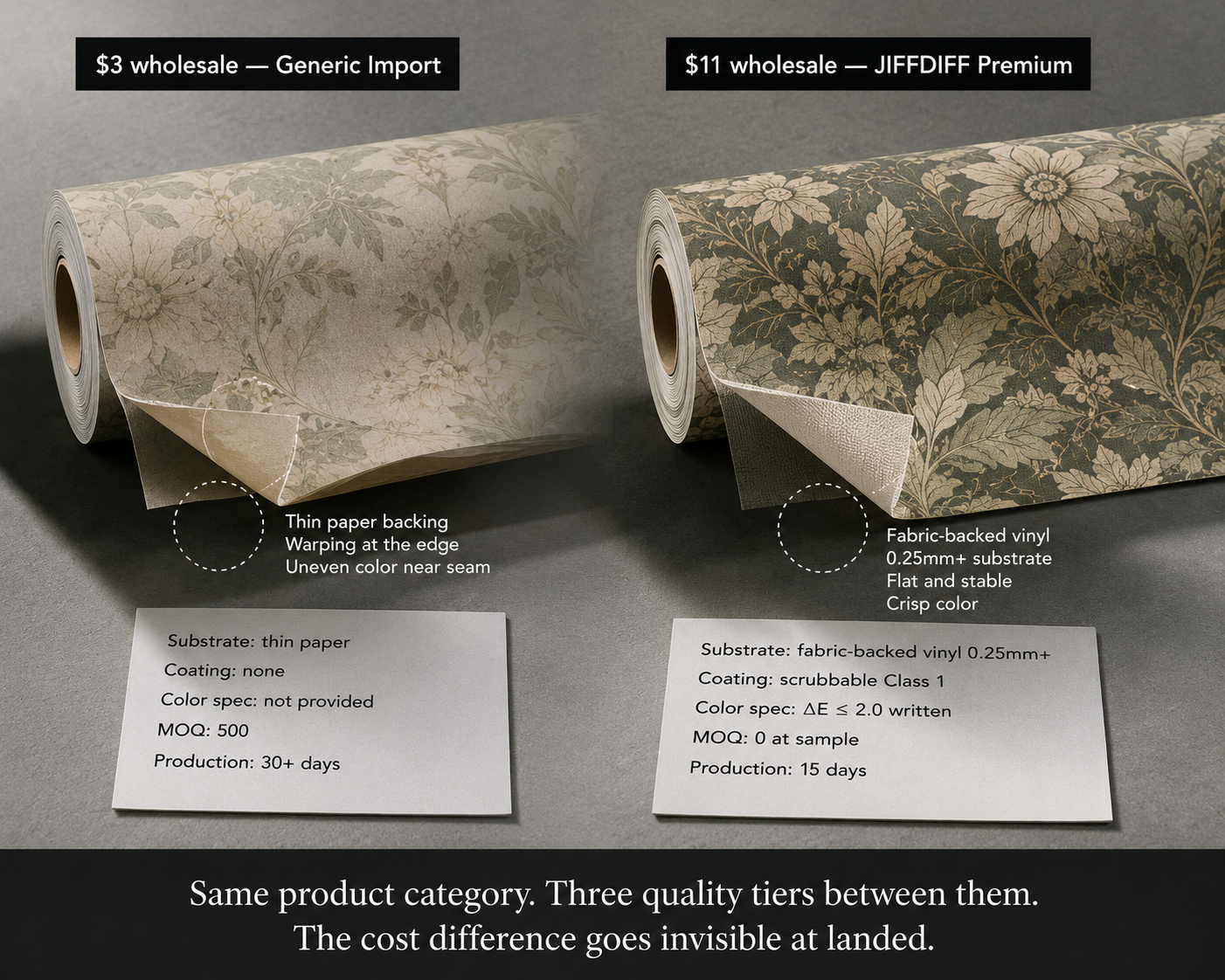
• Importation générique (niveau le plus bas). 1,80 $–5 $ par rouleau à partir de 500 MOQ. Substrat en papier fin ou vinyle de faible qualité, finition non revêtue, aucune spécification de tolérance de couleur, délais d'échantillonnage de 2 à 4 semaines, production de 4 à 6 semaines. Convient aux acheteurs disposant d'une infrastructure de contrôle qualité interne gérant les SKU de produits de base en volume. Les coûts cachés effacent généralement 15 à 25 % des économies par unité par rapport aux options de niveau supérieur.
• Vinyle standard. 3,80 $–14 $ par rouleau selon le volume. Substrat vinyle de poids moyen, revêtement de surface de base, gestion des couleurs au niveau du fournisseur mais variable selon les lots. Courant dans les catalogues B2B destinés aux bricoleurs et aux vendeurs en ligne à fort volume.
• Vinyle premium. 6 $–22 $ par rouleau selon les niveaux de volume. Substrat en vinyle épais ou renforcé de tissu (0,25 mm et plus), revêtement de surface lavable, spécifications de tolérance de couleur ΔE disponibles, livraison de contenu généralement incluse. La spécification B2B professionnelle pour l'aménagement, la décoration intérieure et les marques de détail qui construisent un inventaire durable.
• OEM personnalisé. 7 $–28 $ par rouleau selon les niveaux de volume. Substrat premium avec production entièrement personnalisée, protection de la propriété intellectuelle du design, emballage sous marque privée, production par lots verrouillés et livraison de contenu. Justifie la prime de prix pour les studios et les marques qui construisent des catalogues propriétaires nécessitant l'exclusivité.
Positionnement tarifaire JIFFDIFF
Les prix B2B de JIFFDIFF se situent dans les catégories Vinyle Premium et OEM Personnalisé, car c'est le niveau de spécification qui prend en charge l'approvisionnement des entreprises de vente au détail et de design professionnelles. Le coût unitaire est plus élevé que celui de l'Importation Générique de base — mais le coût total rendu, après avoir tenu compte des catégories de coûts cachés que nous aborderons ensuite, se situe généralement à parité ou en dessous de l'approvisionnement en produits de base, tout en offrant des performances opérationnelles nettement plus solides.
Réalité des volumes : JIFFDIFF B2B prend en charge un MOQ de 0 au stade de l'échantillon, avec des prix de volume débloqués à partir de 50 rouleaux — ce qui est nettement inférieur aux seuils de 500+ rouleaux que la plupart des fournisseurs de niveau premium exigent pour des prix unitaires équivalents. C'est ce qui permet aux studios de design en croissance, aux agenceurs et aux marques DTC d'accéder à des produits de qualité professionnelle avant d'avoir le volume qui les qualifierait auprès de la plupart des autres fabricants.

Partie 2 · Les coûts cachés qui déterminent le coût réel de revient
Pourquoi votre coût réel par rouleau est-il souvent 30 à 50 % plus élevé que le devis de gros ?
Le prix unitaire de gros est le chiffre visible. Le coût de revient est le chiffre réel. L'écart entre les deux détermine si votre stock de papier peint génère une marge ou l'absorbe — et la plupart des acheteurs novices ne voient pas cet écart avant que le premier bon de commande ne soit déjà expédié.
|
Ligne de coût caché |
Impact typique |
Comment minimiser |
|
Fret international |
0,80 $–2,50 $ par rouleau |
Négocier FOB vs CIF ; consolider les expéditions |
|
Droits de douane + dédouanement |
5–8 % sur le coût de revient |
Vérifier l'exactitude du code SH ; éviter les douanes accélérées |
|
Frais de manutention FBA / 3PL |
2 $–5 $ par rouleau livré |
Expédition directe depuis le partenaire B2B pour les petites commandes |
|
Retours dus à une inadéquation de couleur entre l'échantillon et le bon de commande |
Perte de marge de 3–8 % lorsque les lots varient |
Exiger un ΔE ≤ 2,0 écrit + production en lots verrouillés |
|
Retours pour dommages (mauvais emballage) |
1–4 % des commandes |
Confirmer l'emballage protecteur dans les spécifications B2B |
|
Dépenses de contenu / photographie |
500 $–2 000 $ par lancement de SKU |
Choisir un partenaire qui inclut la livraison de contenu |
|
Rupture de stock due à un délai de livraison lent |
Ventes perdues 6–12 % par cycle |
Exiger une production de 15 jours + des échantillons sous 48 heures |
|
Stock immobilisé à rotation lente |
10–30 % du capital immobilisé |
Modèle de micro-lots sans MOQ au lieu de bons de commande en vrac |
L'effet cumulatif — Un exemple réel
Considérons deux bons de commande pour le même produit nominal. L'acheteur A s'approvisionne auprès d'un fournisseur générique de produits de base à 3,20 $/rouleau pour 500 rouleaux. L'acheteur B s'approvisionne auprès d'un partenaire B2B premium à 7,50 $/rouleau pour les mêmes 500 rouleaux. La lecture instinctive : l'acheteur A paie 57 % de moins. Le calcul réel du coût de revient :
• Acheteur A (Importation Générique) : 3,20 $/rouleau × 500 = 1 600 $ + fret 850 $ + droits 135 $ + 3PL 1 250 $ + retours pour non-conformité des couleurs 480 $ + production de contenu propre 2 500 $ + dépréciation de stock immobilisé à rotation lente 400 $ = 7 215 $ au total / 500 = 14,43 $ par rouleau coût réel de revient.
• Acheteur B (B2B Premium avec contenu + verrouillage de lot) : 7,50 $/rouleau × 500 = 3 750 $ + fret 600 $ + droits 200 $ + 3PL 1 000 $ + retours minimes 80 $ + contenu inclus 0 $ + stock immobilisé réduit 150 $ = 5 780 $ au total / 500 = 11,56 $ par rouleau coût réel de revient.
L'écart de prix de gros de 4,30 $ par rouleau se réduit — et s'inverse — une fois que le coût de revient est calculé honnêtement. L'acheteur payant « plus » par rouleau paie en fait 20 % de moins par unité livrée, avec des performances opérationnelles nettement plus solides tout au long du cycle d'inventaire.
C'est la raison mathématique pour laquelle les acheteurs au détail expérimentés s'approvisionnent systématiquement auprès de partenaires B2B professionnels plutôt que d'importateurs de produits de base — et pourquoi les acheteurs novices attirés par le prix unitaire visible le plus bas finissent souvent avec des marges pires que les acheteurs payant des tarifs « premium ».

Partie 3 · Ce qui motive la fourchette de prix — Comprendre votre devis
Quelles spécifications justifient un prix par rouleau plus élevé — et lesquelles ne font qu'ajouter au coût ?
Au sein de n'importe quel niveau de qualité, les devis individuels varient de 15 à 40 % en fonction des spécifications spécifiques du produit. Comprendre quelles spécifications justifient leur surcoût — et lesquelles sont essentiellement un langage marketing superposé à une production similaire — permet à un acheteur d'évaluer les devis intelligemment plutôt que de se contenter du chiffre le plus bas.
Spécifications justifiant un coût plus élevé
• Substrat en vinyle épais (0,25 mm+) ou renforcé par un tissu par rapport à du papier fin ou du vinyle non spécifié. Le substrat détermine la durabilité, la capacité de retrait et les performances en matière d'humidité – les trois facteurs qui influencent le taux de retour, la fréquence de remplacement et les avis des clients.
• Gestion des couleurs calibrée G7 avec une tolérance écrite ΔE ≤ 2.0 par rapport à une précision des couleurs non spécifiée. C'est ce qui élimine les retours pour non-concordance de lot et soutient les marques de vente au détail qui développent un inventaire cohérent.
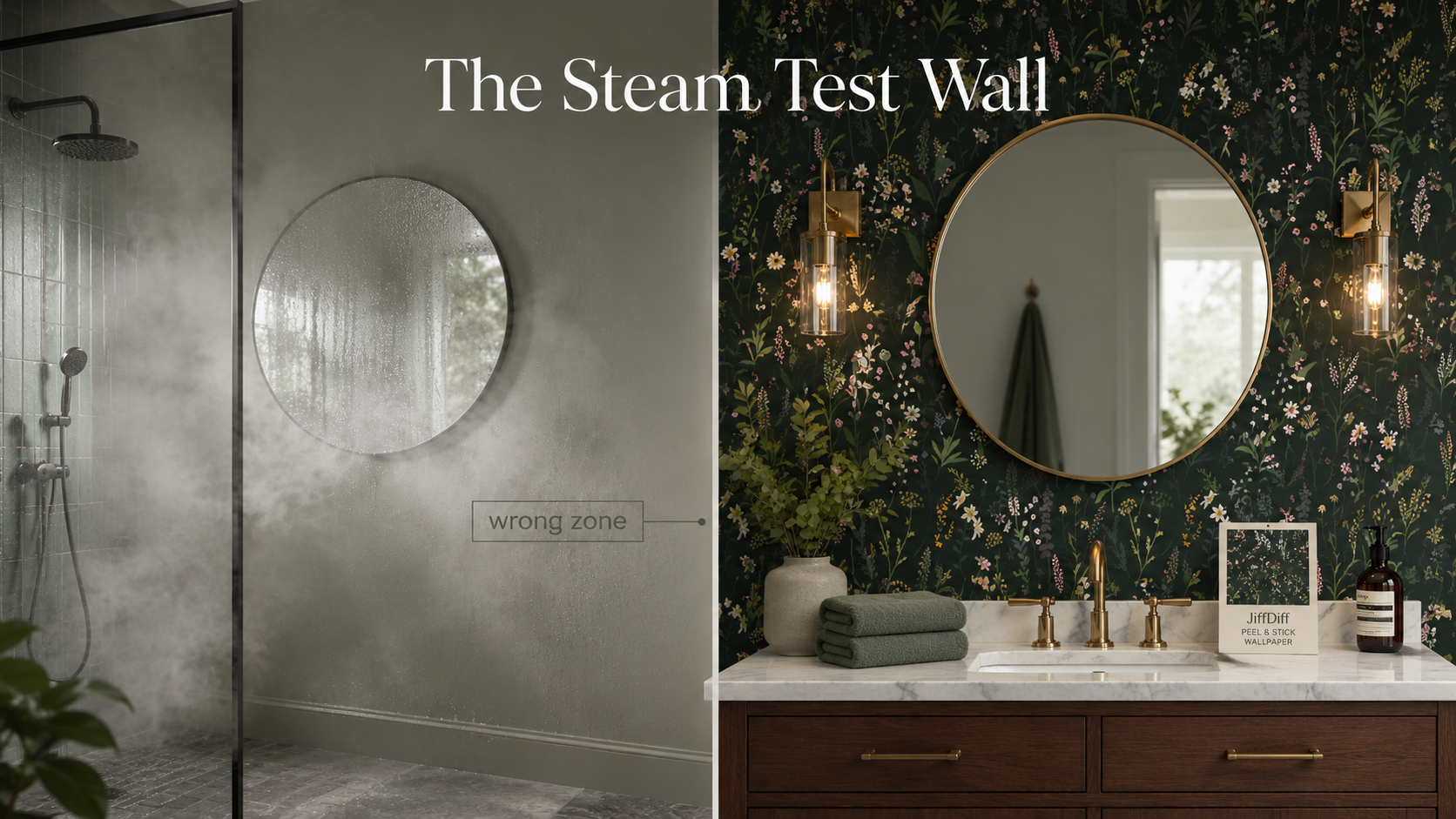
• Adhésif PSA acrylique testé à 65 % d'humidité et plus par rapport à un adhésif générique. La différence se manifeste par le décollement des bords, la séparation des joints et la capacité de retrait – tous des facteurs qui génèrent des plaintes de clients dans les applications sensibles à l'humidité.
• Revêtement de surface lavable de Classe 1 par rapport à une finition mate non revêtue. Requis pour les spécifications commerciales, précieux pour l'usage résidentiel, élimine la décoloration sous un nettoyage standard.
• Livraison de colis de contenu (photos, rendus, documents d'installation) par rapport au produit seul. Ajoute 500 à 2 000 $ de valeur effective par SKU – un contenu qui nécessiterait autrement une production photographique distincte.
Spécifications qui ne justifient pas un prix Premium
• Positionnement « design européen » ou « sélectionné par un designer » sans propriété intellectuelle de design distinctive ou améliorations du substrat. Il s'agit souvent d'un langage marketing superposé à une production comparable.
• Finitions gaufrées ou spéciales qui n'ajoutent pas de valeur fonctionnelle — certains gaufrages sont significatifs (texture 3D pour une profondeur visuelle) ; d'autres sont décoratifs et ajoutent des coûts sans avantage proportionnel.
• Marque premium sans différenciation opérationnelle — si les spécifications opérationnelles sont identiques à celles d'un fournisseur concurrent, le premium de la marque achète de la reconnaissance, pas un meilleur produit.

Partie 4 · Pourquoi la tarification JIFFDIFF est différente
Comment le modèle de tarification de JIFFDIFF se compare-t-il réellement sur la base du coût d'acquisition réel ?
Le modèle de tarification B2B de JIFFDIFF est structuré pour offrir une compétitivité réelle en termes de coût d'acquisition plutôt qu'un devis au prix unitaire le plus bas. Les capacités opérationnelles spécifiques qui se traduisent directement par des coûts cachés inférieurs et une meilleure défense des marges sont les suivantes :
• 0 MOQ au stade de l'échantillon. Testez la qualité du produit au coût d'un seul rouleau avant de vous engager sur le volume — élimine le risque d'inventaire bloqué qui pèse sur l'approvisionnement en gros volumes de produits de base.
• Expédition d'échantillons physiques en 48 heures. Valide l'adéquation du produit avant l'engagement de commande, éliminant ainsi les 30 % et plus des décisions d'approvisionnement B2B qui échouent parce que le produit réel diffère de la représentation du catalogue.
• Production en 15 jours avec 100 % de livraison à temps documentée. Élimine les ventes perdues dues aux ruptures de stock qui effacent 6 à 12 % des revenus par cycle dans les chaînes d'approvisionnement plus lentes.
• Tolérance de couleur écrite ΔE ≤ 2.0 calibrée G7. Élimine le taux de retour pour non-concordance de lot qui coûte aux acheteurs de produits de base 3 à 8 % de marge par an.
• Pack de contenu inclus avec les commandes B2B. Économise entre 500 et 2 000 $ par SKU en coûts de production de contenu que vous financeriez autrement séparément.
• Substrat vinyle renforcé de tissu comme spécification par défaut. Pas une amélioration premium — inclus à chaque niveau de qualité, de l'échantillon à l'OEM sur mesure.
• Accès multi-canal (Amazon Prime, TikTok Shop, B2B Direct). Validez la demande des consommateurs avant de vous engager sur des volumes B2B, éliminant ainsi le coût des erreurs d'assortiment qui immobilisent le capital dans des stocks à faible rotation.
Chez JIFFDIFF, nous croyons qu'un papier peint fait plus que couvrir un mur – il renouvelle discrètement l'atmosphère d'un espace. Pour les acheteurs B2B, cette conviction se traduit par une transparence des prix et une intégrité opérationnelle : nous ne rivalisons pas sur le coût unitaire visible le plus bas ; nous rivalisons sur le coût réel le plus bas. Nous avons commencé avec la conviction que les beaux espaces ne devraient pas être coûteux, compliqués ou inaccessibles – et ce principe s'étend aux acheteurs en gros qui méritent des prix qui reflètent la valeur réelle livrée, et non un langage marketing superposé aux devis unitaires.

Partie 5 · FAQ — Réponses spécifiques qui mettent fin à la recherche
Foire aux questions : Prix du papier peint adhésif pelable en gros
Tiré de Reddit (r/ecommerce, r/smallbusiness, r/wholesale, r/Entrepreneur, r/Shopify) et des requêtes les plus fréquentes de Google sur les prix du papier peint adhésif pelable B2B.
Q : Combien coûte un rouleau de papier peint adhésif pelable en gros en 2026 ?
Les prix de gros authentiques varient de 1,80 $ par rouleau (Importation générique avec un MOQ de 500+) à 28 $ par rouleau (OEM personnalisé au stade de l'échantillon), le vinyle Premium pour un volume B2B standard (50 à 200 rouleaux) se situant généralement entre 9 et 14 $ par rouleau — le bon niveau dépend de votre positionnement commercial, que vous cibliez les clients axés sur la valeur, le marché grand public ou le segment premium.
Q : Quel est le MOQ typique pour le papier peint adhésif pelable en gros ?
Les MOQ varient de 500+ rouleaux pour les usines de vinyle traditionnelles et les fournisseurs d'importation génériques jusqu'à 0 MOQ au stade de l'échantillon avec des partenaires B2B professionnels comme JIFFDIFF ; les seuils de MOQ inférieurs permettent aux entreprises de design en croissance d'accéder à des prix premium sans gros engagements de capitaux initiaux.
Q : Pourquoi le prix par rouleau est-il si différent entre les fournisseurs proposant des produits similaires ?
Le prix unitaire visible ne reflète que le coût de production direct ; le coût réel d'acquisition comprend le fret (5 à 15 % de l'unité), les droits de douane (5 à 8 % de la valeur d'acquisition), la manutention par 3PL/FBA (2 à 5 $/rouleau), les retours pour non-concordance de lot (3 à 8 % de perte de marge), la production de contenu séparée (500 à 2 000 $/SKU) et le risque d'inventaire bloqué — les partenaires B2B premium offrent souvent un coût réel d'acquisition inférieur à celui des fournisseurs de produits de base, malgré des prix unitaires visibles plus élevés.
Q : Comment calculer le coût d'acquisition pour les importations de papier peint adhésif pelable ?
Ajoutez : coût unitaire départ usine + fret international (taux d'expédition FOB) + droits de douane (généralement 5 à 8 % sur la valeur débarquée) + frais de dédouanement + manutention entrepôt/3PL + réserve pour retours (3 à 8 % pour les problèmes de couleur/qualité) + production de contenu si non inclus + coût en capital de l'inventaire bloqué — ce total divisé par les unités livrées est votre coût réel par rouleau, souvent 30 à 50 % supérieur au devis de gros.
Q : Quelle est la différence de prix entre le papier peint vinyle « Generic Import », « Standard » et « Premium » ?
L'importation générique (1,80 à 5 $/rouleau) utilise un substrat papier fin ou vinyle non spécifié sans gestion des couleurs ; le vinyle standard (4 à 14 $) utilise un vinyle de poids moyen avec un revêtement de base et une consistance de lot variable ; le vinyle premium (6 à 22 $) utilise un vinyle de 0,25 mm+ renforcé de tissu avec gestion des couleurs G7, tolérance ΔE ≤ 2,0, surface lavable et livraison de colis de contenu — le niveau détermine les performances opérationnelles, pas seulement le prix.
Q : Puis-je obtenir des prix de gros sur le papier peint adhésif pelable sans un MOQ de plus de 500 rouleaux ?
Oui — les partenaires B2B professionnels comme JIFFDIFF proposent des structures de prix de gros à partir de 0 MOQ pour la validation d'échantillons, avec des niveaux de volume débloqués à 10-50 rouleaux (ODM B2B) et des OEM personnalisés complets à 50-200 rouleaux ; vous n'avez pas besoin de vous engager sur plus de 500 rouleaux pour accéder aux prix B2B pour les niveaux de qualité premium.
Q : Quel pourcentage de mon stock de détail dois-je consacrer au papier peint ?
Pour une ligne de stock de papier peint adhésif pelable visant une marge brute de 55 à 70 %, prévoyez un coût unitaire de 30 à 45 % du prix de détail (incluant le coût d'acquisition et le contenu), la marge restante protégeant contre les retours, les coûts d'acquisition marketing et les frais de plateforme — le niveau de vinyle premium à 9-14 $ en gros supporte un prix de détail de 30-45 $ avec les performances opérationnelles nécessaires pour maintenir cette marge.
Q : Quels prix dois-je prévoir pour des papiers peints muraux adhésifs pelables conçus sur mesure ?
La production de murales OEM sur mesure coûte entre 11 et 28 dollars par rouleau, selon les volumes, avec la possibilité d'échantillons sans MOQ pour la validation de la conception avant de s'engager dans la production ; la prime de prix par rapport aux SKU standards reflète la protection de la propriété intellectuelle du design, la production de fichiers personnalisés, l'appariement des couleurs selon votre cahier des charges et l'emballage sous marque privée — JIFFDIFF prend en charge l'OEM sur mesure avec des échantillons en 48 heures et une production en 15 jours.

Laisser un commentaire
Ce site est protégé par hCaptcha, et la Politique de confidentialité et les Conditions de service de hCaptcha s’appliquent.