
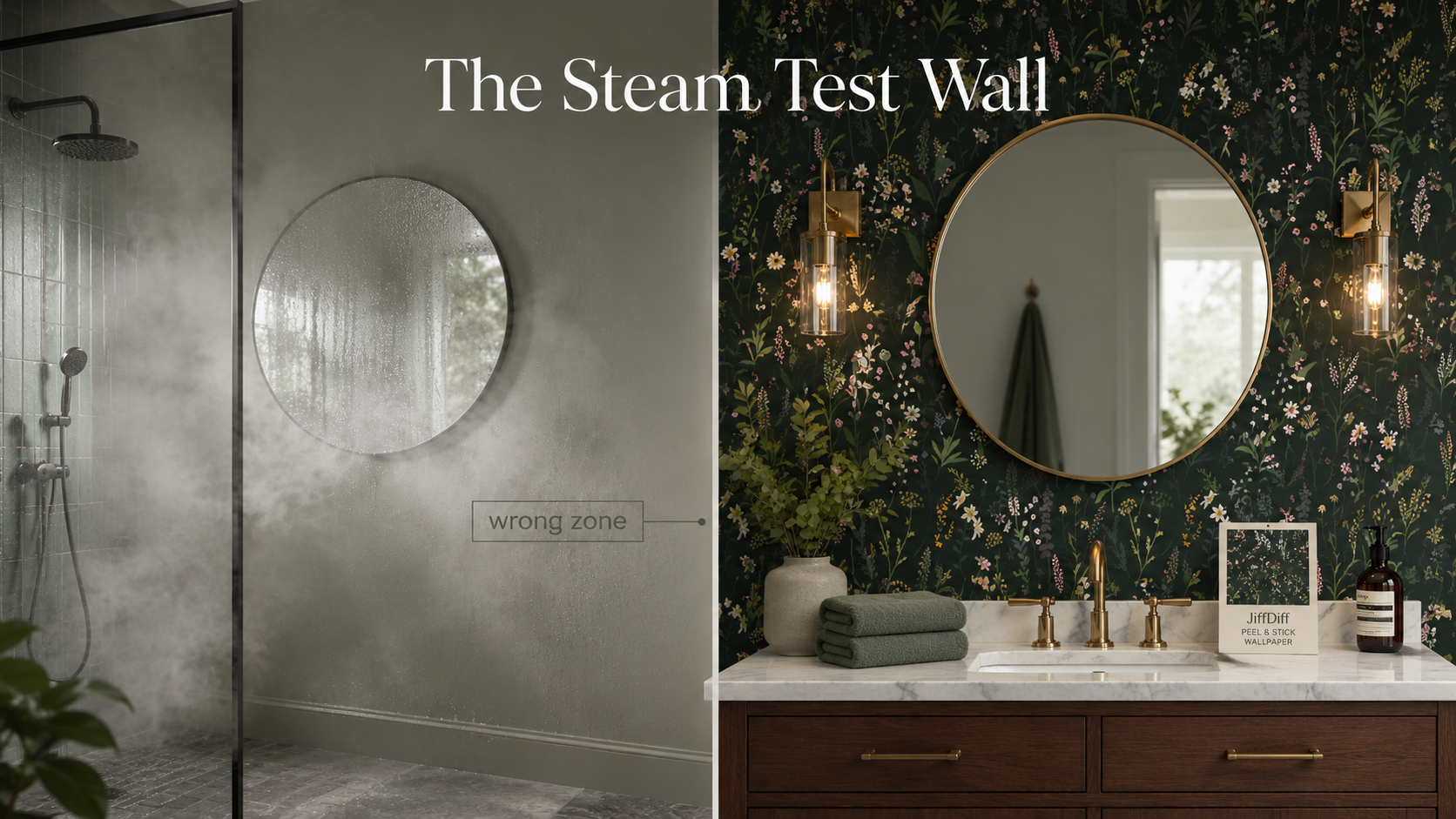
Papier peint autocollant dans les salles de bain : ce qui résiste réellement à la vapeur, à l'humidité et aux éclaboussures quotidiennes
Pour les décorateurs d'intérieur et les home stagers, les salles de bain sont l'un des espaces les plus efficaces à rafraîchir – et l'un des endroits où un beau revêtement mural peut le plus facilement échouer. Des toilettes peuvent devenir un moment mémorable pour les photos d'annonces immobilières avec du papier peint autocollant botanique, du papier peint texturé amovible, ou une fresque murale personnalisée. Une salle de bain complète, cependant, introduit de la vapeur, des éclaboussures quotidiennes, de la condensation, des produits de nettoyage et des variables de ventilation qui peuvent exposer toutes les faiblesses du matériau, de l'adhésif et de l'installation.
La réponse pratique n'est pas « oui » ou « non ». Le papier peint autocollant peut fonctionner dans les salles de bain lorsqu'il est spécifié comme un matériau, et non traité comme un raccourci. La différence dépend de la zone du mur, de la préparation de la surface, du contrôle de l'humidité, de la qualité du support et de savoir si le papier peint est véritablement résistant à l'humidité plutôt que simplement étiqueté « imperméable ». Les discussions entre propriétaires sur Reddit montrent les deux résultats : certains utilisateurs signalent des années de bonnes performances dans les salles de bain, tandis que d'autres ont constaté un décollement des bords ou des panneaux tombant des salles de bain complètes très humides, ce qui renforce la même conclusion professionnelle : l'emplacement, la ventilation et la qualité du produit décident du résultat.
Qu'est-ce qui échoue en premier ?
Dans la plupart des échecs de papier peint de salle de bain, la surface frontale n'est pas le premier problème – les bords le sont. La vapeur ne fait généralement pas « fondre » un papier peint auto-adhésif de qualité par la face. Au lieu de cela, l'humidité trouve une petite couture, un coin, un bord supérieur ou une zone exposée aux éclaboussures, puis affaiblit lentement la liaison adhésive derrière le panneau. C'est pourquoi un mur d'accent de salle de bain derrière une vanité peut paraître parfait pendant des années, tandis que le même papier peint autocollant placé à côté d'une douche peut se décoller en quelques mois.
Pour les projets B2B, cette distinction est importante car les rappels coûtent plus cher que le matériel. Un home stager préparant un bien vacant, un designer rafraîchissant les toilettes d'un client, ou un petit studio recherchant du papier peint amovible pour des rénovations adaptées à la location a besoin d'un produit performant de manière prévisible. L'avantage de JiffDiff ne réside pas seulement dans le choix des motifs, mais aussi dans un support de spécification pratique : les acheteurs professionnels peuvent demander des échantillons, vérifier la texture du matériau et la qualité d'impression avant de passer des commandes plus importantes, et utiliser des options de commande flexibles pour les commandes d'essai, les besoins de projets, la revente et l'approvisionnement répété.
Où devrait-il être placé ?
Les meilleurs emplacements pour les salles de bain sont les toilettes, les salles d'eau, les murs de vanité, les murs d'accent derrière les toilettes et le côté sec d'une salle de bain complète. Ces zones créent un fort impact visuel sans forcer l'adhésif à lutter quotidiennement contre le contact direct avec l'eau. Pour la mise en scène, c'est particulièrement précieux : un papier peint floral autocollant bien choisi, un papier peint texturé neutre ou une fresque murale autocollante peuvent faire en sorte qu'une petite salle de bain apparaisse comme un espace conçu plutôt que comme une pièce utilitaire sur une photo.
Évitez d'installer du papier peint autocollant à l'intérieur d'une douche, sur le pourtour d'une baignoire, directement derrière un évier avec des éclaboussures constantes, ou sur un mur extérieur froid où se forme de la condensation. Pensez par zones : l'humidité est gérable ; le contact répété avec l'eau ne l'est pas. Un designer peut dire en toute confiance à un client : « Ce mur fonctionne ; ce mur devrait rester carrelé, peint, vitré ou avec une autre surface résistante à l'eau. » Ce type de précision est ce qui protège la confiance.
Pour JiffDiff, c'est là que la marque s'inscrit naturellement : les beaux espaces devraient être plus faciles à transformer, mais pas spécifiés négligemment. L'objectif n'est pas de faire de chaque surface une surface de papier peint – c'est de rendre la bonne surface considérablement meilleure avec une solution plus rapide, plus propre et plus flexible.
Quel est le niveau d'humidité excessif ?
Une salle de bain n'a pas besoin d'être humide pour être risquée. L'EPA des États-Unis recommande de maintenir l'humidité relative intérieure en dessous de 60 %, idéalement entre 30 % et 50 %, et conseille spécifiquement d'utiliser un ventilateur de salle de bain ou d'ouvrir une fenêtre lors de la douche. En pratique, cela signifie qu'une salle de bain complète avec des douches quotidiennes nécessite une ventilation fonctionnelle avant de spécifier un papier peint amovible, un papier peint auto-adhésif ou un papier peint de salle de bain résistant à l'humidité. Lecture d'autorité : le guide de l'EPA sur la moisissure et l'humidité explique pourquoi le contrôle de l'humidité est essentiel pour prévenir les problèmes d'humidité dans les maisons.
Pour les designers et les stagers, la règle professionnelle est simple : si le miroir reste embué, les murs restent humides ou si le ventilateur d'extraction est faible, considérez cette salle de bain comme une installation à haut risque. Dans une salle de bain complète ventilée, un papier peint autocollant de qualité peut très bien fonctionner sur un mur d'accent sec. Dans une salle de bain mal ventilée, même les meilleurs matériaux ont moins de marge d'erreur. Les discussions sur Reddit confirment cette divergence : les utilisateurs signalent des installations réussies sur des murs peints semi-lustrés et des zones de vanité, tandis que d'autres utilisateurs signalent un décollement dans des salles de bain complètes fortement exposées à la vapeur.
Quel produit les designers devraient-ils spécifier ?
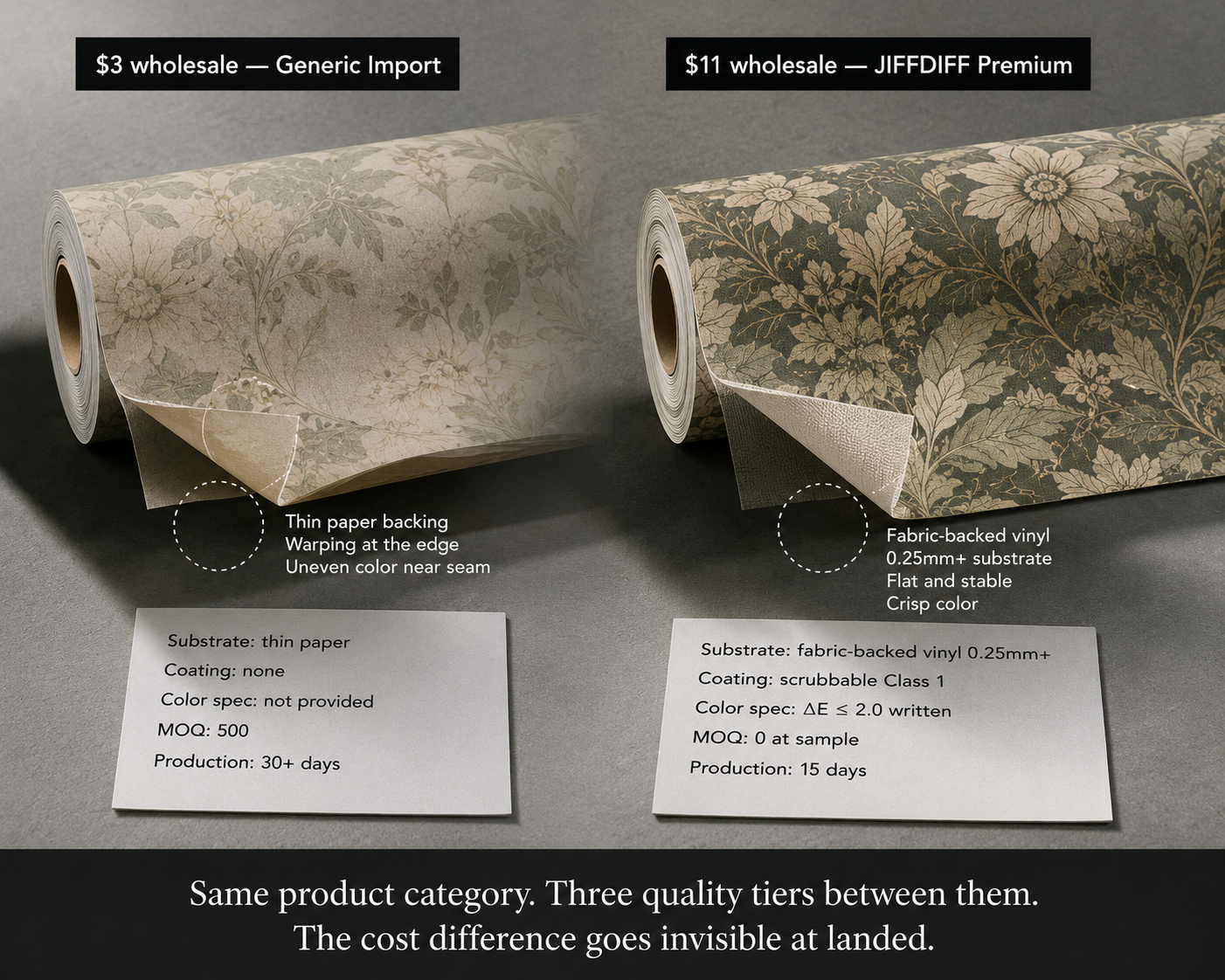
Pour les salles de bain, évitez les produits fins à dos en papier. Recherchez un papier peint autocollant plus épais, résistant à l'eau, lavable, à faible odeur avec un adhésif stable et une surface pouvant supporter un nettoyage doux. Les propres directives de JiffDiff sur les matériaux mettent en évidence les films autocollants à base de PET comme étant épais, durables, à faible odeur, non toxiques, résistants à l'eau et faciles à installer et à retirer – des qualités particulièrement pertinentes pour les salles de bain, les locations, les crèches, les projets de mise en scène et les intérieurs sensibles.
Pour les acheteurs B2B, la question la plus intelligente n'est pas « Est-ce un papier peint imperméable ? » mais :
Puis-je l'échantillonner, le tester, le commander à nouveau et faire confiance à la finition pour tous les projets ?
C'est là que le modèle commercial de JiffDiff devient utile pour les décorateurs d'intérieur, les grossistes et les petits studios : un faible MOQ, la disponibilité d'échantillons, une qualité constante, des prix professionnels et un approvisionnement fiable aident les professionnels à tester avant de passer à l'échelle. Pour les rafraîchissements de salle de bain, cela signifie que vous pouvez commander des échantillons, vérifier la finition sous l'éclairage réel, le tester dans l'environnement d'humidité réel, puis vous engager sur le bon mur – et non aveuglément sur toute la pièce.
Quelles étapes d'installation sont les plus importantes ?
L'installation dans une salle de bain n'est pas le moment de se presser. Appliquez le papier peint autocollant uniquement sur un mur lisse, propre et complètement sec. Évitez les surfaces fraîchement peintes jusqu'à ce que la peinture soit correctement séchée. Utilisez un outil de lissage ou un rouleau à joint pour presser fermement chaque bord, et accordez une attention particulière aux joints près du plafond, du dosseret de la vanité et de la ligne de plinthe. Dans une salle de bain complète, une petite quantité de joint d'étanchéité clair et peignable sur les joints vulnérables peut aider à réduire l'entrée d'humidité, en particulier autour des moulures et des zones adjacentes à la vanité.
Par exemple, un home stager préparant des toilettes pour une annonce pourrait utiliser un papier peint amovible botanique JiffDiff derrière les toilettes et le miroir de la vanité, en le maintenant au-dessus de la hauteur du dosseret et loin du contact humide. Un architecte d'intérieur spécifiant une salle de bain d'invités pourrait utiliser un papier peint autocollant texturé sur le mur sec en face de la douche, puis conserver du carrelage ou des surfaces peintes résistantes à l'humidité autour de la baignoire. Les deux projets obtiennent l'amélioration visuelle souhaitée par les clients sans prétendre que le papier peint a sa place dans la zone humide.
Note de la marque JiffDiff : « Peel in a Jiff. Make it Diff. » fonctionne mieux lorsque la rapidité est associée au jugement – une transformation rapide, pas un échec rapide.
FAQ : Papier peint autocollant dans les salles de bain
Q : Peut-on utiliser du papier peint autocollant dans une salle de bain avec une douche ?
Oui, mais uniquement sur des murs secs, loin des éclaboussures directes de la douche, avec une bonne ventilation et un papier peint résistant à l'humidité.
Q : Le papier peint autocollant se décollera-t-il à cause de la vapeur de la salle de bain ?
Il peut se décoller si la pièce est mal ventilée, si les murs sont texturés, si l'adhésif est faible ou si les joints sont exposés près des zones humides.
Q : Quel est le meilleur papier peint autocollant pour les salles de bain ?
Le meilleur papier peint autocollant pour salle de bain est épais, lavable, résistant à l'eau, à faible odeur et installé sur des murs lisses et parfaitement secs.
Q : Le papier peint autocollant peut-il être placé derrière un lavabo de salle de bain ?
Oui, s'il est placé au-dessus du dosseret et qu'il évite les éclaboussures répétées ; les zones d'éclaboussures directes devraient être recouvertes de carrelage, de pierre, de verre ou de peinture.
Q : Le papier peint autocollant est-il adapté aux toilettes ?
Oui, les toilettes sont l'un des espaces les plus sûrs et les plus efficaces car ils ont généralement moins de vapeur que les salles de bain complètes.
Q : Combien de temps le papier peint autocollant dure-t-il dans une salle de bain ?
Sur un mur sec, lisse et ventilé, un papier peint amovible de qualité peut durer des années ; les défaillances proviennent généralement de l'humidité, des joints ou d'une mauvaise préparation.
Q : Le papier peint amovible provoque-t-il des moisissures dans les salles de bain ?
Non, pas en soi ; le risque de moisissure provient de l'humidité emprisonnée, des murs humides, des fuites, de la condensation ou d'une mauvaise ventilation.
Q : Les architectes d'intérieur devraient-ils échantillonner le papier peint de salle de bain avant de le spécifier ?
Oui, les acheteurs B2B devraient toujours tester un échantillon physique sur le mur réel de la salle de bain avant de commander pour un projet client.

Laisser un commentaire
Ce site est protégé par hCaptcha, et la Politique de confidentialité et les Conditions de service de hCaptcha s’appliquent.